
| Date | 23rd, Oct 2019 |
|---|
Home > Press > How perovskite in solar cells recrystallizes and why modified carbon nanotubes can help overcome the reproducibility problem by making use of this
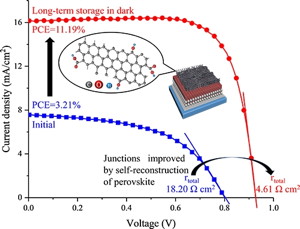 Figure 1. Self-recrystallization of functionalized CNT-covered perovskite
The initial power conversion efficiency (PCE) soared after long-term storage because of the self-recrystallization process that perovskite undergoes when stored in the dark. Much higher conductivity and lower resistance was observed for perovskite covered with carbon nanotubes (CNTs) with oxygen-containing functional groups.
Figure 1. Self-recrystallization of functionalized CNT-covered perovskite
The initial power conversion efficiency (PCE) soared after long-term storage because of the self-recrystallization process that perovskite undergoes when stored in the dark. Much higher conductivity and lower resistance was observed for perovskite covered with carbon nanotubes (CNTs) with oxygen-containing functional groups.
Abstract: Scientists at Tokyo Institute of Technology (Tokyo Tech) conducted an in-depth study on how carbon nanotubes with oxygen-containing groups can be used to greatly enhance the performance of perovskite solar cells. The newly discovered self-recrystallization ability of perovskite could lead to improvement of low-cost and efficient perovskite solar cells.
Tokyo, Japan | Posted on October 18th, 2019
Our search for sustainable energy generation technology has led researchers to investigate various materials and their combinations in many types of devices. One such synthetic material is called "perovskite", which is low-cost and easy to produce, and can be used in solar cells. Perovskite solar cells have attracted much attention because their power conversion efficiency (that is, their efficiency at turning sunlight into electricity) has seen dramatic improvements in recent years. However, it has proven difficult to implement them for large-scale energy generation because of a handful of issues.
One problem that perovskite solar cells face is reproducibility. This means that it is hard to consistently create perovskite crystal layers free of defects and holes, which means that deviations from design values are always likely to occur, which reduce their efficiency. On the bright side, researchers have found that the efficiency of these cells can be boosted by combining perovskite with carbon nanotubes (CNTs). The mechanism by which CNTs and perovskite bond together and how this affects the performance of CNT perovskite solar cells has not been studied in depth. In particular, the ability of pure CNTs to bond to perovskite is not very good, and this could compromise the structural and conducting properties at the interface of both materials.
Hence, a team from Tokyo Tech lead by Prof. Keiko Waki conducted a series of experiments on perovskite solar cells combined with different types of CNTs in an attempt to both improve their performance and stability and understand the underlying mechanisms. They used not just pure CNTs, but also CNTs that bore "oxygen-containing functional groups" in their structure, which have been known to strengthen the interaction between the CNTs and perovskite, resulting in better interfaces and enhancing the crystallization of perovskite.
This research consisted of several experiments that provided insight into many aspects of CNT�perovskite interactions. First, they demonstrated the superior electrical performance of cells with functionalized CNTs over those with pure CNTs and found evidence supporting that larger crystals and fewer surface defects occur when using functionalized CNTs. Then, the team inferred that the perovskite in the cells would undergo a recrystallization process if stored in the dark, and that the presence of the functional groups in CNT would have a significant effect on this process. This was confirmed by storing the cells for over two months and measuring their electrical characteristics afterwards (Fig. 1). "We have discovered the self-recrystallization ability of perovskite at room temperature, whose morphology greatly improved after long-term storage. However, the most interesting result was the ability of functionalized CNTs to make use of the self-recrystallization nature to form a stronger junction between the perovskite and CNTs through the reconstruction" explains Prof. Waki. Most notably, the functionalized CNTs improved the contact between the two materials greatly and the functional groups served as a protection against attacks from moisture on the perovskite, allowing the self-recrystallization and interface reconstruction to proceed without noticeable degradation. The research team also found that the recrystallization process could be immensely sped up by constantly subjecting the solar cells to frequent measurements, but this ultimately affected their stability and degraded them.
Such in-depth studies on perovskite solar cells and ways to enhance them are very valuable because they get us closer to new sources of clean energy. "We hope this study contributes toward the production of perovskites with higher stability and reproducibility," concludes Prof. Waki. These findings will serve as another stepping stone so that we may one see perovskite solar cells as a key technology to preserve our planet.
####
For more information, please click here
Contacts:Further Information
Associate Professor Keiko Waki
School of Materials and Chemical Technology, Tokyo Institute of Technology
Email Tel +81-45-924-5614
Contact
Public Relations Section, Tokyo Institute of Technology
Email Tel +81-3-5734-2975
Corresponding authors' email:
Copyright © Tokyo Institute of Technology
If you have a comment, please Contact us.
Issuers of news releases, not 7th Wave, Inc. or Nanotechnology Now, are solely responsible for the accuracy of the content.
Bookmark:


News and information
 Two opposing approaches could give lithium-sulfur batteries a leg up over lithium-ion July 1st, 2022
Efficiently processing high-quality periodic nanostructures with ultrafast laser July 1st, 2022
Photonic synapses with low power consumption and high sensitivity are expected to integrate sensing-memory-preprocessing capabilities July 1st, 2022
Perovskites
Quantum �shock absorbers� allow perovskite to exhibit superfluorescence at room temperature April 1st, 2022
�Workhorse� of photovoltaics combined with perovskite in tandem for the first time February 25th, 2022
Photon recycling � The key to high-efficiency perovskite solar cells January 14th, 2022
Possible Futures
Sieving carbons: Ideal anodes for high-energy sodium-ion batteries July 1st, 2022
An artificial intelligence probe help see tumor malignancy July 1st, 2022
Photon-controlled diode: an optoelectronic device with a new signal processing behavior July 1st, 2022
Nanotubes/Buckyballs/Fullerenes/Nanorods
Boron nitride nanotube fibers get real: Rice lab creates first heat-tolerant, stable fibers from wet-spinning process June 24th, 2022
Nanotubes: a promising solution for advanced rubber cables with 60% less conductive filler June 1st, 2022
Protective equipment with graphene nanotubes meets the strictest ESD safety standards March 25th, 2022
CEA and Startup C12 Join Forces to Develop Next-Generation Quantum Computers with Multi-Qubit Chips at Wafer Scale March 25th, 2022
Discoveries
Sieving carbons: Ideal anodes for high-energy sodium-ion batteries July 1st, 2022
Efficiently processing high-quality periodic nanostructures with ultrafast laser July 1st, 2022
Photonic synapses with low power consumption and high sensitivity are expected to integrate sensing-memory-preprocessing capabilities July 1st, 2022
Announcements
Two opposing approaches could give lithium-sulfur batteries a leg up over lithium-ion July 1st, 2022
Efficiently processing high-quality periodic nanostructures with ultrafast laser July 1st, 2022
Photonic synapses with low power consumption and high sensitivity are expected to integrate sensing-memory-preprocessing capabilities July 1st, 2022
Interviews/Book Reviews/Essays/Reports/Podcasts/Journals/White papers/Posters
Sieving carbons: Ideal anodes for high-energy sodium-ion batteries July 1st, 2022
An artificial intelligence probe help see tumor malignancy July 1st, 2022
Photon-controlled diode: an optoelectronic device with a new signal processing behavior July 1st, 2022
Energy
Key in increasing efficiency of next-generation solar cell, found in �light absorption capacity�! July 1st, 2022
Solving the solar energy storage problem with rechargeable batteries that can convert and store energy at once June 24th, 2022
Organic water splitters get a boost June 10th, 2022
Solar/Photovoltaic
Key in increasing efficiency of next-generation solar cell, found in �light absorption capacity�! July 1st, 2022
Solving the solar energy storage problem with rechargeable batteries that can convert and store energy at once June 24th, 2022
USTC found a pathway to high-quality ZnSe quantum wires April 8th, 2022
Graphene crystals grow better under copper cover April 1st, 2022
