
| Date | 23rd, Oct 2019 |
|---|
Home > Press > Nanoparticles may have bigger impact on the environment than previously thought: Non-antibacterial nanoparticles can cause resistance in bacteria
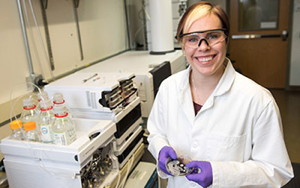 Chemist Erin Carlson led research showing that nanoparticles can cause resistance in bacteria.
Credit: Patrick O'Leary, University of Minnesota
Chemist Erin Carlson led research showing that nanoparticles can cause resistance in bacteria.
Credit: Patrick O'Leary, University of Minnesota
Abstract: Over the last two decades, nanotechnology has improved many everyday products, from microelectronics to sunscreens. Nanoparticles (particles just a few hundred atoms in size) are ending up in the environment by the ton, but scientists are still unclear about the long-term effects of these super-small particles.
Alexandria, VA | Posted on October 17th, 2019
In a first-of-its-kind study, published in Chemical Science, researchers have shown that nanoparticles may have a bigger impact on the environment than previously thought.
Researchers at the University of Minnesota, through the National Science Foundation Center for Sustainable Nanotechnology, found that a common, non-disease-causing bacterium in the environment, Shewanella oneidensis MR-1, developed rapid resistance when repeatedly exposed to nanoparticles used in making lithium ion batteries, the rechargeable batteries used in portable electronics and electric vehicles. The resistance means that the fundamental biochemistry and biology of the bacteria are changing.
The results of the study are unusual, the researchers say. Bacterial resistance usually occurs because bacteria become resistant to attempts to kill them. In this case, the nanoparticles used in lithium ion batteries were not intended to kill bacteria. This is the first report of non-antibacterial nanoparticles causing resistance in bacteria.
Bacteria are prevalent in lakes and soil where there is a delicate balance of organisms. Other organisms feed on the microbes, and the resistant bacteria could have effects scientists can't yet predict.
"Research that advances technology and sustains our environment is a priority for the Division of Chemistry," said Michelle Bushey, program director for the NSF Chemical Centers for Innovation Program. "This work reveals the unexplored and long-term impacts some nanoparticles have on the living organisms around us. This discovery at the chemistry-biology interface is a first step toward developing new sustainable materials and practices and providing the groundwork for possible remediation approaches."
####
For more information, please click here
Contacts:NSF Public Affairs, (703) 292-7090
Copyright © National Science Foundation
If you have a comment, please Contact us.
Issuers of news releases, not 7th Wave, Inc. or Nanotechnology Now, are solely responsible for the accuracy of the content.
Bookmark:


News and information
 Two opposing approaches could give lithium-sulfur batteries a leg up over lithium-ion July 1st, 2022
Efficiently processing high-quality periodic nanostructures with ultrafast laser July 1st, 2022
Photonic synapses with low power consumption and high sensitivity are expected to integrate sensing-memory-preprocessing capabilities July 1st, 2022
Govt.-Legislation/Regulation/Funding/Policy
Solving the solar energy storage problem with rechargeable batteries that can convert and store energy at once June 24th, 2022
Boron nitride nanotube fibers get real: Rice lab creates first heat-tolerant, stable fibers from wet-spinning process June 24th, 2022
UBCO researchers change the game when it comes to activity tracking: Flexible, highly sensitive motion device created by extrusion printing June 17th, 2022
University of Illinois Chicago joins Brookhaven Lab's Quantum Center June 10th, 2022
Possible Futures
Sieving carbons: Ideal anodes for high-energy sodium-ion batteries July 1st, 2022
An artificial intelligence probe help see tumor malignancy July 1st, 2022
Photon-controlled diode: an optoelectronic device with a new signal processing behavior July 1st, 2022
Discoveries
Sieving carbons: Ideal anodes for high-energy sodium-ion batteries July 1st, 2022
Efficiently processing high-quality periodic nanostructures with ultrafast laser July 1st, 2022
Photonic synapses with low power consumption and high sensitivity are expected to integrate sensing-memory-preprocessing capabilities July 1st, 2022
Announcements
Two opposing approaches could give lithium-sulfur batteries a leg up over lithium-ion July 1st, 2022
Efficiently processing high-quality periodic nanostructures with ultrafast laser July 1st, 2022
Photonic synapses with low power consumption and high sensitivity are expected to integrate sensing-memory-preprocessing capabilities July 1st, 2022
Interviews/Book Reviews/Essays/Reports/Podcasts/Journals/White papers/Posters
Sieving carbons: Ideal anodes for high-energy sodium-ion batteries July 1st, 2022
An artificial intelligence probe help see tumor malignancy July 1st, 2022
Photon-controlled diode: an optoelectronic device with a new signal processing behavior July 1st, 2022
Safety-Nanoparticles/Risk management
New protocol for assessing the safety of nanomaterials July 1st, 2022
Nylon cooking bags, plastic-lined cups can release nanoparticles into liquids April 22nd, 2022
No nanoparticle risks to humans found in field tests of spray sunscreens December 2nd, 2020
