
| Date | 25th, Oct 2019 |
|---|
Home > Press > Achieving Quantum Supremacy: UC Santa Barbara/Google researchers demonstrate the power of 53 entangled qubits
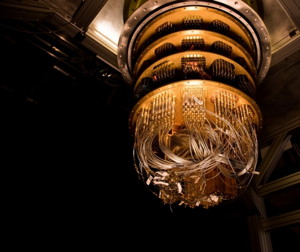 Google�s quantum supreme cryostat with Sycamore inside
Photo Credit: ERIC LUCERO/GOOGLE, INC.
Google�s quantum supreme cryostat with Sycamore inside
Photo Credit: ERIC LUCERO/GOOGLE, INC.
Abstract: Researchers in UC Santa Barbara/Google scientist John Martinis� group have made good on their claim to quantum supremacy. Using 53 entangled quantum bits (�qubits�), their Sycamore computer has taken on � and solved � a problem considered intractable for classical computers.
Santa Barbara, CA | Posted on October 24th, 2019
�A computation that would take 10,000 years on a classical supercomputer took 200 seconds on our quantum computer,� said Brooks Foxen, a graduate student researcher in the Martinis Group. �It is likely that the classical simulation time, currently estimated at 10,000 years, will be reduced by improved classical hardware and algorithms, but, since we are currently 1.5 billion times faster, we feel comfortable laying claim to this achievement.�
The feat is outlined in a paper in the journal Nature.
The milestone comes after roughly two decades of quantum computing research conducted by Martinis and his group, from the development of a single superconducting qubit to systems including architectures of 72 and, with Sycamore, 54 qubits (one didn�t perform) that take advantage of the both awe-inspiring and bizarre properties of quantum mechanics.
�The algorithm was chosen to emphasize the strengths of the quantum computer by leveraging the natural dynamics of the device,� said Ben Chiaro, another graduate student researcher in the Martinis Group. That is, the researchers wanted to test the computer�s ability to hold and rapidly manipulate a vast amount of complex, unstructured data.
�We basically wanted to produce an entangled state involving all of our qubits as quickly as we can,� Foxen said, �and so we settled on a sequence of operations that produced a complicated superposition state that, when measured, returned output ("bitstring") with a probability determined by the specific sequence of operations used to prepare that particular superposition." The exercise, which was to verify that the circuit�s output correspond to the sequence used to prepare the state, sampled the quantum circuit a million times in just a few minutes, exploring all possibilities � before the system could lose its quantum coherence.
�A complex superposition state� �We performed a fixed set of operations that entangles 53 qubits into a complex superposition state,� Chiaro explained. �This superposition state encodes the probability distribution. For the quantum computer, preparing this superposition state is accomplished by applying a sequence of tens of control pulses to each qubit in a matter of microseconds. We can prepare and then sample from this distribution by measuring the qubits a million times in 200 seconds.�
�For classical computers, it is much more difficult to compute the outcome of these operations because it requires computing the probability of being in any one of the 2^53 possible states, where the 53 comes from the number of qubits � the exponential scaling is why people are interested in quantum computing to begin with,� Foxen said. �This is done by matrix multiplication, which is expensive for classical computers as the matrices become large.�
According to the new paper, the researchers used a method called cross-entropy benchmarking to compare the quantum circuit�s bitstring to its �corresponding ideal probability computed via simulation on a classical computer� to ascertain that the quantum computer was working correctly.
�We made a lot of design choices in the development of our processor that are really advantageous,� said Chiaro. Among these advantages, he said, are the ability to experimentally tune the parameters of the individual qubits as well as their interactions.
The John Martinis Group at their Google facilityThe UCSB/Google Quantum AI group
Photo Credit: Matt Perko, UC Santa Barbara
While the experiment was chosen as a proof-of-concept for the computer, the research has resulted in a very real and valuable tool: a certified random number generator. Useful in a variety of fields, random numbers can ensure that encrypted keys can�t be guessed, or that a sample from a larger population is truly representative, leading to optimal solutions for complex problems and more robust machine learning applications. The speed with which the quantum circuit can produce its randomized bitstring is so great that there is no time to analyze and �cheat� the system.
�Quantum mechanical states do things that go beyond our day-to-day experience and so have the potential to provide capabilities and application that would otherwise be unattainable,� commented Joe Incandela, UC Santa Barbara�s vice chancellor for research. �The team has demonstrated the ability to reliably create and repeatedly sample complicated quantum states involving 53 entangled elements to carry out an exercise that would take millennia to do with a classical supercomputer. This is a major accomplishment. We are at the threshold of a new era of knowledge acquisition.�
Looking aheadWith an achievement like �quantum supremacy,� it�s tempting to think that the UC Santa Barbara/Google researchers will plant their flag and rest easy. But for Foxen, Chiaro, Martinis and the rest of the UCSB/Google AI Quantum group, this is just the beginning.
�It�s kind of a continuous improvement mindset,� Foxen said. �There are always projects in the works.� In the near term, further improvements to these �noisy� qubits may enable the simulation of interesting phenomena in quantum mechanics, such as thermalization, or the vast amount of possibility in the realms of materials and chemistry.
In the long term, however, the scientists are always looking to improve coherence times, or, at the other end, to detect and fix errors, which would take many additional qubits per qubit being checked. These efforts have been running parallel to the design and build of the quantum computer itself, and ensure the researchers have a lot of work before hitting their next milestone.
�It�s been an honor and a pleasure to be associated with this team,� Chiaro said. �It�s a great collection of strong technical contributors with great leadership and the whole team really synergizes well.�
####
For more information, please click here
Contacts:Sonia Fernandez(805) 893-4765
Shelly Leachman(805) 893-8726
Copyright © University of California, Santa Barbara
If you have a comment, please Contact us.
Issuers of news releases, not 7th Wave, Inc. or Nanotechnology Now, are solely responsible for the accuracy of the content.
Bookmark:


News and information
 Two opposing approaches could give lithium-sulfur batteries a leg up over lithium-ion July 1st, 2022
Efficiently processing high-quality periodic nanostructures with ultrafast laser July 1st, 2022
Photonic synapses with low power consumption and high sensitivity are expected to integrate sensing-memory-preprocessing capabilities July 1st, 2022
Possible Futures
Sieving carbons: Ideal anodes for high-energy sodium-ion batteries July 1st, 2022
An artificial intelligence probe help see tumor malignancy July 1st, 2022
Photon-controlled diode: an optoelectronic device with a new signal processing behavior July 1st, 2022
Quantum Computing
University of Illinois Chicago joins Brookhaven Lab's Quantum Center June 10th, 2022
Bumps could smooth quantum investigations: Rice University models show unique properties of 2D materials stressed by contoured substrates June 10th, 2022
Discoveries
Sieving carbons: Ideal anodes for high-energy sodium-ion batteries July 1st, 2022
Efficiently processing high-quality periodic nanostructures with ultrafast laser July 1st, 2022
Photonic synapses with low power consumption and high sensitivity are expected to integrate sensing-memory-preprocessing capabilities July 1st, 2022
Announcements
Two opposing approaches could give lithium-sulfur batteries a leg up over lithium-ion July 1st, 2022
Efficiently processing high-quality periodic nanostructures with ultrafast laser July 1st, 2022
Photonic synapses with low power consumption and high sensitivity are expected to integrate sensing-memory-preprocessing capabilities July 1st, 2022
Interviews/Book Reviews/Essays/Reports/Podcasts/Journals/White papers/Posters
Sieving carbons: Ideal anodes for high-energy sodium-ion batteries July 1st, 2022
An artificial intelligence probe help see tumor malignancy July 1st, 2022
Photon-controlled diode: an optoelectronic device with a new signal processing behavior July 1st, 2022
Grants/Sponsored Research/Awards/Scholarships/Gifts/Contests/Honors/Records
Solving the solar energy storage problem with rechargeable batteries that can convert and store energy at once June 24th, 2022
Boron nitride nanotube fibers get real: Rice lab creates first heat-tolerant, stable fibers from wet-spinning process June 24th, 2022
