
| Date | 1st, Nov 2019 |
|---|
Home > Press > Visible light and nanoparticle catalysts produce desirable bioactive molecules: Simple photochemical method takes advantage of quantum mechanics
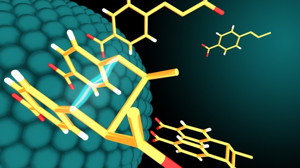 Nanoparticle catalysts and light drive a reaction that produces bioactive molecules.
Abstract: �Arrangement of atoms in molecules is most relevant for drug companies �Nanoparticles are only three nanometers wide �Catalysts can be reused for more chemical reactions
Evanston, IL | Posted on October 31st, 2019
Northwestern University chemists have used visible light and extremely tiny nanoparticles to quickly and simply make molecules that are of the same class as many lead compounds for drug development.
Driven by light, the nanoparticle catalysts perform chemical reactions with very specific chemical products -- molecules that don�t just have the right chemical formulas but also have specific arrangements of their atoms in space. And the catalyst can be reused for additional chemical reactions.
The semiconductor nanoparticles are known as quantum dots -- so small that they are only a few nanometers across. But the small size is power, providing the material with attractive optical and electronic properties not possible at greater length scales.
�Quantum dots behave more like organic molecules than metal nanoparticles,� said Emily A. Weiss, who led the research. �The electrons are squeezed into such a small space that their reactivity follows the rules of quantum mechanics. We can take advantage of this, along with the templating power of the nanoparticle surface.�
This work, published recently by the journal Nature Chemistry, is the first use of a nanoparticle�s surface as a template for a light-driven reaction called a cycloaddition, a simple mechanism for making very complicated, potentially bioactive compounds.
�We use our nanoparticle catalysts to access this desirable class of molecules, called tetrasubstituted cyclobutanes, through simple, one-step reactions that not only produce the molecules in high yield, but with the arrangement of atoms most relevant for drug development,� Weiss said. �These molecules are difficult to make any other way.�
Weiss is the Mark and Nancy Ratner Professor of Chemistry in the Weinberg College of Arts and Sciences. She specializes in controlling light-driven electronic processes in quantum dots and using them to perform light-driven chemistry with unprecedented selectivity.
The nanoparticle catalysts use energy from visible light to activate molecules on their surfaces and fuse them together to form larger molecules in configurations useful for biological applications. The larger molecule then detaches easily from the nanoparticle, freeing the nanoparticle to be used again in another reaction cycle.
In their study, Weiss and her team used three-nanometer nanoparticles made of the semiconductor cadmium selenide and a variety of starter molecules called alkenes in solution. Alkenes have core carbon-carbon double bonds which are needed to form the cyclobutanes.
The study is titled �Regio- and diastereoselective intermolecular [2+2] cycloadditions photocatalysed by quantum dots.� Yishu Jiang, a graduate student in Weiss� lab, is the study�s first author.
The research was supported by the Air Force Office of Scientific Research (grant 9550-17-1-0271) and by the Center for Bio-Inspired Energy Science, an Energy Frontier Research Center funded by the U.S. Department of Energy, Office of Science, Basic Energy Sciences (award no. DE-SC0000989).
####
For more information, please click here
Contacts:Megan Fellman at 847-491-3115 or
Source contact: Emily Weiss at
Copyright © Northwestern University
If you have a comment, please Contact us.
Issuers of news releases, not 7th Wave, Inc. or Nanotechnology Now, are solely responsible for the accuracy of the content.
Bookmark:


Chemistry
News and information
 Two opposing approaches could give lithium-sulfur batteries a leg up over lithium-ion July 1st, 2022
Efficiently processing high-quality periodic nanostructures with ultrafast laser July 1st, 2022
Photonic synapses with low power consumption and high sensitivity are expected to integrate sensing-memory-preprocessing capabilities July 1st, 2022
Govt.-Legislation/Regulation/Funding/Policy
Solving the solar energy storage problem with rechargeable batteries that can convert and store energy at once June 24th, 2022
Boron nitride nanotube fibers get real: Rice lab creates first heat-tolerant, stable fibers from wet-spinning process June 24th, 2022
UBCO researchers change the game when it comes to activity tracking: Flexible, highly sensitive motion device created by extrusion printing June 17th, 2022
University of Illinois Chicago joins Brookhaven Lab's Quantum Center June 10th, 2022
Possible Futures
Sieving carbons: Ideal anodes for high-energy sodium-ion batteries July 1st, 2022
An artificial intelligence probe help see tumor malignancy July 1st, 2022
Photon-controlled diode: an optoelectronic device with a new signal processing behavior July 1st, 2022
Nanomedicine
An artificial intelligence probe help see tumor malignancy July 1st, 2022
New technology helps reveal inner workings of human genome June 24th, 2022
Discoveries
Sieving carbons: Ideal anodes for high-energy sodium-ion batteries July 1st, 2022
Efficiently processing high-quality periodic nanostructures with ultrafast laser July 1st, 2022
Photonic synapses with low power consumption and high sensitivity are expected to integrate sensing-memory-preprocessing capabilities July 1st, 2022
Announcements
Two opposing approaches could give lithium-sulfur batteries a leg up over lithium-ion July 1st, 2022
Efficiently processing high-quality periodic nanostructures with ultrafast laser July 1st, 2022
Photonic synapses with low power consumption and high sensitivity are expected to integrate sensing-memory-preprocessing capabilities July 1st, 2022
Interviews/Book Reviews/Essays/Reports/Podcasts/Journals/White papers/Posters
Sieving carbons: Ideal anodes for high-energy sodium-ion batteries July 1st, 2022
An artificial intelligence probe help see tumor malignancy July 1st, 2022
Photon-controlled diode: an optoelectronic device with a new signal processing behavior July 1st, 2022
Military
Boron nitride nanotube fibers get real: Rice lab creates first heat-tolerant, stable fibers from wet-spinning process June 24th, 2022
Bumps could smooth quantum investigations: Rice University models show unique properties of 2D materials stressed by contoured substrates June 10th, 2022
Nanostructured fibers can impersonate human muscles June 3rd, 2022
Lightening up the nanoscale long-wavelength optoelectronics May 13th, 2022
Quantum Dots/Rods
New substance classes for nanomaterials: Nano spheres and diamond slivers made of silicon and germanium: Potential applications as nano semiconductor materials September 10th, 2021
�Missing jigsaw piece�: engineers make critical advance in quantum computer design August 20th, 2021
Nanobiotechnology
New technology helps reveal inner workings of human genome June 24th, 2022
