
| Date | 6th, Nov 2019 |
|---|
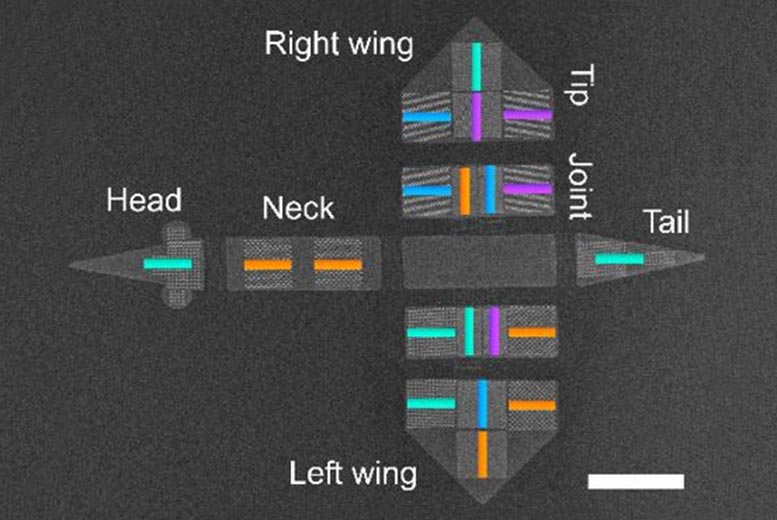
The scanning electron microscope image shows the bird-like construct with arrangements of nanoscale magnets. The magnets can be magnetized in different orientations parallel to the color bars. By programming their magnetization, the researchers can make bird carry out different movements in a magnetic field. Credit: Paul Scherrer Institute/Swiss Federal Institute of Technology, Zurich
Researchers at the Paul Scherrer Institute PSI and ETH Zurich have developed a micromachine that can perform different actions. First nanomagnets in the components of the microrobots are magnetically programmed and then the various movements are controlled by magnetic fields. Such machines, which are only a few tens of micrometers across, could be used, for example, in the human body to perform small operations. Their results were published today (November 6, 2019) in the scientific journal Nature.
The robot, which measures only a few micrometers across, (a human hair is 30-100 micrometers in diameter) is reminiscent of a paper bird made with origami – the Japanese art of paper folding. But, unlike a paper structure, the robot moves as if by magic without a visible force. It flaps its wings or bends its neck and retracts its head. These actions are all made possible by magnetism.
Researchers at the Paul Scherrer Institute PSI and ETH Zurich have assembled the micromachine from materials that contain small nanomagnets. These nanomagnets can be programmed to assume a particular magnetic orientation. When the programmed nanomagnets are then exposed to a magnetic field, specific forces act on them. If these magnets are located in flexible components, the forces acting on them cause the components to move.
