
| Date | 10th, Nov 2019 |
|---|
Home > Press > Scientists probe the limits of ice: Transition between ice and liquid water gets fuzzy at the nanoscale
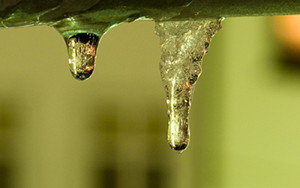 The coexistence of ice and liquid water breaks down at the nanoscale.
Credit: Wikimedia Commons
The coexistence of ice and liquid water breaks down at the nanoscale.
Credit: Wikimedia Commons
Abstract: How small is the tiniest possible particle of ice? According to new NSF-funded research published in the journal Proceedings of the National Academy of Sciences, the smallest nanodroplet of water in which ice can form is only as big as 90 water molecules -- a tenth the size of the smallest virus. At those small scales, according to University of Utah chemist and study co-author Valeria Molinero, the transition between ice and water gets a little fuzzy.
Alexandria, VA | Posted on November 9th, 2019
That transition is among the most important transformations between phases (solids, liquids and gases) on our planet, where it has unique effects on climate while regulating the viability of life. Understanding the conditions that lead to the formation of ice is an active quest in the environmental and earth sciences, physics, chemistry, biology and engineering.
Ice exists on Earth almost exclusively in the highly ordered hexagonal crystal structure known as "ice I." In our atmosphere, small water clusters form and subsequently freeze, seeding larger crystals and eventually clouds. Due to competing thermodynamic effects, however, below a certain diameter these water clusters cannot form stable ice I. The size range of water clusters capable of forming ice I has been investigated for years, with most recent estimates narrowing the range from as low as 90 water molecules to as high as 400.
In the new study, researchers combine recent advances to disentangle the interplay between the constraints that act on the ice-liquid transition in nanometer-sized clusters.
"This research provides fundamental insights into a substance as familiar as water," says Anne-Marie Schmoltner, a program director in NSF's Division of Chemistry. "With sophisticated computer models, we can understand what happens with every single water molecule in a very, very small droplet."
The research was funded through an NSF award supporting the Center for Aerosol Impacts on Climate and the Environment.
####
For more information, please click here
Contacts:NSF Public Affairs, (703) 292-7090
Copyright © National Science Foundation
If you have a comment, please Contact us.
Issuers of news releases, not 7th Wave, Inc. or Nanotechnology Now, are solely responsible for the accuracy of the content.
Bookmark:


Chemistry
News and information
 Two opposing approaches could give lithium-sulfur batteries a leg up over lithium-ion July 1st, 2022
Efficiently processing high-quality periodic nanostructures with ultrafast laser July 1st, 2022
Photonic synapses with low power consumption and high sensitivity are expected to integrate sensing-memory-preprocessing capabilities July 1st, 2022
Govt.-Legislation/Regulation/Funding/Policy
Solving the solar energy storage problem with rechargeable batteries that can convert and store energy at once June 24th, 2022
Boron nitride nanotube fibers get real: Rice lab creates first heat-tolerant, stable fibers from wet-spinning process June 24th, 2022
UBCO researchers change the game when it comes to activity tracking: Flexible, highly sensitive motion device created by extrusion printing June 17th, 2022
University of Illinois Chicago joins Brookhaven Lab's Quantum Center June 10th, 2022
Possible Futures
Sieving carbons: Ideal anodes for high-energy sodium-ion batteries July 1st, 2022
An artificial intelligence probe help see tumor malignancy July 1st, 2022
Photon-controlled diode: an optoelectronic device with a new signal processing behavior July 1st, 2022
Discoveries
Sieving carbons: Ideal anodes for high-energy sodium-ion batteries July 1st, 2022
Efficiently processing high-quality periodic nanostructures with ultrafast laser July 1st, 2022
Photonic synapses with low power consumption and high sensitivity are expected to integrate sensing-memory-preprocessing capabilities July 1st, 2022
Materials/Metamaterials
New protocol for assessing the safety of nanomaterials July 1st, 2022
Nanotubes: a promising solution for advanced rubber cables with 60% less conductive filler June 1st, 2022
New route to build materials out of tiny particles May 27th, 2022
A one-stop shop for quantum sensing materials May 27th, 2022
Announcements
Two opposing approaches could give lithium-sulfur batteries a leg up over lithium-ion July 1st, 2022
Efficiently processing high-quality periodic nanostructures with ultrafast laser July 1st, 2022
Photonic synapses with low power consumption and high sensitivity are expected to integrate sensing-memory-preprocessing capabilities July 1st, 2022
Interviews/Book Reviews/Essays/Reports/Podcasts/Journals/White papers/Posters
Sieving carbons: Ideal anodes for high-energy sodium-ion batteries July 1st, 2022
An artificial intelligence probe help see tumor malignancy July 1st, 2022
Photon-controlled diode: an optoelectronic device with a new signal processing behavior July 1st, 2022
Water
Scientists offer solutions for risky tap water June 17th, 2022
UBCO researchers change the game when it comes to activity tracking: Flexible, highly sensitive motion device created by extrusion printing June 17th, 2022
Organic water splitters get a boost June 10th, 2022
