
| Date | 25th, Nov 2019 |
|---|
Home > Press > Research shows old newspapers can be used to grow carbon nanotubes: Newspapers provide a green, economical way to produce carbon nanotubes
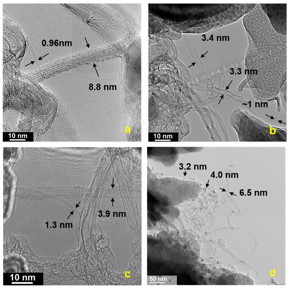 TEM images of raw carbon soot grown on kaolin sized paper showing (a) roped single-walled carbon nanotubes (SWCNTs) helically wrapped by a SWCNT, and large SWCNTs, (b) collapsed, (c) folded, and (d) twisted nanotubes. Scale bar = 10 nm (a-c) and 50 nm (d).
CREDIT
Rice University
TEM images of raw carbon soot grown on kaolin sized paper showing (a) roped single-walled carbon nanotubes (SWCNTs) helically wrapped by a SWCNT, and large SWCNTs, (b) collapsed, (c) folded, and (d) twisted nanotubes. Scale bar = 10 nm (a-c) and 50 nm (d).
CREDIT
Rice University
Abstract: A research collaboration between Rice University and the Energy Safety Research Institute (ESRI) at Swansea University has found that old newspapers can be used as a low cost, eco-friendly material on which to grow single walled carbon nanotubes on a large scale.
Swansea, UK | Posted on November 22nd, 2019
Carbon nanotubes are tiny molecules with incredible physical properties that can be used in a huge range of things, such as conductive films for touchscreen displays, flexible electronics, fabrics that create energy and antennas for 5G networks.
The new study, published in the MDPI Journal C , details the research experiments carried out in producing carbon nanotubes which could have the potential to solve some of the problems associated with their large scale production such as:-
The high cost of preparing a suitable surface for chemical growth.The difficulties in scaling up the process, as only single surface growth processes have been previously available.The research team discovered that the large surface area of newspapers provided an unlikely but ideal way to chemically grow carbon nanotubes.
Lead researcher Bruce Brinson said: "Newspapers have the benefit of being used in a roll-to-roll process in a stacked form making it an ideal candidate as a low-cost stackable 2D surface to grow carbon nanotubes."
However, not all newspaper is equally good - only newspaper produced with sizing made from kaolin, which is china clay, resulted in carbon nanotube growth.
Co-author Varun Shenoy Gangoli said: "Many substances including talc, calcium carbonate, and titanium dioxide can be used in sizing in papers which act as a filler to help with their levels of absorption and wear. However it was our observation that kaolin sizing, and not calcium carbonate sizing, showed us how the growth catalyst, which in our case was iron, is affected by the chemical nature of the substrate."
ESRI Director Andrew Barron, also a professor at Rice University in the USA, said: "While there have been previous research that shows that graphene, carbon nanotubes and carbon dots can be been synthesised on a variety of materials, such as food waste, vegetation waste, animal, bird or insect waste and chemically grown on natural materials, to date, this research has been limited.
"With our new research, we have found a continuous flow system that dramatically reduces the cost of both substrate and post synthesis process which could impact on the future mass manufacture of single walled carbon nanotubes."
####
For more information, please click here
Contacts:Delyth Purchase
@swanseauni
Copyright © Swansea University
If you have a comment, please Contact us.
Issuers of news releases, not 7th Wave, Inc. or Nanotechnology Now, are solely responsible for the accuracy of the content.
Bookmark:


News and information
 Two opposing approaches could give lithium-sulfur batteries a leg up over lithium-ion July 1st, 2022
Efficiently processing high-quality periodic nanostructures with ultrafast laser July 1st, 2022
Photonic synapses with low power consumption and high sensitivity are expected to integrate sensing-memory-preprocessing capabilities July 1st, 2022
Possible Futures
Sieving carbons: Ideal anodes for high-energy sodium-ion batteries July 1st, 2022
An artificial intelligence probe help see tumor malignancy July 1st, 2022
Photon-controlled diode: an optoelectronic device with a new signal processing behavior July 1st, 2022
Nanotubes/Buckyballs/Fullerenes/Nanorods
Boron nitride nanotube fibers get real: Rice lab creates first heat-tolerant, stable fibers from wet-spinning process June 24th, 2022
Nanotubes: a promising solution for advanced rubber cables with 60% less conductive filler June 1st, 2022
Protective equipment with graphene nanotubes meets the strictest ESD safety standards March 25th, 2022
CEA and Startup C12 Join Forces to Develop Next-Generation Quantum Computers with Multi-Qubit Chips at Wafer Scale March 25th, 2022
Discoveries
Sieving carbons: Ideal anodes for high-energy sodium-ion batteries July 1st, 2022
Efficiently processing high-quality periodic nanostructures with ultrafast laser July 1st, 2022
Photonic synapses with low power consumption and high sensitivity are expected to integrate sensing-memory-preprocessing capabilities July 1st, 2022
Announcements
Two opposing approaches could give lithium-sulfur batteries a leg up over lithium-ion July 1st, 2022
Efficiently processing high-quality periodic nanostructures with ultrafast laser July 1st, 2022
Photonic synapses with low power consumption and high sensitivity are expected to integrate sensing-memory-preprocessing capabilities July 1st, 2022
Interviews/Book Reviews/Essays/Reports/Podcasts/Journals/White papers/Posters
Sieving carbons: Ideal anodes for high-energy sodium-ion batteries July 1st, 2022
An artificial intelligence probe help see tumor malignancy July 1st, 2022
Photon-controlled diode: an optoelectronic device with a new signal processing behavior July 1st, 2022
Environment
University of Strathclyde and National University of Singapore to co-ordinate satellite quantum communications May 13th, 2022
Lightening up the nanoscale long-wavelength optoelectronics May 13th, 2022
Research partnerships
New technology helps reveal inner workings of human genome June 24th, 2022
Boron nitride nanotube fibers get real: Rice lab creates first heat-tolerant, stable fibers from wet-spinning process June 24th, 2022
