
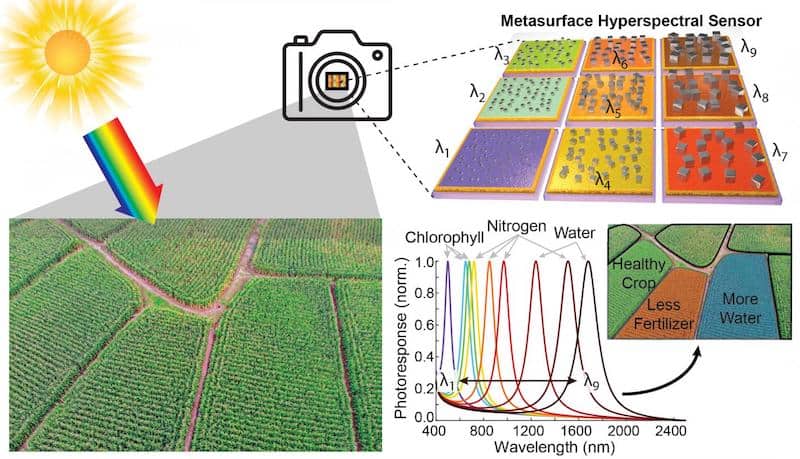
 A new type of lightweight, inexpensive hyperspectral camera. CREDIT:
Maiken Mikkelsen & Jon Stewart, Duke University
A new type of lightweight, inexpensive hyperspectral camera. CREDIT:
Maiken Mikkelsen & Jon Stewart, Duke University
Researchers at Duke University in the US have developed a cheap and easy-to-construct thermal camera that can capture a multispectral image half a million times faster than existing broad-spectrum detectors. The new camera owes its speed to advanced plasmonic and pyroelectric materials, and its inventors say it might find applications in medicine and food inspection as well as the up-and-coming field of precision agriculture.
Thermal cameras can sense radiation across a wide range of frequencies within the electromagnetic spectrum, but they suffer from relatively slow response times, on the order of a few milliseconds. They are also bulky, difficult to make and can cost hundreds of thousands of dollars.
Now, researchers led by Maiken Mikkelsen have constructed a new type of photodetector that can be integrated into a single chip, and is capable of recording a multispectral image in just 700 picoseconds (10-12 s). With a potential cost of just $10 in terms of the materials employed, the device is also a fraction of the price of conventional thermal cameras. These are costlier, among other reasons, because of the expensive materials used in their lenses, which are usually made of germanium.
Plasmonic metasurface and pyroelectric thin film
The new camera contains a metallic material with a structure that can be fine-tuned to interact with light in very specific ways. It works by exploiting the physics of plasmons, which are quasiparticles that arise when light interacts with the electrons in a metal and causes them to oscillate. The shape, size and arrangement of nanoscale structures within so-called plasmonic materials make it possible to support plasmons at specific frequencies. Hence, by adjusting these structural parameters, the researchers can dictate which frequencies of light the material will absorb and scatter.
In the Duke group’s camera, the plasmonic metasurface is made from silver cubes a few hundred nanometres in size. These cubes are placed a few nanometres above a layer of gold (just 75-nm thick) that rests on a thin film of aluminium nitride (105-nm thick). The aluminium nitride is a pyroelectric, meaning that it produces a voltage when it is heated.
When light hits the surface of a nanocube in the thermal camera, it excites the electrons in the metal, trapping the light energy at a frequency that depends on the size of the nanostructure and its distance from the base layer of gold. The heat from this trapped light energy is enough to change the crystal structure of the pyroelectric aluminium nitride below the nanocube, creating a voltage that can then be measured.
Fast process
This process is very fast because over 98% of the light falling on the camera is converted into localized surface plasmons that are confined between the silver nanocubes and the gold film. These plasmons decay in just femtoseconds (10-15 s), generating heat through the scattering of electrons with vibrations of the material lattice (phonons) – a process that takes several picoseconds. This heat then quickly diffuses though the gold film into the underlying aluminium nitride, again in just tens of picoseconds.
