
| Date | 12th, Dec 2019 |
|---|
Home > Press > How to induce magnetism in graphene: Elusive molecule predicted in the 1970s finally synthesized
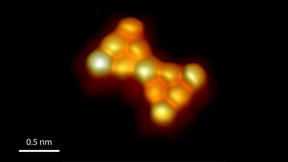 3D-rendered high-resolution scanning tunneling micrograph of Clar�s goblet. Image: Empa
Abstract: Depending on the shape and orientation of their edges, graphene nanostructures (also known as nanographenes) can have very different properties - for example, they may ex-hibit conducting, semiconducting or insulating behavior. However, one property has so far been elusive: magnetism. Together with colleagues from the Technical University in Dresden, Aalto University in Finland, Max Planck Institute for Polymer Research in Mainz and University of Bern, Empa researchers have now succeeded in building a nanogra-phene with magnetic properties that could be a decisive component for spin-based elec-tronics functioning at room temperature.
D�bendorf, Switzerland | Posted on December 11th, 2019
Graphene consists only of carbon atoms, but magnetism is a property hardly associated with carbon. So how is it possible for carbon nanomaterials to exhibit magnetism? To un-derstand this, we need to take a trip into the world of chemistry and atomic physics.
The carbon atoms in graphene are arranged in a honeycomb structure. Each carbon atom has three neighbors, with which it forms alternating single or double bonds. In a single bond, one electron from each atom - a so-called valence electron - binds with its neigh-bor; while in a double bond, two electrons from each atom participate. This alternating single and double bond representation of organic compounds is known as the Kekul� structure, named after the German chemist August Kekul� who first proposed this repre-sentation for one of the simplest organic compound, benzene (Figure 1). The rule here is that electron pairs inhabiting the same orbital must differ in their direction of rotation - the so-called spin - a consequence of the quantum mechanical Pauli's exclusion princi-ple.
"However, in certain structures made of hexagons, one can never draw alternating single and double bond patterns that satisfy the bonding requirements of every carbon atom. As a consequence, in such structures, one or more electrons are forced to remain unpaired and cannot form a bond," explains Shantanu Mishra, who is researching novel nanogra-phenes in the Empa laboratory headed by Roman Fasel. This phe-nomenon of involuntary unpairing of electrons is called "topological frustration".
But what does this have to do with magnetism? The answer lies in the "spins" of the elec-trons. The rotation of an electron around its own axis causes a tiny magnetic field, a mag-netic moment. If, as usual, there are two electrons with opposite spins in an orbital of an atom, these magnetic fields cancel each other. If, however, an electron is alone in its or-bital, the magnetic moment remains - and a measurable magnetic field results.
This alone is fascinating. But in order to be able to use the spin of the electrons as circuit elements, one more step is needed. One answer could be a structure that looks like a bow tie under a scanning tunneling microscope.
Two frustrated electrons in one molecule
Back in the 1970s, the Czech chemist Erich Clar, a distinguished expert in the field of nanographene chemistry, predicted a bow tie-like structure known as "Clar's goblet" (Fig-ure 1). It consists of two symmetrical halves and is constructed in such a way that one electron in each of the halves must remain topologically frustrated. However, since the two electrons are connected via the structure, they are antiferromagnetically coupled - that is, their spins necessarily orient in opposite directions.
In its antiferromagnetic state, Clar's goblet could act as a "NOT" logic gate: if the direction of the spin at the input is reversed, the output spin must also be forced to rotate.
However, it is also possible to bring the structure into a ferromagnetic state, where both spins orient along the same direction. To do this, the structure must be excited with a cer-tain energy, the so-called exchange coupling energy, so that one of the electrons reverses its spin.
In order for the gate to remain stable in its antiferromagnetic state, however, it must not spontaneously switch to the ferromagnetic state. For this to be possible, the exchange coupling energy must be higher than the energy dissipation when the gate is operated at room temperature. This is a central prerequisite for ensuring that a future spintronic cir-cuit based on nanographenes can function faultlessly at room temperature.
From theory to reality
So far, however, room-temperature stable magnetic carbon nanostructures have only been theoretical constructs. For the first time, the researchers have now succeeded in pro-ducing such a structure in practice, and showed that the theory does correspond to reali-ty. "Realizing the structure is demanding, since Clar's goblet is highly reactive, and the synthesis is complex," explains Mishra. Starting from a precursor molecule, the researchers were able to realize Clar's goblet in ultrahigh vacuum on a gold surface, and experimen-tally demonstrate that the molecule has exactly the predicted properties.
Importantly, they were able to show that the exchange coupling energy in Clar's goblet is relatively high at 23 meV, implying that spin-based logic operations could therefore be stable at room temperature. "This is a small but important step toward spintronics," says Roman Fasel.
####
For more information, please click here
Contacts:Karin Weinmann
41-587-654-708
@Empa_CH
Further informationShantanu Mishra
Phone +41 58 765 4839
Prof. Dr. Roman FaseLHead of LaboratoryPhone +41 58 765 4348
Copyright © EMPA
If you have a comment, please Contact us.
Issuers of news releases, not 7th Wave, Inc. or Nanotechnology Now, are solely responsible for the accuracy of the content.
Bookmark:


News and information
 Two opposing approaches could give lithium-sulfur batteries a leg up over lithium-ion July 1st, 2022
Efficiently processing high-quality periodic nanostructures with ultrafast laser July 1st, 2022
Photonic synapses with low power consumption and high sensitivity are expected to integrate sensing-memory-preprocessing capabilities July 1st, 2022
Quantum Physics
Quantum network nodes with warm atoms June 24th, 2022
University of Illinois Chicago joins Brookhaven Lab's Quantum Center June 10th, 2022
Bumps could smooth quantum investigations: Rice University models show unique properties of 2D materials stressed by contoured substrates June 10th, 2022
Graphene/ Graphite
OCSiAl expands its graphene nanotube production capacities to Europe June 17th, 2022
Bumps could smooth quantum investigations: Rice University models show unique properties of 2D materials stressed by contoured substrates June 10th, 2022
Dynamic metasurfaces and metadevices empowered by graphene May 6th, 2022
Magnetism/Magnons
�Nanomagnetic� computing can provide low-energy AI, researchers show May 6th, 2022
Possible Futures
Sieving carbons: Ideal anodes for high-energy sodium-ion batteries July 1st, 2022
An artificial intelligence probe help see tumor malignancy July 1st, 2022
Photon-controlled diode: an optoelectronic device with a new signal processing behavior July 1st, 2022
Spintronics
Magnet-free chiral nanowires for spintronic devices March 18th, 2022
NGI advances graphene spintronics as 1D contacts improve mobility in nano-scale devices February 11th, 2022
Terahertz light-driven spin-lattice control: A new potential path to faster and more efficient data storage January 7th, 2022
Chip Technology
Photon-controlled diode: an optoelectronic device with a new signal processing behavior July 1st, 2022
Photonic synapses with low power consumption and high sensitivity are expected to integrate sensing-memory-preprocessing capabilities July 1st, 2022
Discoveries
Sieving carbons: Ideal anodes for high-energy sodium-ion batteries July 1st, 2022
Efficiently processing high-quality periodic nanostructures with ultrafast laser July 1st, 2022
Photonic synapses with low power consumption and high sensitivity are expected to integrate sensing-memory-preprocessing capabilities July 1st, 2022
Materials/Metamaterials
New protocol for assessing the safety of nanomaterials July 1st, 2022
Nanotubes: a promising solution for advanced rubber cables with 60% less conductive filler June 1st, 2022
New route to build materials out of tiny particles May 27th, 2022
A one-stop shop for quantum sensing materials May 27th, 2022
Announcements
Two opposing approaches could give lithium-sulfur batteries a leg up over lithium-ion July 1st, 2022
Efficiently processing high-quality periodic nanostructures with ultrafast laser July 1st, 2022
Photonic synapses with low power consumption and high sensitivity are expected to integrate sensing-memory-preprocessing capabilities July 1st, 2022
Interviews/Book Reviews/Essays/Reports/Podcasts/Journals/White papers/Posters
Sieving carbons: Ideal anodes for high-energy sodium-ion batteries July 1st, 2022
An artificial intelligence probe help see tumor malignancy July 1st, 2022
Photon-controlled diode: an optoelectronic device with a new signal processing behavior July 1st, 2022
Quantum nanoscience
Bumps could smooth quantum investigations: Rice University models show unique properties of 2D materials stressed by contoured substrates June 10th, 2022
UCI scientists turn a hydrogen molecule into a quantum sensor: New technique enables precise measurement of electrostatic properties of materials April 22nd, 2022
