
| Date | 28th, Dec 2019 |
|---|
Home > Press > Buckyballs release electron-positron pairs in forward directions: Theoretical calculations reveal that when impacted by positrons of particular energies, spherical nanoparticles release unstable electron-positron pairs, with signals dominating in the same direction as the incomin
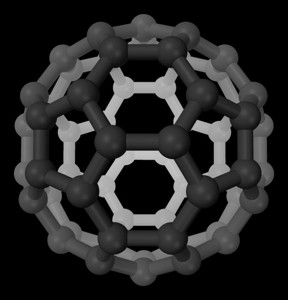 Impacting positrons release positronium from C60.
CREDIT
Benjah-bmm27, public domain.
Impacting positrons release positronium from C60.
CREDIT
Benjah-bmm27, public domain.
Abstract: When electrons collide with positrons, their antimatter counterparts, unstable pairs can form in which both types of particle orbit around each other. Named 'positronium', physicists have now produced this intriguing structure using a diverse range of positron targets - from atomic gases to metal films. However, they have yet to achieve the same result from vapours of nanoparticles, whose unique properties are influenced by the 'gases' of free electrons they contain in well-defined, nanoscopic regions. In new research published in EPJ D, Paul-Antoine Hervieux at the University of Strasbourg, France and Himadri Chakraborty at Northwest Missouri State University, USA, reveal the characteristics of positronium formation within football-shaped nanoparticles, C60, for the first time. At specific positron impact energies, they show that positronium emission dominates in the same direction as the incoming antiparticles.
Heidelberg, Germany | Posted on December 27th, 2019
Commonly known as buckminsterfullerene, or 'buckyballs', C60 is stable, easily synthesised and sustainable at room temperatures. Thanks to these useful properties, Hervieux and Chakraborty's findings could have important implications for fields including astrophysics, materials physics, and pharmaceutical research. In particular, they could offer improvements in tests of how antimatter responds to gravity, which can involve structures including dipositronium and antihydrogen atoms; each of which feature positronium in the first steps of their fabrication processes.
When positrons of certain energies approach buckyballs at angles of up to 10 degrees, the physicists showed that a series of narrow, forward-facing positronium signals resulted from the 'diffraction resonance' of the particles. The effect is comparable to how light is diffracted by microscopic spherical obstructions; showing variation with larger fullerene molecules like C240, and when particles are excited to higher energy levels. Hervieux and Chakraborty modelled these properties through theoretical calculations of how diffraction resonance affected the angles over which positronium is emitted, as a function of positron impact energy. Their results offer important insights for the wide variety of researchers who use these short-lived structures. In future studies, the duo now hopes to further explore their potential for use in real experiments.
###
Reference: P-A Hervieux, H.S. Chakraborty (2019), Strongly resolved diffraction resonances in positronium formation from C60 in forward direction, Eur. Phys. J. D (2019), DOI
####
For more information, please click here
Contacts:Sabine Lehr
49-622-144-878-336
@SpringerNature
Copyright © Springer
If you have a comment, please Contact us.
Issuers of news releases, not 7th Wave, Inc. or Nanotechnology Now, are solely responsible for the accuracy of the content.
Bookmark:


News and information
 Two opposing approaches could give lithium-sulfur batteries a leg up over lithium-ion July 1st, 2022
Efficiently processing high-quality periodic nanostructures with ultrafast laser July 1st, 2022
Photonic synapses with low power consumption and high sensitivity are expected to integrate sensing-memory-preprocessing capabilities July 1st, 2022
Physics
Flexing the power of a conductive polymer: A new material holds promise for the next generation of organic electronics June 24th, 2022
Observation of fractional exclusion statistics in quantum critical matter May 27th, 2022
Possible Futures
Sieving carbons: Ideal anodes for high-energy sodium-ion batteries July 1st, 2022
An artificial intelligence probe help see tumor malignancy July 1st, 2022
Photon-controlled diode: an optoelectronic device with a new signal processing behavior July 1st, 2022
Nanotubes/Buckyballs/Fullerenes/Nanorods
Boron nitride nanotube fibers get real: Rice lab creates first heat-tolerant, stable fibers from wet-spinning process June 24th, 2022
Nanotubes: a promising solution for advanced rubber cables with 60% less conductive filler June 1st, 2022
Protective equipment with graphene nanotubes meets the strictest ESD safety standards March 25th, 2022
CEA and Startup C12 Join Forces to Develop Next-Generation Quantum Computers with Multi-Qubit Chips at Wafer Scale March 25th, 2022
Discoveries
Sieving carbons: Ideal anodes for high-energy sodium-ion batteries July 1st, 2022
Efficiently processing high-quality periodic nanostructures with ultrafast laser July 1st, 2022
Photonic synapses with low power consumption and high sensitivity are expected to integrate sensing-memory-preprocessing capabilities July 1st, 2022
Materials/Metamaterials
New protocol for assessing the safety of nanomaterials July 1st, 2022
Nanotubes: a promising solution for advanced rubber cables with 60% less conductive filler June 1st, 2022
New route to build materials out of tiny particles May 27th, 2022
A one-stop shop for quantum sensing materials May 27th, 2022
Announcements
Two opposing approaches could give lithium-sulfur batteries a leg up over lithium-ion July 1st, 2022
Efficiently processing high-quality periodic nanostructures with ultrafast laser July 1st, 2022
Photonic synapses with low power consumption and high sensitivity are expected to integrate sensing-memory-preprocessing capabilities July 1st, 2022
Interviews/Book Reviews/Essays/Reports/Podcasts/Journals/White papers/Posters
Sieving carbons: Ideal anodes for high-energy sodium-ion batteries July 1st, 2022
An artificial intelligence probe help see tumor malignancy July 1st, 2022
Photon-controlled diode: an optoelectronic device with a new signal processing behavior July 1st, 2022
