
| Date | 4th, Jan 2020 |
|---|
Home > Press > Color superlensing to assist in surpassing diffraction barrier: A paper by Kazan Federal University's Sergey Kharintsev appeared in Optics Letters
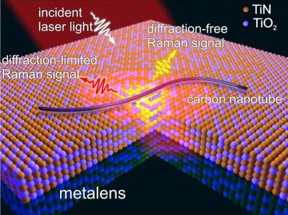 Schematic of the working principle of a disordered TiN?TiO2 metalens.
CREDIT
Kazan Federal University
Schematic of the working principle of a disordered TiN?TiO2 metalens.
CREDIT
Kazan Federal University
Abstract: The research was supported by a Russian Science Foundation's grant under the title "Synthesis and research of a new class of nanocomposite ceramics with degenerate dielectric permeability for opto-plasmonic applications."
Kazan, Russian Federation | Posted on January 3rd, 2020
A metalens described in the article is a thin composite metal-dielectric film placed on a dielectric substrate; the width is several dozen nanometers.
"The light has a wave nature, so there is a diffraction limit which confines the resolution of traditional optical microscopy," explains Kharintsev. "Our metalens is an optical device capable of surpassing that diffraction limit. Such a solution paves way for using optical technologies in nanoscale integral circuits and sensors."
The ultra-high resolution is based on an unusual behavior of the metalens in optical and infrared ranges.
"The material part of the dielectric constant oscillates near zero. This property can be used to enhance stimulated Raman scattering of light in a spatially limited medium illuminated by low-intensity continuous laser light. For most materials found in nature, nonlinear effects are weak, and to observe them it is necessary to increase the length of the medium (for example, using optical fibers) and / or to increase the laser pump power (using high-power pulsed lasers).
"We used a 50 nm thick titanium oxy nitride (TiON) film as a disordered nonlinear medium. The film was synthesized by magnetron sputtering and subsequent oxidation in air. As a result of a two-stage procedure, metal (TiN) and dielectric (TiO2) nanoparticles were formed in the film. An increase in the amplitude of the Stokes wave in a TiN / TiO2 film occurs due to the enhancement of the cubic susceptibility because of localized plasmon resonance and a small refractive index of the effective medium. Such metal-insulator nanocomposite films having several epsilon-near-zero frequencies in the visible and infrared ramges have found application in creating broadband metal technologies providing resolution beyond the limits of light diffraction," adds the author.
Kazan University employees have succeeded in visualizing 40 nm multiwall carbon nanotubes scattered along the surface of the metalens created by them, and the resolution was below 100 nm.
"Nanocomposite epsilon-near-zero film works as a surface-enhanced Raman scattering substrate, and it helps not only enhance the scattered signal, but also achieve beyond-diffraction resolutions. Metalenses and ENZ films can be used to create broadband absorbers for solar panels," concludes Dr. Kharintsev.
####
For more information, please click here
Contacts:Yury Nurmeev
@KazanUni
Copyright © Kazan Federal University
If you have a comment, please Contact us.
Issuers of news releases, not 7th Wave, Inc. or Nanotechnology Now, are solely responsible for the accuracy of the content.
Bookmark:


Imaging
 An artificial intelligence probe help see tumor malignancy July 1st, 2022
News and information
Two opposing approaches could give lithium-sulfur batteries a leg up over lithium-ion July 1st, 2022
Efficiently processing high-quality periodic nanostructures with ultrafast laser July 1st, 2022
Photonic synapses with low power consumption and high sensitivity are expected to integrate sensing-memory-preprocessing capabilities July 1st, 2022
Thin films
Thin-film, high-frequency antenna array offers new flexibility for wireless communications November 5th, 2021
Leibniz Prize winner Professor Dr. Oliver G. Schmidt moves to Chemnitz University of Technology: President Professor Dr. Gerd Strohmeier refers to an 'absolute top transfer' September 10th, 2021
Nanotubes/Buckyballs/Fullerenes/Nanorods
Boron nitride nanotube fibers get real: Rice lab creates first heat-tolerant, stable fibers from wet-spinning process June 24th, 2022
Nanotubes: a promising solution for advanced rubber cables with 60% less conductive filler June 1st, 2022
Protective equipment with graphene nanotubes meets the strictest ESD safety standards March 25th, 2022
CEA and Startup C12 Join Forces to Develop Next-Generation Quantum Computers with Multi-Qubit Chips at Wafer Scale March 25th, 2022
Discoveries
Sieving carbons: Ideal anodes for high-energy sodium-ion batteries July 1st, 2022
Efficiently processing high-quality periodic nanostructures with ultrafast laser July 1st, 2022
Photonic synapses with low power consumption and high sensitivity are expected to integrate sensing-memory-preprocessing capabilities July 1st, 2022
Announcements
Two opposing approaches could give lithium-sulfur batteries a leg up over lithium-ion July 1st, 2022
Efficiently processing high-quality periodic nanostructures with ultrafast laser July 1st, 2022
Photonic synapses with low power consumption and high sensitivity are expected to integrate sensing-memory-preprocessing capabilities July 1st, 2022
Interviews/Book Reviews/Essays/Reports/Podcasts/Journals/White papers/Posters
Sieving carbons: Ideal anodes for high-energy sodium-ion batteries July 1st, 2022
An artificial intelligence probe help see tumor malignancy July 1st, 2022
Photon-controlled diode: an optoelectronic device with a new signal processing behavior July 1st, 2022
Tools
New technology helps reveal inner workings of human genome June 24th, 2022
Snapshot measurement of single nanostructure�s circular dichroism March 25th, 2022
Eyebrow-raising: Researchers reveal why nanowires stick to each other February 11th, 2022
JEOL Introduces New Scanning Electron Microscope with �Simple SEM� Automation and Live Elemental and 3D Analysis January 14th, 2022
Energy
Key in increasing efficiency of next-generation solar cell, found in �light absorption capacity�! July 1st, 2022
Solving the solar energy storage problem with rechargeable batteries that can convert and store energy at once June 24th, 2022
Organic water splitters get a boost June 10th, 2022
Solar/Photovoltaic
Key in increasing efficiency of next-generation solar cell, found in �light absorption capacity�! July 1st, 2022
Solving the solar energy storage problem with rechargeable batteries that can convert and store energy at once June 24th, 2022
USTC found a pathway to high-quality ZnSe quantum wires April 8th, 2022
Graphene crystals grow better under copper cover April 1st, 2022
