
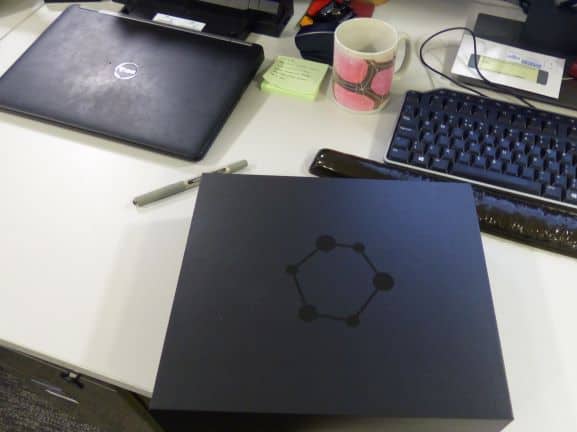
 Graphene gadget A pair of graphene-enabled headphones arrives to brighten a grey winter's day in the Physics World office. (Courtesy: Margaret Harris)
When I returned to work last week after the holiday break, I had a belated present waiting on my desk. In December, I agreed to review a pair of graphene headphones made by a Canadian start-up, ORA, which Physics World contributing editor Belle Dumé wrote about back in 2016 when ORA was developing graphene components for loudspeakers. A hitch in the trans-Atlantic post delayed the headphones’ arrival, but now they were here and ready for testing.
As regular readers of Physics World know, graphene is extraordinarily stiff and lightweight. Speaker components made from graphene will therefore vibrate more rapidly (for a given energy input) than components made from materials like polyethylene terephthalate (PET) or cellulose. They will also warp less, which is good news for audiophiles, since warping distorts the speakers’ sound.
At least, that’s what the company claims. Regular readers of Physics World will also know about graphene hype, whereby this two-dimensional form of carbon gets touted as the ideal ingredient in pretty much anything. According to graphene pioneer Konstantin Novoselov, who gave a lecture on “The First 15 Years of Graphene” at the Royal Society last October, the first commercial graphene product was a tennis racket. Since then, graphene has appeared (with, I suspect, varying degrees of usefulness) in several other consumer devices, including motorcycle helmets, bicycle wheels, fishing rods and a very expensive watch made by the Formula 1 supercar manufacturer McLaren.
ORA’s headphones stand out in this gaggle of graphene gadgets for two reasons. One is an endorsement from Novoselov himself, who notes that (unlike some “graphene-enabled” products), the ORA device contains a relatively high amount of actual graphene. The other reason, of course, is that (unlike the graphene motorcycle helmet, watch, etc.), I got to try the headphones myself.
For my first test, I chose the song “Sum” by the Swedish singer-songwriter Loney Dear. I picked it partly because I wanted to see if ORA’s headphones could transport me back to the sun-drenched festival where I first heard it, but mostly because Loney is cool and indie, and if I was going to pretend to be a music journalist for an afternoon, then by God I was going to do it properly.
I started out by listening to “Sum” on my usual ‘phones: a Soundcore Space noise-cancelling model that has seen me through a flight to Boston for last year’s APS March Meeting and numerous full-volume conversations from Physics World’s business development manager Ed Jost, who sits behind me. They’re a decent pair of cans, and I figured their over-the-ears design would make a good form-factor comparison to ORA’s devoce.
After a couple of repeats of “Sum” (and surprisingly few comments from my colleagues about “working” with my eyes closed), I figured I had a suitable baseline. Out came the ORA headphones, and once they paired with the Bluetooth on my mobile phone, I pressed “play” and waited to see if I could hear the difference.
Reader, I could. The opening arpeggios of “Sum” were noticeably clearer, the bass notably more solid, and though the ORA device lacks an active noise-cancelling feature, the shimmering wall of sound in Loney’s mesmerizing electronica meant I had no trouble tuning out the usual office noise (albeit at a time when Ed was temporarily out of the office).
In addition to Novoselov, the ORA headphones have also been endorsed by the Los Angeles Philharmonic conductor Gustavo Dudamel, who says they provide “a level of clarity I’ve only ever experienced from the podium in front of an orchestra”. I’ve never been on the podium in front of an orchestra, so I can’t judge Dudamel’s claim directly. I have, however, spent some time in the choir stalls, so I tried the ORA device on the final movement of Carl Orff’s Carmina Burana. I found the dynamic range between the chimes and timpani particularly fine, and – in contrast to my experience of standing behind the timpanist during a concert – my ears weren’t ringing afterward.
