
| Date | 11th, Jan 2020 |
|---|
Home > Press > Copper-based nanomaterials can kill cancer cells in mice
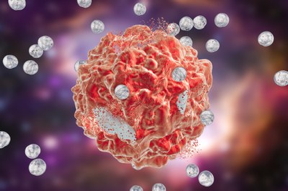 Nanoparticles attack a tumour cell. � Shutterstock
Abstract: An interdisciplinary team of scientists from KU Leuven, the University of Bremen, the Leibniz Institute of Materials Engineering, and the University of Ioannina has succeeded in killing tumour cells in mice using nano-sized copper compounds together with immunotherapy. After the therapy, the cancer did not return.
Leuven, Belgium | Posted on January 10th, 2020
Recent advances in cancer therapy use one's own immunity to fight the cancer. However, in some cases, immunotherapy has proven unsuccessful. The team of biomedical researchers, physicists, and chemical engineers found that tumours are sensitive to copper oxide nanoparticles- a compound composed of copper and oxygen. Once inside a living organism, these nanoparticles dissolve and become toxic. By creating the nanoparticles using iron oxide, the researchers were able to control this process to eliminate cancer cells, while healthy cells were not affected.
"Any material that you create at a nanoscale has slightly different characteristics than its normal-sized counterpart," explain Professor Stefaan Soenen and Dr Bella B. Manshian from the Department of Imaging and Pathology, who worked together on the study. "If we would ingest metal oxides in large quantities, they can be dangerous, but at a nanoscale and at controlled, safe, concentrations, they can actually be beneficial."
As the researchers expected, the cancer returned after treating with only the nanoparticles. Therefore, they combined the nanoparticles with immunotherapy. "We noticed that the copper compounds not only could kill the tumour cells directly, they also could assist those cells in the immune system that fight foreign substances, like tumours," says Dr Manshian.
The combination of the nanoparticles and immunotherapy made the tumours disappear entirely and, as a result, works as a vaccine for lung and colon cancer - the two types that were investigated in the study. To confirm their finding, the researchers injected tumour cells back into the mice. These cells were immediately eliminated by the immune system, which was on the lookout for any new, similar, cells invading the body.
The authors state that the novel technique can be used for about sixty per cent of all cancers, given that the cancer cells stem from a mutation in the p53 gene. Examples include lung, breast, ovarian, and colon cancer.
A crucial element is that the tumours disappeared without the use of chemotherapy, which typically comes with major side-effects. Chemotherapeutic drugs not only attack cancer cells, they often damage healthy cells along the way. For example, some of these drugs wipe out white blood cells, abolishing the immune system.
"As far as I'm aware, this is the first time that metal oxides are used to efficiently fight cancer cells with long-lasting immune effects in live models," Professor Soenen says. "As a next step, we want to create other metal nanoparticles, and identify which particles affect which types of cancer. This should result in a comprehensive database."
The team also plans to test tumour cells derived from cancer patient tissue. If the results remain the same, Professor Soenen plans to set up a clinical trial. For that to happen, however, there are still some hurdles along the way. He explains: "Nanomedicine is on the rise in the USA and Asia, but Europe is lagging behind. It's a challenge to advance in this field, because doctors and engineers often speak a different language. We need more interdisciplinary collaboration, so that we can understand each other better and build upon each other's knowledge."
####
For more information, please click here
Contacts:Stefaan Soenen
32-492-208-679
@LeuvenU
Copyright © KU Leuven
If you have a comment, please Contact us.
Issuers of news releases, not 7th Wave, Inc. or Nanotechnology Now, are solely responsible for the accuracy of the content.
Bookmark:


News and information
 Two opposing approaches could give lithium-sulfur batteries a leg up over lithium-ion July 1st, 2022
Efficiently processing high-quality periodic nanostructures with ultrafast laser July 1st, 2022
Photonic synapses with low power consumption and high sensitivity are expected to integrate sensing-memory-preprocessing capabilities July 1st, 2022
Cancer
New technology helps reveal inner workings of human genome June 24th, 2022
New nano-gel to protect children receiving chemotherapy from hearing loss June 17th, 2022
Electron-phonon coupling assisted universal red luminescence of o-phenylenediamine-based CDs June 10th, 2022
Emerging vaccine nanotechnology June 3rd, 2022
Possible Futures
Sieving carbons: Ideal anodes for high-energy sodium-ion batteries July 1st, 2022
An artificial intelligence probe help see tumor malignancy July 1st, 2022
Photon-controlled diode: an optoelectronic device with a new signal processing behavior July 1st, 2022
Nanomedicine
An artificial intelligence probe help see tumor malignancy July 1st, 2022
New technology helps reveal inner workings of human genome June 24th, 2022
Discoveries
Sieving carbons: Ideal anodes for high-energy sodium-ion batteries July 1st, 2022
Efficiently processing high-quality periodic nanostructures with ultrafast laser July 1st, 2022
Photonic synapses with low power consumption and high sensitivity are expected to integrate sensing-memory-preprocessing capabilities July 1st, 2022
Announcements
Two opposing approaches could give lithium-sulfur batteries a leg up over lithium-ion July 1st, 2022
Efficiently processing high-quality periodic nanostructures with ultrafast laser July 1st, 2022
Photonic synapses with low power consumption and high sensitivity are expected to integrate sensing-memory-preprocessing capabilities July 1st, 2022
Interviews/Book Reviews/Essays/Reports/Podcasts/Journals/White papers/Posters
Sieving carbons: Ideal anodes for high-energy sodium-ion batteries July 1st, 2022
An artificial intelligence probe help see tumor malignancy July 1st, 2022
Photon-controlled diode: an optoelectronic device with a new signal processing behavior July 1st, 2022
Nanobiotechnology
New technology helps reveal inner workings of human genome June 24th, 2022
