
| Date | 11th, Jan 2020 |
|---|
Home > Press > Generation and Manipulation of spin currents for advanced electronic devices
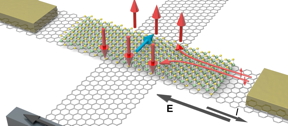 Schematic representation of a graphene-based heterostructure in which spin currents are generated and tuned by proximity effect with a transition metal dichalcogenide strip.
Abstract: ICN2 researchers, in the framework of the Graphene Flagship, demonstrate that spin currents can be generated and manipulated in graphene-based heterostructures at room temperature. The results of this study, published in Nature Materials, provide relevant information on the fundamental physics of the phenomena involved and open the door to new applications, such as the development of ultra-compact electronic and low energy consumption devices and magnetic memories.
Barcelona, Spain | Posted on January 9th, 2020
Graphene-based heterostructures of the van der Waals class could be used to design ultra-compact and low-energy electronic devices and magnetic memories. This is what a paper published in the latest issue of the Nature Materials journal suggests. The results have shown that it is possible to perform an efficient and tunable spin-charge conversion in these structures and, for the first time, even at room temperature.The work has been led by ICREA Prof. Sergio O. Valenzuela, head of the ICN2 Physics and Engineering of Nanodevices Group. The first authors are L. Antonio Ben�tez and Williams Savero Torres, of the same group. Members of the ICN2 Theoretical and Computational Nanoscience Group, as its head, ICREA Prof. Stephan Roche, also signed the paper. This study has been developed within the framework of the Graphene Flagship, a broad European Project in which researchers of the Catalan Institute of Nanoscience and Nanotechnology (ICN2) play a leadership role. The results complement recent researches carried out within this same initiative, such as the one published in 2019 in NanoLetters by scientists from the University of Groningen (RUG).The electronics that use spin - a property of electrons - to store, manipulate and transfer information, called spintronics, are driving important markets, such as those of motion sensors and information storage technologies. However, the development of efficient and versatile spin-based technologies requires high-quality materials that allow long-distance spin transfer, as well as methods to generate and manipulate spin currents, i.e. electron movements with their spin oriented in a given direction.The spin currents are usually produced and detected using ferromagnetic materials. As an alternative, spin-orbit interactions allow the generation and control of spin currents exclusively through electric fields, providing a much more versatile tool for the implementation of large-scale spin devices.Graphene is a unique material for long distance spin transport. The present work demonstrates that this transport can be manipulated in graphene by proximity effects. To induce these effects, transition metal dichalcogenides have been used, which are two-dimensional materials as graphene. Researchers have demonstrated a good efficiency of spin-charge interconversion at room temperature, which is comparable to the best performance of traditional materials.These advances are the result of a joint effort by experimental and theoretical researchers, who worked side by side in the framework of the Graphene Flagship. The outcomes of this study are of great relevance for the communities of spintronics and two-dimensional materials, as they provide relevant information on the fundamental physics of the phenomena involved and open the door to new applications.
Article posted by the Graphene Flagship:Layered heterostructures put a spin on magnetic memory devices
####
For more information, please click here
Contacts:Institut Catalŕ de Nanocičncia i Nanotecnologia (ICN2)Marketing and Communication DepartmentDr Virginia Greco, Science Writer +34 937 375 719Ŕlex Argem�, Head of Marketing and Communication +34 937 372 607; +34 635 861 543
Copyright © ICN2
If you have a comment, please Contact us.
Issuers of news releases, not 7th Wave, Inc. or Nanotechnology Now, are solely responsible for the accuracy of the content.
Bookmark:


News and information
 Two opposing approaches could give lithium-sulfur batteries a leg up over lithium-ion July 1st, 2022
Efficiently processing high-quality periodic nanostructures with ultrafast laser July 1st, 2022
Photonic synapses with low power consumption and high sensitivity are expected to integrate sensing-memory-preprocessing capabilities July 1st, 2022
2 Dimensional Materials
Controlled synthesis of crystal flakes paves path for advanced future electronics June 17th, 2022
Solving the puzzle of 2D disorder: An interdisciplinary team developed a new method to characterize disorder in 2D materials June 17th, 2022
UBCO researchers change the game when it comes to activity tracking: Flexible, highly sensitive motion device created by extrusion printing June 17th, 2022
Bumps could smooth quantum investigations: Rice University models show unique properties of 2D materials stressed by contoured substrates June 10th, 2022
UCI scientists turn a hydrogen molecule into a quantum sensor: New technique enables precise measurement of electrostatic properties of materials April 22nd, 2022
Graphene/ Graphite
OCSiAl expands its graphene nanotube production capacities to Europe June 17th, 2022
Bumps could smooth quantum investigations: Rice University models show unique properties of 2D materials stressed by contoured substrates June 10th, 2022
Nanotubes: a promising solution for advanced rubber cables with 60% less conductive filler June 1st, 2022
Dynamic metasurfaces and metadevices empowered by graphene May 6th, 2022
Magnetism/Magnons
�Nanomagnetic� computing can provide low-energy AI, researchers show May 6th, 2022
Possible Futures
Sieving carbons: Ideal anodes for high-energy sodium-ion batteries July 1st, 2022
An artificial intelligence probe help see tumor malignancy July 1st, 2022
Photon-controlled diode: an optoelectronic device with a new signal processing behavior July 1st, 2022
Spintronics
Magnet-free chiral nanowires for spintronic devices March 18th, 2022
NGI advances graphene spintronics as 1D contacts improve mobility in nano-scale devices February 11th, 2022
Terahertz light-driven spin-lattice control: A new potential path to faster and more efficient data storage January 7th, 2022
Chip Technology
Photon-controlled diode: an optoelectronic device with a new signal processing behavior July 1st, 2022
Photonic synapses with low power consumption and high sensitivity are expected to integrate sensing-memory-preprocessing capabilities July 1st, 2022
Memory Technology
Quantum network nodes with warm atoms June 24th, 2022
Boron nitride nanotube fibers get real: Rice lab creates first heat-tolerant, stable fibers from wet-spinning process June 24th, 2022
Reconfigurable silicon nanoantennas controlled by vectorial light field May 6th, 2022
Artificial neurons go quantum with photonic circuits: Quantum memristor as missing link between artificial intelligence and quantum computing March 25th, 2022
Discoveries
Sieving carbons: Ideal anodes for high-energy sodium-ion batteries July 1st, 2022
Efficiently processing high-quality periodic nanostructures with ultrafast laser July 1st, 2022
Photonic synapses with low power consumption and high sensitivity are expected to integrate sensing-memory-preprocessing capabilities July 1st, 2022
Announcements
Two opposing approaches could give lithium-sulfur batteries a leg up over lithium-ion July 1st, 2022
Efficiently processing high-quality periodic nanostructures with ultrafast laser July 1st, 2022
Photonic synapses with low power consumption and high sensitivity are expected to integrate sensing-memory-preprocessing capabilities July 1st, 2022
Interviews/Book Reviews/Essays/Reports/Podcasts/Journals/White papers/Posters
Sieving carbons: Ideal anodes for high-energy sodium-ion batteries July 1st, 2022
An artificial intelligence probe help see tumor malignancy July 1st, 2022
Photon-controlled diode: an optoelectronic device with a new signal processing behavior July 1st, 2022
