
| Date | 15th, Jan 2020 |
|---|
Home > Press > Nanomaterial fabric destroys nerve agents in battlefield-relevant conditions: Metal-organic framework-based composites don�t need liquid water to work
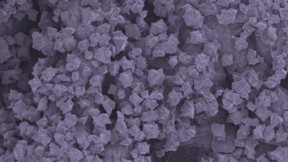 Composites made from metal-organic frameworks can destroy nerve agents under relevant conditions. (Credit: Journal of the American Chemical Society)
Abstract: �Smart chemistry quickly makes toxic nerve gases nontoxic�Material�s features bring it closer to practical use in the field �New approach is scalable and economical�Seeks to replace current technology of activated carbon
Evanston, IL | Posted on January 14th, 2020
Northwestern University scientists have successfully combined a nanomaterial effective at destroying toxic nerve agents with textile fibers. This new composite material one day could be integrated into protective suits and face masks for use by people facing hazardous conditions, such as chemical warfare.
The material, a zirconium-based metal-organic framework (MOF), degrades in minutes some of the most toxic chemical agents known to mankind: VX and soman (GD), a more toxic relative of sarin.
�With the correct chemistry, we can render toxic gases nontoxic,� said Omar K. Farha, associate professor of chemistry in the Weinberg College of Arts and Sciences, who led the research. �The action takes place at the nanolevel.�
The authors write that their work represents, to the best of their knowledge, the first example of the use of MOF composites for the efficient catalytic hydrolysis of nerve agent simulants without using liquid water and toxic volatile bases -- a major advantage.
The new composite material integrates MOFs and non-volatile polymeric bases onto textile fibers. The researchers found the MOF-coated textiles efficiently detoxify nerve agents under battlefield-relevant conditions using the gaseous water in the air. They also found the material stands up over a long period of time to degrading conditions, such as sweat, atmospheric carbon dioxide and pollutants.
These features bring the promising material closer to practical use in the field.
�MOFs can capture, store and destroy a lot of the nasty material, making them very attractive for defense-related applications,� said Farha, a member of the International Institute for Nanotechnology.
MOFs are well-ordered, lattice-like crystals. The nodes of the lattices are metals, and organic molecules connect the nodes. Within their very roomy pores, MOFs can effectively capture gases and vapors, such as nerve agents.
It is these roomy pores that also can pull enough water from the humidity in the air to drive the chemical reaction in which water is used to break down the bonds of the nerve agent.
The approach developed at Northwestern seeks to replace the technology currently in use: activated carbon and metal-oxide blends, which are slower to react to nerve agents. Because the MOFs are built from simple components, the new approach is scalable and economical.
The research was supported by the Defense Threat Reduction Agency (grants HDTRA1-18-1-0003 and CB3934) and the National Science Foundation Graduate Research Fellowship (grant DGE-1842165).
The title of the paper is �Integration of Metal�Organic Frameworks on Protective Layers for Destruction of Nerve Agents under Relevant Conditions.� The first authors are Zhijie Chen and Kaikai Ma, postdoctoral fellows in Farha�s research group.
####
For more information, please click here
Contacts:Source contact: Omar Farha at
Media contact:Megan Fellman
847.491.3115
Copyright © Northwestern University
If you have a comment, please Contact us.
Issuers of news releases, not 7th Wave, Inc. or Nanotechnology Now, are solely responsible for the accuracy of the content.
Bookmark:


Chemistry
News and information
 Two opposing approaches could give lithium-sulfur batteries a leg up over lithium-ion July 1st, 2022
Efficiently processing high-quality periodic nanostructures with ultrafast laser July 1st, 2022
Photonic synapses with low power consumption and high sensitivity are expected to integrate sensing-memory-preprocessing capabilities July 1st, 2022
Govt.-Legislation/Regulation/Funding/Policy
Solving the solar energy storage problem with rechargeable batteries that can convert and store energy at once June 24th, 2022
Boron nitride nanotube fibers get real: Rice lab creates first heat-tolerant, stable fibers from wet-spinning process June 24th, 2022
UBCO researchers change the game when it comes to activity tracking: Flexible, highly sensitive motion device created by extrusion printing June 17th, 2022
University of Illinois Chicago joins Brookhaven Lab's Quantum Center June 10th, 2022
Possible Futures
Sieving carbons: Ideal anodes for high-energy sodium-ion batteries July 1st, 2022
An artificial intelligence probe help see tumor malignancy July 1st, 2022
Photon-controlled diode: an optoelectronic device with a new signal processing behavior July 1st, 2022
Nanomedicine
An artificial intelligence probe help see tumor malignancy July 1st, 2022
New technology helps reveal inner workings of human genome June 24th, 2022
Discoveries
Sieving carbons: Ideal anodes for high-energy sodium-ion batteries July 1st, 2022
Efficiently processing high-quality periodic nanostructures with ultrafast laser July 1st, 2022
Photonic synapses with low power consumption and high sensitivity are expected to integrate sensing-memory-preprocessing capabilities July 1st, 2022
Announcements
Two opposing approaches could give lithium-sulfur batteries a leg up over lithium-ion July 1st, 2022
Efficiently processing high-quality periodic nanostructures with ultrafast laser July 1st, 2022
Photonic synapses with low power consumption and high sensitivity are expected to integrate sensing-memory-preprocessing capabilities July 1st, 2022
Interviews/Book Reviews/Essays/Reports/Podcasts/Journals/White papers/Posters
Sieving carbons: Ideal anodes for high-energy sodium-ion batteries July 1st, 2022
An artificial intelligence probe help see tumor malignancy July 1st, 2022
Photon-controlled diode: an optoelectronic device with a new signal processing behavior July 1st, 2022
Homeland Security
Sensors developed at URI can identify threats at the molecular level: More sensitive than a dog's nose and the sensors don't get tired May 21st, 2021
Highly sensitive dopamine detector uses 2D materials August 7th, 2020
Military
Boron nitride nanotube fibers get real: Rice lab creates first heat-tolerant, stable fibers from wet-spinning process June 24th, 2022
Bumps could smooth quantum investigations: Rice University models show unique properties of 2D materials stressed by contoured substrates June 10th, 2022
Nanostructured fibers can impersonate human muscles June 3rd, 2022
Lightening up the nanoscale long-wavelength optoelectronics May 13th, 2022
