
| Date | 17th, Jan 2020 |
|---|
Home > Press > Pretty with a twist: Complex porous, chiral nano-patterns arise from a simple linear building block
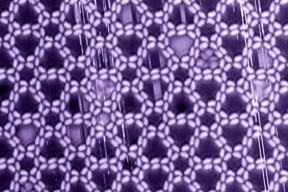 Using a simple rod-like building block with hydroxamic acids at both ends scientists at the Technical University of Munich created self-assembling porous, chrial nano structures.
CREDIT
Bodong Zhang / TUM
Using a simple rod-like building block with hydroxamic acids at both ends scientists at the Technical University of Munich created self-assembling porous, chrial nano structures.
CREDIT
Bodong Zhang / TUM
Abstract: Nanoscience can arrange minute molecular entities into nanometric patterns in an orderly manner using self-assembly protocols. Scientists at the Technical University of Munich (TUM) have functionalized a simple rod-like building block with hydroxamic acids at both ends. They form molecular networks that not only display the complexity and beauty of mono-component self-assembly on surfaces; they also exhibit exceptional properties.
Munich, Germany | Posted on January 16th, 2020
Designing components for molecular self-assembly calls for functionalities that 'interlock'. For example, our genetic information is encoded in two DNA strands, zipped together in a 'spiral staircase' double helix structure in a self-assembly process that is stabilized by hydrogen bonding.
Inspired by nature's 'zippers' researchers at the Technical University of Munich aim to construct functional nanostructures to push the boundaries of man-made structures.
Building blocks for complex nanostructures
Scientists at the Technical University of Munich, diverse in discipline, nationality and gender, joined forces to explore a new feature in two-dimensional architectures: a chemical group named hydroxamic acid.
A conceptually simple building block was prepared at the Chair of Proteomics and Bioanalytics: a rod-like molecule with a hydroxamic acid group at each end. This building block was then transferred to the Chair of Surface and Interface Physics, where its assembly was inspected on atomically planar silver and gold surfaces.
A nano-porous network
A combination of advanced microscopy tools, spectroscopy and density functional theory investigations found that the molecular building block adapts its shape somewhat in the environment of the supporting surface and its neighboring molecules. This affords an unusual manifold of supramolecular surface motifs: two to six molecules held together by intermolecular interactions.
Only a handful of these motifs self-organized into 2-D crystals. Among them, an unparalleled network emerged, whose patterns evoke images of sliced lemons, snowflakes or rosettes. They feature three differently sized pores able to snuggly hold individual small molecules of gas such as carbon monoxide in the smallest, or small proteins like insulin in the largest.
"In this regard, it is a milestone in the tessellations achieved by molecular nanostructures and the number of different pores expressed in crystalline 2-D networks," says Dr. Anthoula Papageorgiou, last author of the publication. "It thus offers unique opportunities in bottom-up nano-templating, which we will explore further."
Nanocages with a twist
Like our left and right hands, the shape of two mirrored cage structures cannot be superimposed. Since the 19th century, academics have characterized this type of object symmetry as 'chiral', from the ancient Greek χε?ρ (hand). These kinds of molecules are frequently found in natural compounds. Chirality influences interactions of polarized light and magnetic properties and plays a vital role in life.
For example, our olfactory receptors react very differently to the two mirror images of the limonene molecule: one smells like lemon, the other like pine. This so-called chiral recognition is a process that can determine whether a molecule acts as medicine or poison.
The inner walls of the obtained nanostructure cages offer sites that can direct guest molecules. The researchers observed such a process in some of the larger pores, where three of the same molecules assembled as a chiral object. At room temperature, this object is in motion, like a music box ballerina, leading to a blurred image.
In their future work, the team hopes to steer these kinds of phenomena for chiral recognition and artificial nano-machinery.
###
Funding was provided by the Postdoctoral Council of China, the China Scholarship Council, the International Max Planck Research School of Advanced Photon Science, the European Union's research project 2D-INK, the European Research Council (project NanoSurfs), the German Research Foundation (via Cluster of Excellence Munich?Centre for Advanced Photonics and Heisenberg professorship). Computations were performed on the Shared Hierarchical Academic Research Computing Network (SHARCNET) and the Cedar, Graham, and Niagara clusters of Compute/Calcul Canada.
####
For more information, please click here
Contacts:Dr. Andreas Battenberg
49-892-891-0510
Copyright © Technical University of Munich (TUM)
If you have a comment, please Contact us.
Issuers of news releases, not 7th Wave, Inc. or Nanotechnology Now, are solely responsible for the accuracy of the content.
Bookmark:


News and information
 Two opposing approaches could give lithium-sulfur batteries a leg up over lithium-ion July 1st, 2022
Efficiently processing high-quality periodic nanostructures with ultrafast laser July 1st, 2022
Photonic synapses with low power consumption and high sensitivity are expected to integrate sensing-memory-preprocessing capabilities July 1st, 2022
2 Dimensional Materials
Controlled synthesis of crystal flakes paves path for advanced future electronics June 17th, 2022
Solving the puzzle of 2D disorder: An interdisciplinary team developed a new method to characterize disorder in 2D materials June 17th, 2022
UBCO researchers change the game when it comes to activity tracking: Flexible, highly sensitive motion device created by extrusion printing June 17th, 2022
Bumps could smooth quantum investigations: Rice University models show unique properties of 2D materials stressed by contoured substrates June 10th, 2022
Govt.-Legislation/Regulation/Funding/Policy
Solving the solar energy storage problem with rechargeable batteries that can convert and store energy at once June 24th, 2022
Boron nitride nanotube fibers get real: Rice lab creates first heat-tolerant, stable fibers from wet-spinning process June 24th, 2022
UBCO researchers change the game when it comes to activity tracking: Flexible, highly sensitive motion device created by extrusion printing June 17th, 2022
University of Illinois Chicago joins Brookhaven Lab's Quantum Center June 10th, 2022
Possible Futures
Sieving carbons: Ideal anodes for high-energy sodium-ion batteries July 1st, 2022
An artificial intelligence probe help see tumor malignancy July 1st, 2022
Photon-controlled diode: an optoelectronic device with a new signal processing behavior July 1st, 2022
Self Assembly
Nanoclusters self-organize into centimeter-scale hierarchical assemblies April 22nd, 2022
Atom by atom: building precise smaller nanoparticles with templates March 4th, 2022
Nanostructures get complex with electron equivalents: Nanoparticles of two different sizes break away from symmetrical designs January 14th, 2022
Discoveries
Sieving carbons: Ideal anodes for high-energy sodium-ion batteries July 1st, 2022
Efficiently processing high-quality periodic nanostructures with ultrafast laser July 1st, 2022
Photonic synapses with low power consumption and high sensitivity are expected to integrate sensing-memory-preprocessing capabilities July 1st, 2022
Announcements
Two opposing approaches could give lithium-sulfur batteries a leg up over lithium-ion July 1st, 2022
Efficiently processing high-quality periodic nanostructures with ultrafast laser July 1st, 2022
Photonic synapses with low power consumption and high sensitivity are expected to integrate sensing-memory-preprocessing capabilities July 1st, 2022
Interviews/Book Reviews/Essays/Reports/Podcasts/Journals/White papers/Posters
Sieving carbons: Ideal anodes for high-energy sodium-ion batteries July 1st, 2022
An artificial intelligence probe help see tumor malignancy July 1st, 2022
Photon-controlled diode: an optoelectronic device with a new signal processing behavior July 1st, 2022
Grants/Sponsored Research/Awards/Scholarships/Gifts/Contests/Honors/Records
Solving the solar energy storage problem with rechargeable batteries that can convert and store energy at once June 24th, 2022
Boron nitride nanotube fibers get real: Rice lab creates first heat-tolerant, stable fibers from wet-spinning process June 24th, 2022
Nanobiotechnology
New technology helps reveal inner workings of human genome June 24th, 2022
Research partnerships
New technology helps reveal inner workings of human genome June 24th, 2022
Boron nitride nanotube fibers get real: Rice lab creates first heat-tolerant, stable fibers from wet-spinning process June 24th, 2022
