
| Date | 17th, Jan 2020 |
|---|
Home > Press > Researchers gain control over internal structure of self-assembled composite materials
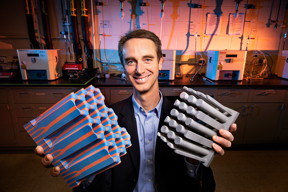 Professor Paul Braun led a team that developed a new templating system to help control the quality and unique properties of a special class of inorganic composite materials.
Photo by Fred Zwicky
Professor Paul Braun led a team that developed a new templating system to help control the quality and unique properties of a special class of inorganic composite materials.
Photo by Fred Zwicky
Abstract: Composites made from self-assembling inorganic materials are valued for their unique strength and thermal, optical and magnetic properties. However, because self-assembly can be difficult to control, the structures formed can be highly disordered, leading to defects during large-scale production. Researchers at the University of Illinois and the University of Michigan have developed a templating technique that instills greater order and gives rise to new 3D structures in a special class of materials, called eutectics, to form new, high-performance materials.
Champaign, IL | Posted on January 16th, 2020
The findings of the collaborative study are published in the journal Nature.
Eutectic materials contain elements and compounds that have different melting and solidification temperatures. When combined, however, the composite formed has single melting and freezing temperatures � like when salt and water combine to form brine, which freezes at a lower temperature than water or salt alone, the researchers said. When a eutectic liquid solidifies, the individual components separate, forming a cohesive structure � most commonly in a layered form. The fact that eutectic materials self-assemble into composites makes them highly desirable to many modern technologies, ranging from high-performance turbine blades to solder alloys.
�Having a single melting point has advantages in composite materials processing,� said Paul Braun, a professor of materials science and engineering and director of the Materials Research Lab at the U. of I., who led the project. �Instead of depositing layers of material individually, we start with a liquid that self-assembles as it solidifies. This can speed up production and allows us to make larger volumes at one time.�
However, self-assembly can lead to problems, he said, as its uncontrolled nature can form defects.
�Templating is a common practice used in organic polymers processing,� said Ashish Kulkarni, an Illinois graduate student and the first author of the study. �However, it is not something that has been explored in inorganic materials processing because inorganic microstructures are more rigid and harder to control.�
To demonstrate this process in the lab, the team built templates with tiny posts arranged in hexagonal shapes to control the resolidification of a melt containing silver chloride and potassium chloride � a eutectic material that naturally forms layers as it cools.
�If not controlled, the only microstructures this system will form are layers,� said Katsuyo Thornton, a professor of materials science and engineering at Michigan, who conducted computer simulations with graduate student Erik Hanson, both of whom are study co-authors. �We can vary the cooling rate to make the layers thicker or thinner, but the pattern stays the same. By adding a template that the liquid solidifies around, we hoped new patterns would emerge.�
The team found that as the silver and potassium chloride melt starts to solidify around the hexagonal-shaped templates, the posts get in the way of the layer formation and produce a composite with an array of different square, triangular and honeycomb-shaped microstructures instead � the specifics of structure depending on the distance between the posts on the template.
�The repeating nature of these templates and newly formed structures reduces the chances for defects to form,� Braun said. �So, not only did we form exciting new microstructures, but we also reduced the number of defects in the resulting composite material.�
The researchers will explore how the new microstructures influence the physical properties of a wide range of eutectic materials.
�The materials we used in our experiments are transparent, so the first direction to head in might be to explore optical materials, and there is a lot of potential in the area of photonic crystals,� Braun said. �We're still a long way from real application, but the possibilities are abundant.�
Braun also is affiliated with the department of chemistry, the department of mechanical science and engineering, the Holonyak Micro & Nanotechnology Lab and the Beckman Institute for Advanced Science and Technology at the U. of I.
This research was supported by the Air Force Office of Scientific Research.
####
For more information, please click here
Contacts:Paul Braun217-244-7293
Copyright © University of Illinois at Urbana-Champaign
If you have a comment, please Contact us.
Issuers of news releases, not 7th Wave, Inc. or Nanotechnology Now, are solely responsible for the accuracy of the content.
Bookmark:


News and information
 Two opposing approaches could give lithium-sulfur batteries a leg up over lithium-ion July 1st, 2022
Efficiently processing high-quality periodic nanostructures with ultrafast laser July 1st, 2022
Photonic synapses with low power consumption and high sensitivity are expected to integrate sensing-memory-preprocessing capabilities July 1st, 2022
Govt.-Legislation/Regulation/Funding/Policy
Solving the solar energy storage problem with rechargeable batteries that can convert and store energy at once June 24th, 2022
Boron nitride nanotube fibers get real: Rice lab creates first heat-tolerant, stable fibers from wet-spinning process June 24th, 2022
UBCO researchers change the game when it comes to activity tracking: Flexible, highly sensitive motion device created by extrusion printing June 17th, 2022
University of Illinois Chicago joins Brookhaven Lab's Quantum Center June 10th, 2022
Possible Futures
Sieving carbons: Ideal anodes for high-energy sodium-ion batteries July 1st, 2022
An artificial intelligence probe help see tumor malignancy July 1st, 2022
Photon-controlled diode: an optoelectronic device with a new signal processing behavior July 1st, 2022
Self Assembly
Nanoclusters self-organize into centimeter-scale hierarchical assemblies April 22nd, 2022
Atom by atom: building precise smaller nanoparticles with templates March 4th, 2022
Nanostructures get complex with electron equivalents: Nanoparticles of two different sizes break away from symmetrical designs January 14th, 2022
Discoveries
Sieving carbons: Ideal anodes for high-energy sodium-ion batteries July 1st, 2022
Efficiently processing high-quality periodic nanostructures with ultrafast laser July 1st, 2022
Photonic synapses with low power consumption and high sensitivity are expected to integrate sensing-memory-preprocessing capabilities July 1st, 2022
Materials/Metamaterials
New protocol for assessing the safety of nanomaterials July 1st, 2022
Nanotubes: a promising solution for advanced rubber cables with 60% less conductive filler June 1st, 2022
New route to build materials out of tiny particles May 27th, 2022
A one-stop shop for quantum sensing materials May 27th, 2022
Announcements
Two opposing approaches could give lithium-sulfur batteries a leg up over lithium-ion July 1st, 2022
Efficiently processing high-quality periodic nanostructures with ultrafast laser July 1st, 2022
Photonic synapses with low power consumption and high sensitivity are expected to integrate sensing-memory-preprocessing capabilities July 1st, 2022
Interviews/Book Reviews/Essays/Reports/Podcasts/Journals/White papers/Posters
Sieving carbons: Ideal anodes for high-energy sodium-ion batteries July 1st, 2022
An artificial intelligence probe help see tumor malignancy July 1st, 2022
Photon-controlled diode: an optoelectronic device with a new signal processing behavior July 1st, 2022
Military
Boron nitride nanotube fibers get real: Rice lab creates first heat-tolerant, stable fibers from wet-spinning process June 24th, 2022
Bumps could smooth quantum investigations: Rice University models show unique properties of 2D materials stressed by contoured substrates June 10th, 2022
Nanostructured fibers can impersonate human muscles June 3rd, 2022
Lightening up the nanoscale long-wavelength optoelectronics May 13th, 2022
Aerospace/Space
Boron nitride nanotube fibers get real: Rice lab creates first heat-tolerant, stable fibers from wet-spinning process June 24th, 2022
University of Strathclyde and National University of Singapore to co-ordinate satellite quantum communications May 13th, 2022
Lightening up the nanoscale long-wavelength optoelectronics May 13th, 2022
Research partnerships
New technology helps reveal inner workings of human genome June 24th, 2022
Boron nitride nanotube fibers get real: Rice lab creates first heat-tolerant, stable fibers from wet-spinning process June 24th, 2022
