
| Date | 22nd, Jan 2020 |
|---|
Home > Press > Let the europium shine brighter
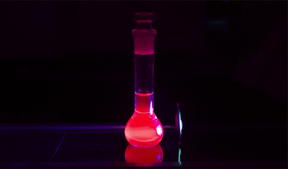 The europium Eu(III) complex with nanocarbon antenna emitting fine red light.
CREDIT
WPI-ICReDD, Hokkaido University
The europium Eu(III) complex with nanocarbon antenna emitting fine red light.
CREDIT
WPI-ICReDD, Hokkaido University
Abstract: A stacked nanocarbon antenna makes a rare earth element shine 5 times more brightly than previous designs, with applications in molecular light-emitting devices.
Let the europium shine brighter
Sapporo, Japan | Posted on January 21st, 2020
A unique molecular design developed by Hokkaido University researchers causes a europium complex to shine more than five times brighter than the best previous design when it absorbs low energy blue light. The findings were published in the journal Communications Chemistry, and could lead to more efficient photosensitizers with a wide variety of applications.
Photosensitizers are molecules that become excited when they absorb light and then transfer this excited energy to another molecule. They are used in photochemical reactions, energy conversion systems, and in photodynamic therapy, which uses light to kill some kinds of early-stage cancer.
The design of currently available photosensitizers often leads to inevitable energy loss, and so they are not as efficient in light absorption and energy transfer as scientists would like. It also requires high energy light such as UV for excitation.
Yuichi Kitagawa and Yasuchika Hasegawa of Hokkaido University's Institute for Chemical Reaction Design and Discovery (WPI-ICReDD) worked with colleagues in Japan to improve the design of conventional photosensitizers.
Their concept is based on extending the lifetime of a molecular energy state called the triplet excited state and reducing gaps between energy levels within the photosensitizer molecule. This would lead to more efficient use of photons and reduced energy loss.
The researchers designed a nanocarbon "antenna" made of coronene, a polycyclic aromatic hydrocarbon containing six benzene rings. Two nanocarbon antennas are stacked one on top of the other and then connected on either side to the rare Earth metal europium. Extra connectors are added to strengthen the bonds between the nanocarbon antennas and europium. When the nanocarbon antennas absorb light, they transfer this energy to europium, causing the complex to emit red light.
Experiments showed the complex best absorbed light with wavelengths of 450nm. When a blue LED (light-emitting diode) light was shone on the complex, it glowed more than five times brighter than the europium complex which until now had the strongest reported emission under blue light. The researchers also demonstrated that the complex can bear high temperatures above 300? thanks to its rigid structure.
"This study provides insights into the design of photosensitizers and can lead to photofunctional materials that efficiently utilize low energy light," says Yuichi Kitagawa of the research team. The new design could be applied to fabricate molecular light-emitting devices, among other applications, the researchers say.
####
For more information, please click here
Contacts:Naoki Namba
81-117-062-185
@hokkaidouni
Copyright © Hokkaido University
If you have a comment, please Contact us.
Issuers of news releases, not 7th Wave, Inc. or Nanotechnology Now, are solely responsible for the accuracy of the content.
Bookmark:


News and information
 Two opposing approaches could give lithium-sulfur batteries a leg up over lithium-ion July 1st, 2022
Efficiently processing high-quality periodic nanostructures with ultrafast laser July 1st, 2022
Photonic synapses with low power consumption and high sensitivity are expected to integrate sensing-memory-preprocessing capabilities July 1st, 2022
Cancer
New technology helps reveal inner workings of human genome June 24th, 2022
New nano-gel to protect children receiving chemotherapy from hearing loss June 17th, 2022
Electron-phonon coupling assisted universal red luminescence of o-phenylenediamine-based CDs June 10th, 2022
Emerging vaccine nanotechnology June 3rd, 2022
Diabetes drug improves antibacterial treatment speed and effectiveness, researchers report May 27th, 2022
Display technology/LEDs/SS Lighting/OLEDs
A solution to perovskite solar cell scalability problems April 22nd, 2022
Possible Futures
Sieving carbons: Ideal anodes for high-energy sodium-ion batteries July 1st, 2022
An artificial intelligence probe help see tumor malignancy July 1st, 2022
Photon-controlled diode: an optoelectronic device with a new signal processing behavior July 1st, 2022
Discoveries
Sieving carbons: Ideal anodes for high-energy sodium-ion batteries July 1st, 2022
Efficiently processing high-quality periodic nanostructures with ultrafast laser July 1st, 2022
Photonic synapses with low power consumption and high sensitivity are expected to integrate sensing-memory-preprocessing capabilities July 1st, 2022
Announcements
Two opposing approaches could give lithium-sulfur batteries a leg up over lithium-ion July 1st, 2022
Efficiently processing high-quality periodic nanostructures with ultrafast laser July 1st, 2022
Photonic synapses with low power consumption and high sensitivity are expected to integrate sensing-memory-preprocessing capabilities July 1st, 2022
Interviews/Book Reviews/Essays/Reports/Podcasts/Journals/White papers/Posters
Sieving carbons: Ideal anodes for high-energy sodium-ion batteries July 1st, 2022
An artificial intelligence probe help see tumor malignancy July 1st, 2022
Photon-controlled diode: an optoelectronic device with a new signal processing behavior July 1st, 2022
Energy
Key in increasing efficiency of next-generation solar cell, found in �light absorption capacity�! July 1st, 2022
Solving the solar energy storage problem with rechargeable batteries that can convert and store energy at once June 24th, 2022
Organic water splitters get a boost June 10th, 2022
Photonics/Optics/Lasers
Photon-controlled diode: an optoelectronic device with a new signal processing behavior July 1st, 2022
Efficiently processing high-quality periodic nanostructures with ultrafast laser July 1st, 2022
Photonic synapses with low power consumption and high sensitivity are expected to integrate sensing-memory-preprocessing capabilities July 1st, 2022
