
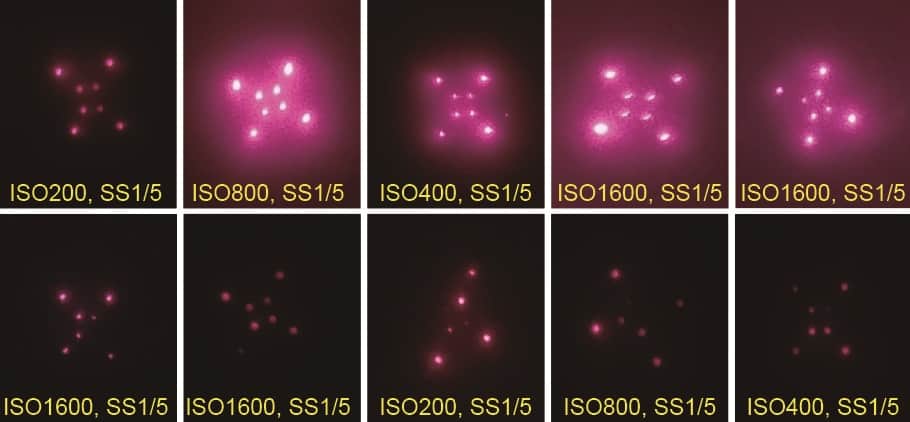
 Smartphone images of the near-infrared signal from quantum dot markings in the skin of rodents at zero weeks (top row) and 12 weeks after administration. (Courtesy: K J McHugh et al Sci. Transl. Med. 2019)
If the dissolvable microneedle patches used to deliver vaccines could also implant an invisible record of the inoculation under the skin, a person’s vaccination history could be known with certainty. With this aim, researchers at Massachusetts Institute of Technology have developed a microneedle patch containing a nanocrystal dye that creates near-infrared-emitting dots under the skin. The emitted light is then detected by a specially modified smartphone (Sci. Transl. Med. 10.1126/scitranslmed.aay7162).
The microneedle patches can be customized to imprint different patterns that correspond to the type of vaccine, the date administered, and the vaccine’s manufacturer and lot number. This technique could reduce problems associated with lack of standardized vaccination record-keeping in many regions of the world.
The team’s goal was to develop a robust, inexpensive and easy-to-use platform that could be applied without difficulty in low-resource settings. For their proof-of-concept study, the researchers developed a robust dye that’s resistant to photobleaching, a technique to encapsulate the dye, and a microneedle design to optimize delivery under the skin.
The dye ultimately selected by the team was a colloidal quantum dot (QD) formulation called S10C5H. This formulation retained 13% of its fluorescent signal after exposure to five years of simulated sunlight through pigmented skin samples at sevenfold the intensity of the sun. To improve biocompatibility, the QDs were encapsulated in PMMA microspheres.
To detect signals from the QDs, the researchers adapted an inexpensive smartphone to have near-infrared imaging capability. Modifications included removal of the standard short-pass filter and addition of 850 nm long-pass filters to block both environmental light and light from LED illumination.
