
| Date | 28th, Jan 2020 |
|---|
Home > Press > Extraction of lithium from its largest source, i.e. seawater, by nanostructured membranes
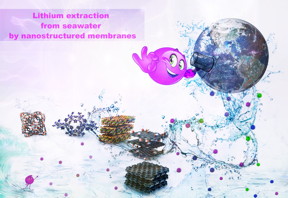 Lithium extraction from seawater by the new types of the membrane in nanoscales. Credit: Ehsan Hosseini, Iran University of Science and Technology
Abstract: It is predicted that the supply of the energy-critical element of Lithium will soon become less than its continuously increasing demand, which will make Lithium a strategically influential element. The amount of Li+ in seawater is estimated to be nearly 230,000 million tons, almost 57000 times higher than its land abundance. Lithium consumption has been increasing substantially worldwide from 265,000 tons in 2015 to an estimated 498,000 tons in 2025. This sharp increase in Li demand is predominantly due to the extensive use of Li-ion batteries or electronic devices. Indeed, over the course of five years from 2010 to 2015, the consumption of Li-ion batteries leaped from 4.6 to 7 billion units. Currently, the main sources of Li+ supply are brine deposits and lithium ores which are reported to amount to approximately 34 million tons worldwide. While these Li+ reserves are sufficient to address the current market demands, the conventional technologies to extract Li+ from the resources are either difficult or require high-cost investment, and will struggle to meet future market demands. Furthermore, a major bottleneck is the distribution of conventional resources of Li+ around the globe, many in less accessible regions. In comparison, the Li+ reserves in seawater. This unconventional resource of Li+ is not limited to a geographic boundary. However, Li+�seawater processing is complicated due to the low concentration of Li+ and the coexistence of chemically similar ions such as Na+ and K +. Therefore, the development of new processing technologies with enhanced product yields are urgently needed.In a new review article in Nature Communications , a team of international researchers including Iranian and Australian researchers from University of Isfahan, Iran University of Science and Technology, University of New South Wales, University of Queensland and Macquarie University have come together to provide an in-depth and thorough review on the opportunities, progress and challenges of design materials for the development of membranes with nanochannels and nanopores with Li selectivity. They have provided insights on how and why design materials may overcome current challenges posed by the existing technology and how they can enhance both device component function and performance, to boost the features of future technologies, in the areas of nanomembranes, lithium batteries, and desalination applications.
Tehran, Iran | Posted on January 27th, 2020
For purification applications, they have reviewed the fundamental concepts relevant to ion transport within nanopores and nanochannels, in addition to discussing the key principles of materials design for the development of membranes with nanochannels and nanopores with Li selectivity. In particular, the advanced materials can serve as building blocks for novel membranes with Li+ ion selectivity and high permeability. It is well-known that ions behave drastically differently in nano-scale confined environments, as compared with their behavior in bulk solutions. This unexpected and surprising phenomenon in nanochannels and nanopores, along with the special characteristics of Li+, serves as an important impetus to design Li+ selective membranes. In a bigger picture, they show how challenges such as nanochannel size, nanochannel surface charge, and nanochannel morphology can increase or decrease the rate of lithium selectivity.Authors suggested that future efforts should be focused on: (i) improving the fundamental understanding of Li+ ion transport mechanisms in nanochannels with extensive theoretical modeling to support experimental results and to guide materials design, (ii) making the Li+ ion-selective membrane materials more stable, reversible and durable, (iii) improving Li+/Na+ or Li+/K+ selectivities without compromising Li+ ion transportation rate, (iv) developing Li+ ion-selective thin films on flexible polymeric substrates, and (v) introducing new inexpensive materials that can serve as building blocks for Li+ ion-selective membranes. The strong scientific and strategic goals that underpin the need for improved Li+ ion separation methods will ensure that this field continues to grow in importance.
####
For more information, please click here
Contacts:Ehsan HosseiniSenior Research FellowIran University of Science and Technology
Copyright © Iran University of Science and Technology
If you have a comment, please Contact us.
Issuers of news releases, not 7th Wave, Inc. or Nanotechnology Now, are solely responsible for the accuracy of the content.
Bookmark:


News and information
 Two opposing approaches could give lithium-sulfur batteries a leg up over lithium-ion July 1st, 2022
Efficiently processing high-quality periodic nanostructures with ultrafast laser July 1st, 2022
Photonic synapses with low power consumption and high sensitivity are expected to integrate sensing-memory-preprocessing capabilities July 1st, 2022
Mining/Extraction/Drilling
Chile coating and composite industry makes leap forward leveraging graphene nanotube solutions April 9th, 2021
Membrane technology could cut emissions and energy use in oil refining July 17th, 2020
Graphene nanotubes outperform ammonium salts and carbon black in PU applications September 11th, 2018
Discoveries
Sieving carbons: Ideal anodes for high-energy sodium-ion batteries July 1st, 2022
Efficiently processing high-quality periodic nanostructures with ultrafast laser July 1st, 2022
Photonic synapses with low power consumption and high sensitivity are expected to integrate sensing-memory-preprocessing capabilities July 1st, 2022
Announcements
Two opposing approaches could give lithium-sulfur batteries a leg up over lithium-ion July 1st, 2022
Efficiently processing high-quality periodic nanostructures with ultrafast laser July 1st, 2022
Photonic synapses with low power consumption and high sensitivity are expected to integrate sensing-memory-preprocessing capabilities July 1st, 2022
Interviews/Book Reviews/Essays/Reports/Podcasts/Journals/White papers/Posters
Sieving carbons: Ideal anodes for high-energy sodium-ion batteries July 1st, 2022
An artificial intelligence probe help see tumor malignancy July 1st, 2022
Photon-controlled diode: an optoelectronic device with a new signal processing behavior July 1st, 2022
Water
Scientists offer solutions for risky tap water June 17th, 2022
UBCO researchers change the game when it comes to activity tracking: Flexible, highly sensitive motion device created by extrusion printing June 17th, 2022
Organic water splitters get a boost June 10th, 2022
Research partnerships
New technology helps reveal inner workings of human genome June 24th, 2022
Boron nitride nanotube fibers get real: Rice lab creates first heat-tolerant, stable fibers from wet-spinning process June 24th, 2022
