
| Date | 28th, Jan 2020 |
|---|
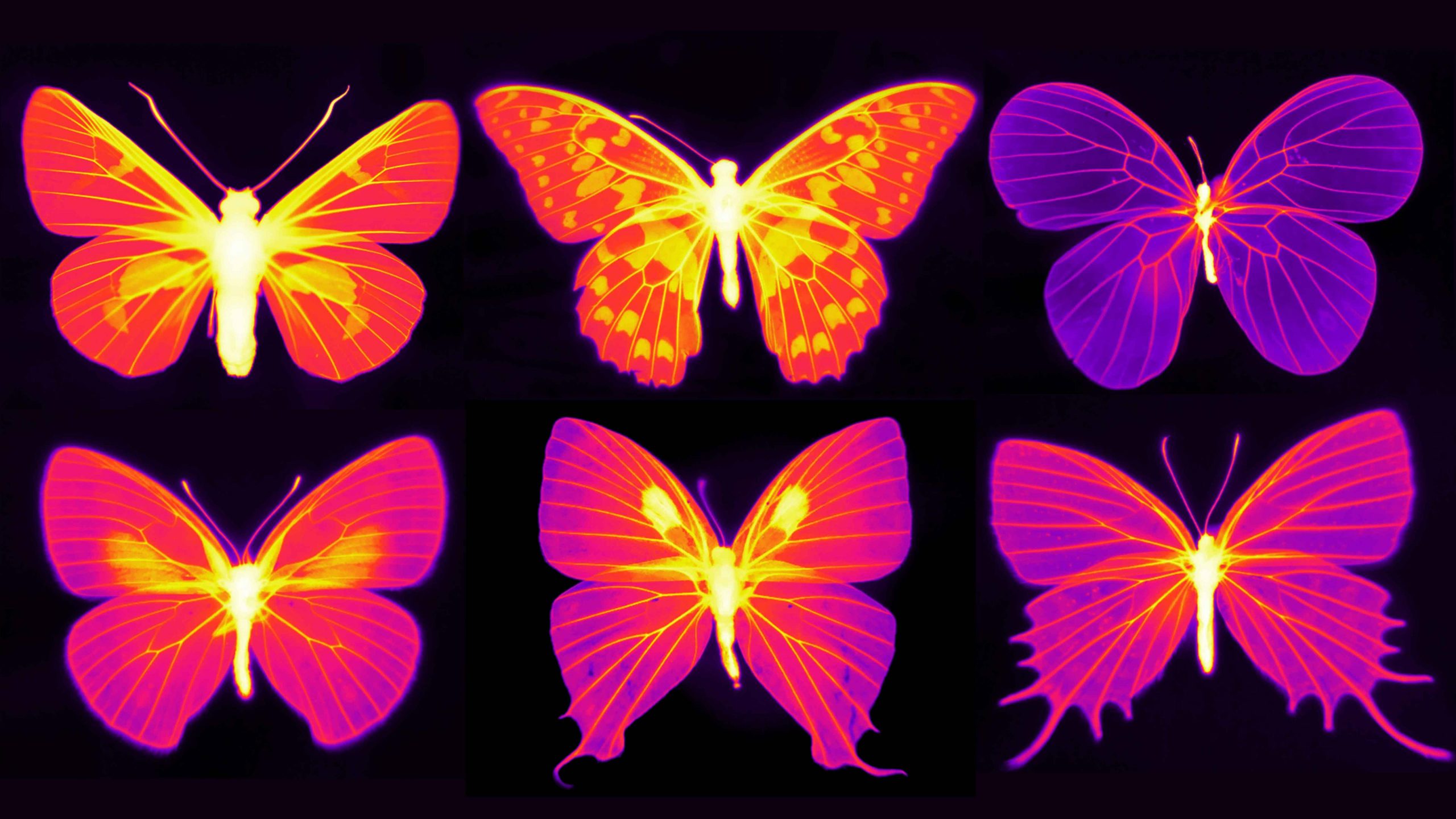
Infrared photographs of butterflies, where brightness correlates with the capability of radiative cooling. Credit: Nanfang Yu and Cheng-Chia Tsai/Columbia Engineering
Researchers discover that butterflies have specialized behaviors and wing scales to protect the living parts of their wings; nanostructures found in the wing scales could inspire the design of radiative-cooling materials to help manage excessive heat conditions; sensory network in the wings could inspire the design of advanced flying machines.
A new study from Columbia Engineering and Harvard identified the critical physiological importance of suitable temperatures for butterfly wings to function properly, and discovered that the insects exquisitely regulate their wing temperatures through both structural and behavioral adaptations.
Contrary to common belief that butterfly wings consist primarily of lifeless membranes, the new study demonstrated that they contain a network of living cells whose function requires a constrained range of temperatures for optimal performance. Given their small thermal capacity, wings can overheat rapidly in the sun when butterflies cease flight, and they can cool down too much during flight in a cold environment. The study, published online today (January 28, 2020) by Nature Communications, is the first to explore the implications of temperature in shaping the wing structure and behavior of butterflies.
