
| Date | 5th, Feb 2020 |
|---|
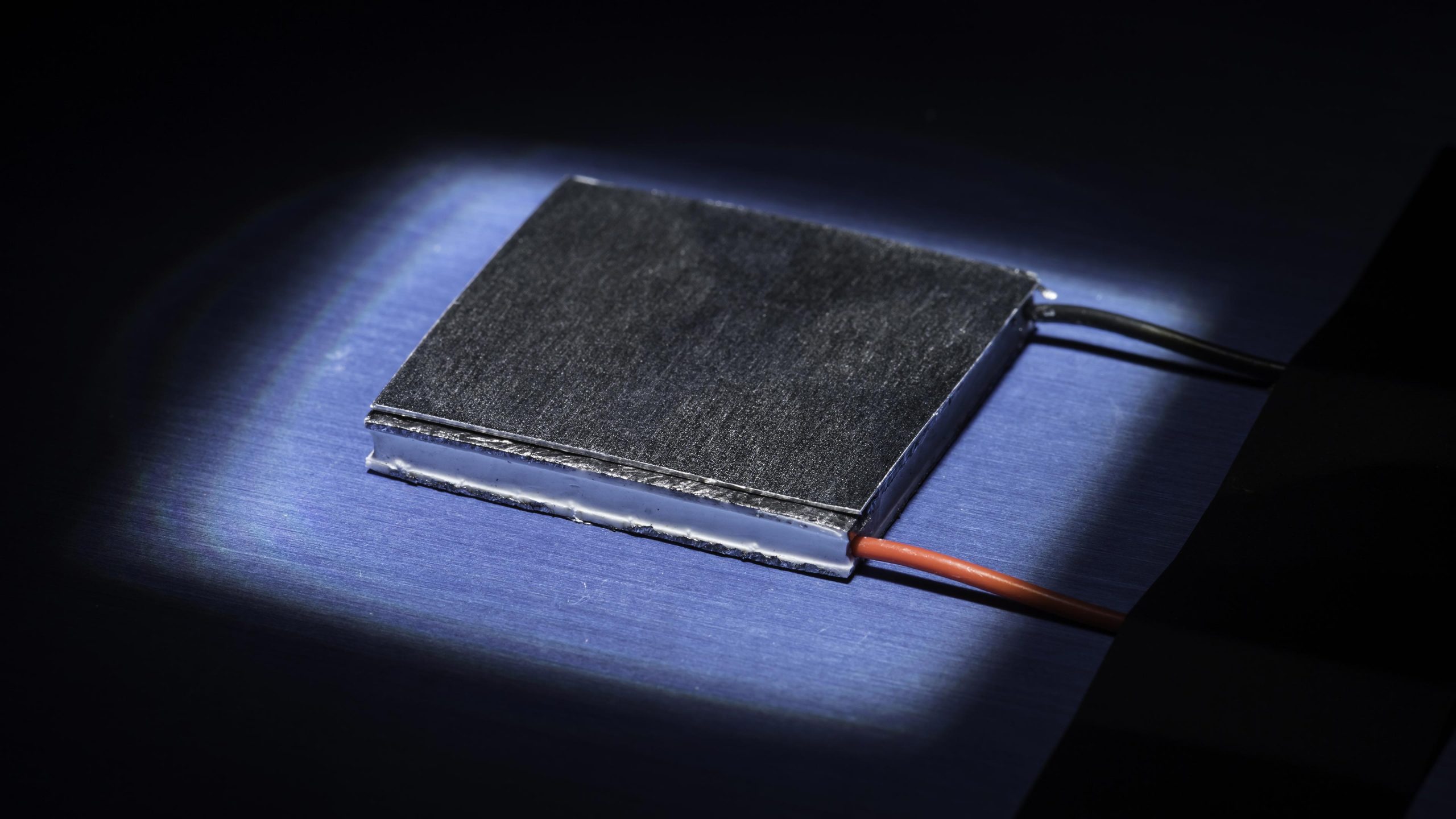
Using femto-second lasers to etch metallic structures, University of Rochester Institute of Optics professor Chunlei Guo and his team have developed a technique that can be used to collect sunlight to heat etched metal surfaces, which can then power an electrical generator for solar power. Credit: J. Adam Fenster/University of Rochester
The University of Rochester research lab that recently used lasers to create unsinkable metallic structures has now demonstrated how the same technology could be used to create highly efficient solar power generators.
In a paper published in Light: Science & Applications today (February 4, 2020), the lab of Chunlei Guo, professor of optics also affiliated with Physics and the Material Sciences Program, describes using powerful femto-second laser pulses to etch metal surfaces with nanoscale structures that selectively absorb light only at the solar wavelengths, but not elsewhere.
A regular metal surface is shiny and highly reflective. Years ago, the Guo lab developed a black metal technology that turned shiny metals pitch black. “But to make a perfect solar absorber,” Guo says, “We need more than a black metal and the result is this selective absorber.”
This surface not only enhances the energy absorption from sunlight, but also reduces heat dissipation at other wavelengths, in effect, “making a perfect metallic solar absorber for the first time,” Guo says. “We also demonstrate solar energy harnessing with a thermal electric generator device.”
“This will be useful for any thermal solar energy absorber or harvesting device,” particularly in places with abundant sunlight, he adds.
The work was funded by the Bill and Melinda Gates Foundation, the Army Research Office, and the National Science Foundation.
