
| Date | 15th, Feb 2020 |
|---|
Home > Press > Does graphene cause or prevent the corrosion of copper? New study finally settles the debate: Scientists in Korea are first to observe an unprecedented way in which graphene forms a hybrid layer that prevents copper corrosion
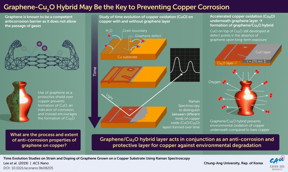 Scientists in Korea are first to observe an unprecedented way in which graphene forms a hybrid layer that prevents copper corrosion
CREDIT
Chung-Ang University
Scientists in Korea are first to observe an unprecedented way in which graphene forms a hybrid layer that prevents copper corrosion
CREDIT
Chung-Ang University
Abstract: Copper has been essential to human technology since its early days--it was even used to make tools and weapons in ancient times. It is widely used even today, especially in electronic devices that require wiring. But, a challenge with using copper is that its surface oxidizes over time, even under ambient conditions, ultimately leading to its corrosion. And thus, finding a long-term method to protect the exposed surfaces of copper is a valuable goal. One common way of protecting metal surfaces is by coating them with anti-corrosive substances. Graphene is studied extensively as a candidate for anti-corrosive coating, as it serves as a barrier to gas molecules. But, despite these properties, graphene sheets are seen to protect copper from corrosion only over short periods (less than 24 hours). In fact, surprisingly, after this initial period, graphene appears to increase the rate of copper corrosion, which is completely in contrast to its anti-corrosive nature.
Seoul, South Korea | Posted on February 14th, 2020
To shed light on the peculiar nature of graphene seen in copper, a research team from Chung-Ang University, Korea, led by Prof Hyungbin Son, studied graphene islands on a copper substrate to analyze the patterns of its corrosion. Prof Son explains, "Graphene is known to be mechanically very strong and impermeable to all gases, including hydrogen. Following studies claiming that the corrosion of copper substrates was accelerated under graphene through various defects, these properties have attracted great attention as an oxidation barrier for metals and have been controversial for over a decade. However, they have not been qualitatively investigated over longer time scales. Thus, we were motivated to study the role of graphene as a corrosion-resistant film at the graphene-copper interface." Prof Son and his team used Raman spectroscopy, scanning electron microscopy, and white light interferometry to observe the trends in copper corrosion for 30 days.
At first, the team detected corrosion developing at the edges, spreading the oxidized form of copper, copper oxide (Cu2O), at various defects such as edges, grain boundaries, and missing atoms. This resulted in the splitting of water vapor, supplying oxygen for the oxidation process, until the entire barrier seemed to be rendered useless and copper was fully corroded underneath. Owing to graphene's effect on ambient water vapor, the protected portion of the copper substrate was more corroded than the unprotected portion. Over time, the formation of Cu2O underneath the graphene sheet dispersed the strain and caused p-doping in graphene--creating a hybrid-like structure. But, after 13 days of exposure to ambient conditions, the team discovered something new. They observed that that the corrosion had significantly slowed down where a new hybrid of graphene and Cu2O layer had formed. Meanwhile, the unprotected copper continued to corrode at a consistent rate, until it had penetrated far deeper than the corrosion under the graphene shield.
These findings show that graphene, in fact, protects copper from deep, penetrating oxidation, unlike what previous studies had concluded. Prof Son explained, "We observed that over a longer time scale (more than 1 year), the graphene-Cu2O hybrid structure became a protective layer against oxidation. The area beyond the graphene was heavily oxidized with CuO, with a depth of ?270 nm."
This study has finally managed to settle the debate on whether graphene can be used to protect copper against oxidation. Prof Son concludes, "For nearly a decade, graphene's anti-corrosive properties have been controversial, with many studies suggesting that graphene accelerates the oxidation of copper (resulting in its corrosion). We have shown for the first time that the graphene-Cu2O hybrid structure, which forms over a long period, significantly slows down the oxidation of copper in the long term, as compared to bare copper."
Only time will reveal more about further applications of graphene as an anti-corrosive material. But one thing is certain--this research has potentially taken down several barriers in using graphene to extend the life of copper.
####
About Chung-Ang UniversityChung-Ang University is a private comprehensive research university located in Seoul, South Korea. It was started as a kindergarten in 1918 and attained university status in 1953. It is fully accredited by the Ministry of Education of Korea. Chung-Ang University conducts research activities under the slogan of "Justice and Truth." Its new vision for completing 100 years is "The Global Creative Leader." Chung-Ang University offers undergraduate, postgraduate, and doctoral programs, which encompass a law school, management program, and medical school; it has 16 undergraduate and graduate schools each. Chung-Ang University's culture and arts programs are considered the best in Korea.
Website: https://neweng.cau.ac.kr/index.do
About Prof Hyungbin Son from Chung-Ang University
Dr Hyungbin Son is a Professor at the Nano-optics Lab, School of Integrative Engineering at Chung-Ang University, Republic of Korea. He has conducted various studies on the physical properties and uses of graphene in different areas, including material physics and medicine. Prof Son has over 30 research publications to his credit, with over 100 citations between 2013 and 2019. His main research interests include optical characterization of two-dimensional materials, stem cells, and lithium-ion batteries.
For more information, please click here
Copyright © Chung-Ang University
If you have a comment, please Contact us.
Issuers of news releases, not 7th Wave, Inc. or Nanotechnology Now, are solely responsible for the accuracy of the content.
Bookmark:


News and information
 Two opposing approaches could give lithium-sulfur batteries a leg up over lithium-ion July 1st, 2022
Efficiently processing high-quality periodic nanostructures with ultrafast laser July 1st, 2022
Photonic synapses with low power consumption and high sensitivity are expected to integrate sensing-memory-preprocessing capabilities July 1st, 2022
Graphene/ Graphite
OCSiAl expands its graphene nanotube production capacities to Europe June 17th, 2022
Bumps could smooth quantum investigations: Rice University models show unique properties of 2D materials stressed by contoured substrates June 10th, 2022
Nanotubes: a promising solution for advanced rubber cables with 60% less conductive filler June 1st, 2022
Dynamic metasurfaces and metadevices empowered by graphene May 6th, 2022
Possible Futures
Sieving carbons: Ideal anodes for high-energy sodium-ion batteries July 1st, 2022
An artificial intelligence probe help see tumor malignancy July 1st, 2022
Photon-controlled diode: an optoelectronic device with a new signal processing behavior July 1st, 2022
Discoveries
Sieving carbons: Ideal anodes for high-energy sodium-ion batteries July 1st, 2022
Efficiently processing high-quality periodic nanostructures with ultrafast laser July 1st, 2022
Photonic synapses with low power consumption and high sensitivity are expected to integrate sensing-memory-preprocessing capabilities July 1st, 2022
Materials/Metamaterials
New protocol for assessing the safety of nanomaterials July 1st, 2022
Nanotubes: a promising solution for advanced rubber cables with 60% less conductive filler June 1st, 2022
New route to build materials out of tiny particles May 27th, 2022
A one-stop shop for quantum sensing materials May 27th, 2022
Announcements
Two opposing approaches could give lithium-sulfur batteries a leg up over lithium-ion July 1st, 2022
Efficiently processing high-quality periodic nanostructures with ultrafast laser July 1st, 2022
Photonic synapses with low power consumption and high sensitivity are expected to integrate sensing-memory-preprocessing capabilities July 1st, 2022
Interviews/Book Reviews/Essays/Reports/Podcasts/Journals/White papers/Posters
Sieving carbons: Ideal anodes for high-energy sodium-ion batteries July 1st, 2022
An artificial intelligence probe help see tumor malignancy July 1st, 2022
Photon-controlled diode: an optoelectronic device with a new signal processing behavior July 1st, 2022
