
| Date | 15th, Feb 2020 |
|---|
Home > Press > Gold nanoclusters: new frontier for developing medication for treatment of Alzheimer's disease
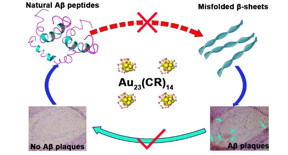 Au23(CR)14 Nanocluster functions in multiple stages of the progression from Aβ monomer to Aβ plaques.
CREDIT
�Science China Press
Au23(CR)14 Nanocluster functions in multiple stages of the progression from Aβ monomer to Aβ plaques.
CREDIT
�Science China Press
Abstract: Alzheimer's disease (AD) is a progressive neurodegenerative disorder characterized by amyloid-β (Aβ) fibrillation and plaque formation. While more than 50 millions of people are devastated by AD, no treatment is available. Recently, anti-Aβ antibody-based immunotherapy has failed in clinical trials, partially due to the increased cytotoxicity of soluble Aβ oligomers. Therefore, developing a medication for AD treatment becomes an even more grave challenge.
Beijing, China | Posted on February 14th, 2020
In a new research article published in the Beijing-based National Science Review, scientists at the State Key Laboratory of Advanced Technology for Materials Synthesis and Processing, Wuhan University of Technology in China explored the possibility of treating with gold nanoclusters.
As illustrated in Figure 1, Au23(CR)14, a novel gold nanocluster modified with Cys-Arg (CR) dipeptide, functions in multiple stages of the progression from Aβ monomer to Aβ plaques: inhibiting the misfolding and fibrillation of amyloid-β (Aβ), fully dissolving the preformed/mature Aβ fibrils and restoring the conformation of Aβ peptides from misfolded β-sheets into unfolded monomer state with abolished cytotoxicity, and more importantly, completely dissolving endogenous Aβ plaques in the brain slices from transgenic AD model mice. Furthermore, Au23(CR)14 has good biocompatibility and infiltration ability across the blood brain barrier (BBB).
This article not only presents a compelling nanotherapeutic candidate for AD treatment, but also opens a new frontier for developing nanomaterial-based medications for AD treatment. Undoubtedly, more researches studying the basic mechanisms by which gold nanoclusters dissolve Aβ plaques will spur the development of new medications for AD treatment.
###
This research received funding from the National Natural Science Foundation of China (21975191, 21805218, 51873168, 81803515, 51533007 and 51521001) and the Natural Science Foundation of Hubei Province (2018CFA002 and 2018CFB348).
####
About Science China PressThe National Science Review is the first comprehensive scholarly journal released in English in China that is aimed at linking the country's rapidly advancing community of scientists with the global frontiers of science and technology. The journal also aims to shine a worldwide spotlight on scientific research advances across China.
For more information, please click here
Contacts:Taolei Sun
Copyright © Science China Press
If you have a comment, please Contact us.
Issuers of news releases, not 7th Wave, Inc. or Nanotechnology Now, are solely responsible for the accuracy of the content.
Bookmark:


News and information
 Two opposing approaches could give lithium-sulfur batteries a leg up over lithium-ion July 1st, 2022
Efficiently processing high-quality periodic nanostructures with ultrafast laser July 1st, 2022
Photonic synapses with low power consumption and high sensitivity are expected to integrate sensing-memory-preprocessing capabilities July 1st, 2022
Possible Futures
Sieving carbons: Ideal anodes for high-energy sodium-ion batteries July 1st, 2022
An artificial intelligence probe help see tumor malignancy July 1st, 2022
Photon-controlled diode: an optoelectronic device with a new signal processing behavior July 1st, 2022
Nanomedicine
An artificial intelligence probe help see tumor malignancy July 1st, 2022
New technology helps reveal inner workings of human genome June 24th, 2022
Discoveries
Sieving carbons: Ideal anodes for high-energy sodium-ion batteries July 1st, 2022
Efficiently processing high-quality periodic nanostructures with ultrafast laser July 1st, 2022
Photonic synapses with low power consumption and high sensitivity are expected to integrate sensing-memory-preprocessing capabilities July 1st, 2022
Announcements
Two opposing approaches could give lithium-sulfur batteries a leg up over lithium-ion July 1st, 2022
Efficiently processing high-quality periodic nanostructures with ultrafast laser July 1st, 2022
Photonic synapses with low power consumption and high sensitivity are expected to integrate sensing-memory-preprocessing capabilities July 1st, 2022
Interviews/Book Reviews/Essays/Reports/Podcasts/Journals/White papers/Posters
Sieving carbons: Ideal anodes for high-energy sodium-ion batteries July 1st, 2022
An artificial intelligence probe help see tumor malignancy July 1st, 2022
Photon-controlled diode: an optoelectronic device with a new signal processing behavior July 1st, 2022
Nanobiotechnology
New technology helps reveal inner workings of human genome June 24th, 2022
