
| Date | 16th, Feb 2020 |
|---|
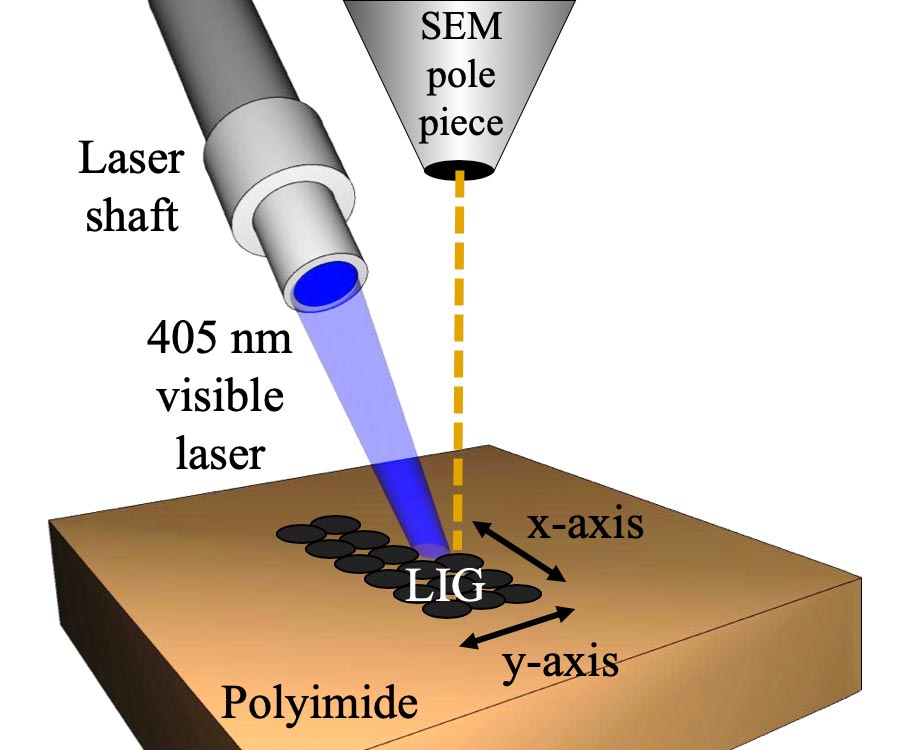
Scientists recorded the formation of laser-induced graphene made with a small laser mounted to a scanning electron microscope. Credit: Tour Group/Rice University
You don’t need a big laser to make laser-induced graphene (LIG). Scientists at Rice University, the University of Tennessee, Knoxville (UT Knoxville) and Oak Ridge National Laboratory (ORNL) are using a very small visible beam to burn the foamy form of carbon into microscopic patterns.
The labs of Rice chemist James Tour, which discovered the original method to turn a common polymer into graphene in 2014, and Tennessee/ORNL materials scientist Philip Rack revealed they can now watch the conductive material form as it makes small traces of LIG in a scanning electron microscope (SEM).
The altered process, detailed in the American Chemical Society’s ACS Applied Materials & Interfaces, creates LIG with features more than 60% smaller than the macro version and almost 10 times smaller than typically achieved with the former infrared laser.
