
| Date | 21st, Feb 2020 |
|---|
Home > Press > Researchers show what drives a novel, ordered assembly of alternating peptides
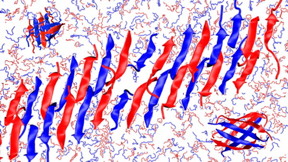 It's well established that peptides can self-assemble into nanofibers composed of beta-sheets. However, that self-assembly has previously involved identical copies of the same molecule -- molecule A connects to another molecule A. New work proves not only that alternating peptides can create these beta sheets -- in an ABAB pattern -- but why it happens. This image is an adaptation of computer simulation of the CATCH(+) and CATCH(-) mixture of peptides.
CREDIT
Greg Hudalla
It's well established that peptides can self-assemble into nanofibers composed of beta-sheets. However, that self-assembly has previously involved identical copies of the same molecule -- molecule A connects to another molecule A. New work proves not only that alternating peptides can create these beta sheets -- in an ABAB pattern -- but why it happens. This image is an adaptation of computer simulation of the CATCH(+) and CATCH(-) mixture of peptides.
CREDIT
Greg Hudalla
Abstract: A team of researchers has verified that it is possible to engineer two-layered nanofibers consisting of an ordered row of alternating peptides, and has also determined what makes these peptides automatically assemble into this pattern. The fundamental discovery raises the possibility of creating tailored "ABAB" peptide nanofibers with a variety of biomedical applications.
Raleigh, NC | Posted on February 20th, 2020
Peptides are small proteins, made up of short strands of amino acids. It's well established that peptides can self-assemble into nanofibers composed of beta-sheets. However, that self-assembly normally involves identical copies of the same molecule - molecule A connects to another molecule A.
The new work proves not only that alternating peptides can create these beta sheets - in an ABAB pattern - but why it happens.
"Our team drew on computational simulations, nuclear magnetic resonance (NMR) observations and experimental approaches for this work, and we now know what drives the creation of these alternating peptide structures," says Carol Hall, corresponding author of a paper on the work and Camille Dreyfus Distinguished University Professor of Chemical and Biomolecular Engineering at North Carolina State University.
"This is important because once you understand why peptides in these ABAB structures are behaving in this way, you can develop more of them," Hall says.
For this study, researchers worked with a pair of peptides called CATCH(+) and CATCH(-). When introduced into a solution, the peptides array themselves in a row, alternating the two peptides. The peptides also assemble in two beta-sheet layers per nanofiber.
The study itself involved three components. Greg Hudalla's lab at the University of Florida created the peptides, facilitated the co-assembly of the peptide beta sheets and performed experimental work that provided an overview of the system and its behavior. Hudalla co-authored the paper and is an associate professor in UF's J. Crayton Pruitt Family Department of Biomedical Engineering.
Meanwhile, Anant Paravastu's team at Georgia Tech used solid-state NMR to measure the precise relative positions of atoms and molecules in the ABAB peptide beta-sheets. Paravastu co-authored the paper and is an associate professor in Georgia Tech's School of Chemical and Biomolecular Engineering.
Lastly, Hall's team at NC State conducted computational simulations to determine what was driving the behavior seen by the researchers at UF and Georgia Tech.
There appear to be multiple forces at play in guiding the assembly of the alternating peptide structures. One of the two types of peptide is negatively charged, while the second type is positively charged. Because positive and negative attract each other, while peptides of the same charge repel each other, this leads to the alternating order of peptides in the strand.
Another aspect of the system's organization, the stacking, is driven by the types of amino acids in each peptide. Specifically, some of the amino acids in each peptide are hydrophobic, while others are hydrophilic. The hydrophobic amino acids, in effect, want to stick to each other, which results in the two-layer "stacking" effect seen in the beta-sheets.
"It is important that different forces balance to produce the target structure," Hall says. "If any one of the molecular forces is too strong or too weak, the molecules may never dissolve in water or may fail to recognize their intended partners. Rather than an ordered nanostructure, the molecules could form a disorganized mess, or no structure at all."
"We're interested in this because it gives us a glimpse into the fundamental nature of how these systems can work," Hudalla says. "We're not aware of any similar co-assembling systems in nature that resemble the system we've made here.
"Co-assembling peptide systems hold promise for biomedical applications because we can attach proteins to the A or B peptides that have some specific utility. For example, we could create a peptide scaffold that holds a regular array of enzymes, and those enzymes could serve as catalysts for influencing body chemistry in localized areas."
"The structures we're making here are impressive, but they are still not as precise and complex as biological structures that we see in nature," Paravastu says. "By the same token, we're not aware of natural structures that contain this alternating peptide structure. This is a good start. We are excited to see where it goes."
"This work would not have been possible without drawing on the diverse areas of expertise in this research group," Hall says.
####
For more information, please click here
Contacts:Matt Shipman
919-515-6386
@NCStateNews
Copyright © North Carolina State University
If you have a comment, please Contact us.
Issuers of news releases, not 7th Wave, Inc. or Nanotechnology Now, are solely responsible for the accuracy of the content.
Bookmark:


News and information
 Two opposing approaches could give lithium-sulfur batteries a leg up over lithium-ion July 1st, 2022
Efficiently processing high-quality periodic nanostructures with ultrafast laser July 1st, 2022
Photonic synapses with low power consumption and high sensitivity are expected to integrate sensing-memory-preprocessing capabilities July 1st, 2022
Govt.-Legislation/Regulation/Funding/Policy
Solving the solar energy storage problem with rechargeable batteries that can convert and store energy at once June 24th, 2022
Boron nitride nanotube fibers get real: Rice lab creates first heat-tolerant, stable fibers from wet-spinning process June 24th, 2022
UBCO researchers change the game when it comes to activity tracking: Flexible, highly sensitive motion device created by extrusion printing June 17th, 2022
University of Illinois Chicago joins Brookhaven Lab's Quantum Center June 10th, 2022
Possible Futures
Sieving carbons: Ideal anodes for high-energy sodium-ion batteries July 1st, 2022
An artificial intelligence probe help see tumor malignancy July 1st, 2022
Photon-controlled diode: an optoelectronic device with a new signal processing behavior July 1st, 2022
Self Assembly
Nanoclusters self-organize into centimeter-scale hierarchical assemblies April 22nd, 2022
Atom by atom: building precise smaller nanoparticles with templates March 4th, 2022
Nanostructures get complex with electron equivalents: Nanoparticles of two different sizes break away from symmetrical designs January 14th, 2022
Discoveries
Sieving carbons: Ideal anodes for high-energy sodium-ion batteries July 1st, 2022
Efficiently processing high-quality periodic nanostructures with ultrafast laser July 1st, 2022
Photonic synapses with low power consumption and high sensitivity are expected to integrate sensing-memory-preprocessing capabilities July 1st, 2022
Interviews/Book Reviews/Essays/Reports/Podcasts/Journals/White papers/Posters
Sieving carbons: Ideal anodes for high-energy sodium-ion batteries July 1st, 2022
An artificial intelligence probe help see tumor malignancy July 1st, 2022
Photon-controlled diode: an optoelectronic device with a new signal processing behavior July 1st, 2022
