
| Date | 28th, Feb 2020 |
|---|
Home > Press > New study explains why superconductivity takes place in graphene: Theoretical physicists take important step in development of high temperature superconductors
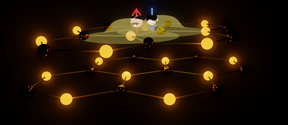 Artist's view of bilayer graphene. Antti Paraoanu.
Abstract: Graphene, a single sheet of carbon atoms, has many extreme electrical and mechanical properties. Two years ago, researchers showed how two sheets laid on top of each other and twisted at just the right angle can become superconducting, so that the material loses its electrical resistivity. New work explains why this superconductivity happens in a surprisingly high temperature.
Aalto, Finland | Posted on February 28th, 2020
Researchers at Aalto University and the University of Jyv�skyl� showed that graphene can be a superconductor at a much higher temperature than expected, due to a subtle quantum mechanics effect of graphene's electrons. The results were published in Physical Review B. The findings were highlighted in Physics viewpoint by the American Physical Society, and looks set to spark lively discussion in the physics community.
The discovery of the superconducting state in twisted bilayer graphene was selected as the Physics breakthrough of the year 2018 by the Physics World magazine, and it spurred an intense debate among physicist about the origin of superconductivity in graphene. Although superconductivity was found only at a few degrees above the absolute zero of temperature, uncovering its origin could help understanding high-temperature superconductors and allow us to produce superconductors that operate near room temperature. Such a discovery has been considered one of the "holy grails" of physics, as it would allow operating computers with radically smaller energy consumption than today.
The new work came from a collaboration between P�ivi T�rm�'s group at Aalto University and Tero Heikkil�'s group at the University of Jyv�skyl�. Both have studied the types of unusual superconductivity most likely found in graphene for several years.
"The geometric effect of the wave functions on superconductivity was discovered and studied in my group in several model systems. In this project it was exciting to see how these studies link to real materials", says the main author of the work, Aleksi Julku from Aalto University. "Besides showing the relevance of the geometric effect of the wave functions, our theory also predicts a number of observations that the experimentalists can check", explains Teemu Peltonen from the University of Jyv�skyl�.
####
For more information, please click here
Contacts:P�ivi T�rm�
358-503-826-770
@aaltouniversity
Copyright © Aalto University
If you have a comment, please Contact us.
Issuers of news releases, not 7th Wave, Inc. or Nanotechnology Now, are solely responsible for the accuracy of the content.
Bookmark:


News and information
 Two opposing approaches could give lithium-sulfur batteries a leg up over lithium-ion July 1st, 2022
Efficiently processing high-quality periodic nanostructures with ultrafast laser July 1st, 2022
Photonic synapses with low power consumption and high sensitivity are expected to integrate sensing-memory-preprocessing capabilities July 1st, 2022
2 Dimensional Materials
Controlled synthesis of crystal flakes paves path for advanced future electronics June 17th, 2022
Solving the puzzle of 2D disorder: An interdisciplinary team developed a new method to characterize disorder in 2D materials June 17th, 2022
UBCO researchers change the game when it comes to activity tracking: Flexible, highly sensitive motion device created by extrusion printing June 17th, 2022
Bumps could smooth quantum investigations: Rice University models show unique properties of 2D materials stressed by contoured substrates June 10th, 2022
Graphene/ Graphite
OCSiAl expands its graphene nanotube production capacities to Europe June 17th, 2022
Bumps could smooth quantum investigations: Rice University models show unique properties of 2D materials stressed by contoured substrates June 10th, 2022
Nanotubes: a promising solution for advanced rubber cables with 60% less conductive filler June 1st, 2022
Dynamic metasurfaces and metadevices empowered by graphene May 6th, 2022
Superconductivity
A new step in the search for room-temperature superconductors May 27th, 2022
Possible Futures
Sieving carbons: Ideal anodes for high-energy sodium-ion batteries July 1st, 2022
An artificial intelligence probe help see tumor malignancy July 1st, 2022
Photon-controlled diode: an optoelectronic device with a new signal processing behavior July 1st, 2022
Discoveries
Sieving carbons: Ideal anodes for high-energy sodium-ion batteries July 1st, 2022
Efficiently processing high-quality periodic nanostructures with ultrafast laser July 1st, 2022
Photonic synapses with low power consumption and high sensitivity are expected to integrate sensing-memory-preprocessing capabilities July 1st, 2022
Announcements
Two opposing approaches could give lithium-sulfur batteries a leg up over lithium-ion July 1st, 2022
Efficiently processing high-quality periodic nanostructures with ultrafast laser July 1st, 2022
Photonic synapses with low power consumption and high sensitivity are expected to integrate sensing-memory-preprocessing capabilities July 1st, 2022
Interviews/Book Reviews/Essays/Reports/Podcasts/Journals/White papers/Posters
Sieving carbons: Ideal anodes for high-energy sodium-ion batteries July 1st, 2022
An artificial intelligence probe help see tumor malignancy July 1st, 2022
Photon-controlled diode: an optoelectronic device with a new signal processing behavior July 1st, 2022
