
| Date | 6th, Mar 2020 |
|---|
Home > Press > Tissue-digging nanodrills do just enough damage: Scientists advance case for use of molecular machines to treat skin diseases
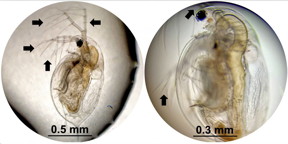 Daphnia, a species of plankton, were exposed to molecular machines developed at Rice University in lab experiments to determine the effects of the microscopic drills on tissue. At left is a healthy plankton with all of its appendages. At right, the daphnia has only two of its appendages after 10 minutes of exposure to light-activated nanomachines. The drills are intended to target drug-resistant bacteria, cancer and other disease-causing cells and destroy them without damaging adjacent healthy cells. (Credit: Alison Buck/Biola University)
Abstract: Molecule-sized drills do the damage they are designed to do. That�s bad news for disease.
Houston, TX | Posted on March 5th, 2020
Scientists at Rice University, Biola University and the Texas A&M Health Science Center have further validation that their molecular motors, light-activated rotors that spin up to 3 million times per second, can target diseased cells and kill them in minutes.
The team led by Biola molecular biochemist Richard Gunasekera and Rice chemist James Tour showed their motors are highly effective at destroying cells in three multicellular test organisms: worms, plankton and mice.
A study in the American Chemical Society journal ACS Applied Materials & Interfaces shows the motors caused various degrees of damage to tissues in all three species. The journal plans to designate the paper as an open-access ACS Editors� Choice.
The project�s original goal was to target drug-resistant bacteria, cancer and other disease-causing cells and destroy them without damaging adjacent healthy cells. Tour has argued cells and bacteria have no possible defense against a nanomechanical drilling force strong enough to punch through their walls.
�Now it has been taken to a whole new level,� Tour said. �The work here shows that whole organisms, such as small worms and water fleas, can be killed by nanomachines that drill into them. This is not just single-cell death, but whole organism, with cell death in the millions.
�They can also be used to drill into skin, thereby suggesting utility in the treatment of things like pre-melanoma,� he said.
The researchers saw different effects in each of the three models. In the worm, C. elegans, the fast motors caused rapid depigmentation as the motors first caused nanomechanical disruption of cells and tissues. In the plankton, Daphnia, the motors first dismembered exterior limbs. In both cases, after a few days, most or all of the organisms died.
For mouse models, researchers applied the nanomachines in a topical solution to the skin. Activating the fast motors caused lesions and ulcerations, demonstrating their ability to function in larger animals.
�That mouse skin changes due to the �drilling� by the nanomachines might be the one of most interesting aspects of the study to scientists,� said Gunasekera, an adjunct faculty member and former visiting scientist at Rice and currently associate dean and a professor of biochemistry at Biola. He is co-lead author of the paper with Thushara Galbadage, an associate professor of public health at Biola.
�It could mean direct topical treatment to skin conditions such as melanomas, eczema and other skin diseases,� Gunasekera said. �This paper is significant because it�s the first testing of nanomachines where we�ve proven its effectiveness in vivo. All other studies done so far were done in vitro.�
He suggested the motors could be used for therapeutic parasite control as well as local treatment of such diseases as skin cancer.
Co-authors of the paper are Ciceron Ayala-Orozco, an academic visitor at Rice and postdoctoral fellow at The University of Texas MD Anderson Cancer Center; Rice postdoctoral researchers Dongdong Liu and Victor Garc�a-L�pez; Rice alumnus Brian Troutman, a senior project engineer at Lockheed Martin; Rice academic visitor Josiah Tour; Robert Pal, a Royal Society University Research Fellow at Durham (U.K.) University; Sunil Krishnan, a professor of radiation oncology at MD Anderson, and Jeffrey Cirillo, a Regents� Professor and director of Texas A&M�s Center for Airborne Pathogen Research and Tuberculosis Imaging. Tour is the T.T. and W.F. Chao Chair in Chemistry as well as a professor of computer science and of materials science and nanoengineering at Rice.
The Discovery Institute, the Welch Foundation and the National Institutes of Health supported the research.
####
About Rice UniversityLocated on a 300-acre forested campus in Houston, Rice University is consistently ranked among the nation�s top 20 universities by U.S. News & World Report. Rice has highly respected schools of Architecture, Business, Continuing Studies, Engineering, Humanities, Music, Natural Sciences and Social Sciences and is home to the Baker Institute for Public Policy. With 3,962 undergraduates and 3,027 graduate students, Rice�s undergraduate student-to-faculty ratio is just under 6-to-1. Its residential college system builds close-knit communities and lifelong friendships, just one reason why Rice is ranked No. 1 for lots of race/class interaction and No. 4 for quality of life by the Princeton Review. Rice is also rated as a best value among private universities by Kiplinger�s Personal Finance.
Follow Rice News and Media Relations via Twitter @RiceUNews.
For more information, please click here
Contacts:Jeff Falk713-348-6775
Mike Williams713-348-6728
Copyright © Rice University
If you have a comment, please Contact us.
Issuers of news releases, not 7th Wave, Inc. or Nanotechnology Now, are solely responsible for the accuracy of the content.
Bookmark:


 Motorized molecules drill through cells:
Wiess School of Natural Sciences:
News and information
Two opposing approaches could give lithium-sulfur batteries a leg up over lithium-ion July 1st, 2022
Efficiently processing high-quality periodic nanostructures with ultrafast laser July 1st, 2022
Photonic synapses with low power consumption and high sensitivity are expected to integrate sensing-memory-preprocessing capabilities July 1st, 2022
Govt.-Legislation/Regulation/Funding/Policy
Solving the solar energy storage problem with rechargeable batteries that can convert and store energy at once June 24th, 2022
Boron nitride nanotube fibers get real: Rice lab creates first heat-tolerant, stable fibers from wet-spinning process June 24th, 2022
UBCO researchers change the game when it comes to activity tracking: Flexible, highly sensitive motion device created by extrusion printing June 17th, 2022
University of Illinois Chicago joins Brookhaven Lab's Quantum Center June 10th, 2022
Possible Futures
Sieving carbons: Ideal anodes for high-energy sodium-ion batteries July 1st, 2022
An artificial intelligence probe help see tumor malignancy July 1st, 2022
Photon-controlled diode: an optoelectronic device with a new signal processing behavior July 1st, 2022
Nanomedicine
An artificial intelligence probe help see tumor malignancy July 1st, 2022
New technology helps reveal inner workings of human genome June 24th, 2022
Discoveries
Sieving carbons: Ideal anodes for high-energy sodium-ion batteries July 1st, 2022
Efficiently processing high-quality periodic nanostructures with ultrafast laser July 1st, 2022
Photonic synapses with low power consumption and high sensitivity are expected to integrate sensing-memory-preprocessing capabilities July 1st, 2022
Announcements
Two opposing approaches could give lithium-sulfur batteries a leg up over lithium-ion July 1st, 2022
Efficiently processing high-quality periodic nanostructures with ultrafast laser July 1st, 2022
Photonic synapses with low power consumption and high sensitivity are expected to integrate sensing-memory-preprocessing capabilities July 1st, 2022
Interviews/Book Reviews/Essays/Reports/Podcasts/Journals/White papers/Posters
Sieving carbons: Ideal anodes for high-energy sodium-ion batteries July 1st, 2022
An artificial intelligence probe help see tumor malignancy July 1st, 2022
Photon-controlled diode: an optoelectronic device with a new signal processing behavior July 1st, 2022
Grants/Sponsored Research/Awards/Scholarships/Gifts/Contests/Honors/Records
Solving the solar energy storage problem with rechargeable batteries that can convert and store energy at once June 24th, 2022
Boron nitride nanotube fibers get real: Rice lab creates first heat-tolerant, stable fibers from wet-spinning process June 24th, 2022
Nanobiotechnology
New technology helps reveal inner workings of human genome June 24th, 2022
