
| Date | 23rd, Mar 2020 |
|---|
Home > Press > Heterostructure and Q-factor engineering for low-threshold and persistent nanowire lasing
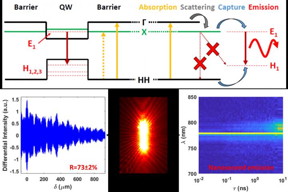 A novel direct-indirect heterostructures is designed, where lasing emission only occurs from quantum well regions but carriers are injected from indirect regions, where recombination is suppressed. This provides a continuous 'topping-up' of carrier density in the quantum well, causing nanosecond lasing after sub-picosecond excitation. Coupled with a mm-scale optical correlation length, corresponding to an end-facet reflectivity of over 70%, these two features provide record-low room-temperature lasing thresholds for near-infrared silicon-integratable nanowire lasers
CREDIT
by Stefan Skalsky, Yunyan Zhang, Juan Arturo Alanis, H. Aruni Fonseka, Ana M. Sanchez, Huiyun Liu and Patrick Parkinson
A novel direct-indirect heterostructures is designed, where lasing emission only occurs from quantum well regions but carriers are injected from indirect regions, where recombination is suppressed. This provides a continuous 'topping-up' of carrier density in the quantum well, causing nanosecond lasing after sub-picosecond excitation. Coupled with a mm-scale optical correlation length, corresponding to an end-facet reflectivity of over 70%, these two features provide record-low room-temperature lasing thresholds for near-infrared silicon-integratable nanowire lasers
CREDIT
by Stefan Skalsky, Yunyan Zhang, Juan Arturo Alanis, H. Aruni Fonseka, Ana M. Sanchez, Huiyun Liu and Patrick Parkinson
Abstract: Over the past decade, the idea of photonic computing - where electrons are replaced with light in microelectronic circuits - has emerged as a future technology. This promises low-cost, ultra-high-speed and potentially quantum-enhanced computing, with specific applications in high-efficiency machine learning and neuromorphic computing. While the computing elements and detectors have been developed, the need for nanoscale, high-density and easily-integrated light sources remains unmet. Semiconductor nanowires are seen as a potential candidate, due to their small size (on the order of the wavelength of light), the possibility for direct growth onto industry-standard silicon, and their use of established materials. However, to date, such nanowire lasers on silicon have not been demonstrated to operate continuously at room temperature.
Changchun, China | Posted on March 22nd, 2020
In a new paper published in Light Science & Application, scientists from the Photon Science Institute in Manchester, UK with colleagues at University College London and the University of Warwick demonstrate a new route to achieving low-threshold silicon-integratable nanowire lasers. Based on a novel direct-indirect semiconductor heterostructures enabled by the nanowire platform, they demonstrate multi-nanosecond lasing at room temperature. A key design element is the need for high-reflectivity nanowire ends; this is typically a challenging requirement, as common growth methods do not allow simple optimization for high quality end-facets. However, in this study, by employing a novel time-gated interferometer the researchers demonstrate that the reflectivity can be over 70% - around double that expected for a conventional flat-ended laser due to the confinement of light.
Together, the novel material structure and high quality cavity contribute to a low lasing threshold - a measure of the power required to activate lasing in the nanowires - of just 6uJ/cm^2, orders of magnitude lower than previously demonstrated. Not only does this new approach provide high quality nanolasers, but the MBE growth provides a high-yield of functioning wires, with over 85% of nanowires tested working at full power without thermal damage. This high yield is critical for industrial integration of this new structure.
####
For more information, please click here
Contacts:Patrick Parkinson
Copyright © Changchun Institute of Optics, Fine Mechanics and Physics, Chinese Academy of Sciences
If you have a comment, please Contact us.
Issuers of news releases, not 7th Wave, Inc. or Nanotechnology Now, are solely responsible for the accuracy of the content.
Bookmark:


News and information
 New technology helps reveal inner workings of human genome June 24th, 2022
Boron nitride nanotube fibers get real: Rice lab creates first heat-tolerant, stable fibers from wet-spinning process June 24th, 2022
Govt.-Legislation/Regulation/Funding/Policy
Solving the solar energy storage problem with rechargeable batteries that can convert and store energy at once June 24th, 2022
Boron nitride nanotube fibers get real: Rice lab creates first heat-tolerant, stable fibers from wet-spinning process June 24th, 2022
UBCO researchers change the game when it comes to activity tracking: Flexible, highly sensitive motion device created by extrusion printing June 17th, 2022
University of Illinois Chicago joins Brookhaven Lab's Quantum Center June 10th, 2022
Possible Futures
New technology helps reveal inner workings of human genome June 24th, 2022
Boron nitride nanotube fibers get real: Rice lab creates first heat-tolerant, stable fibers from wet-spinning process June 24th, 2022
Chip Technology
Boron nitride nanotube fibers get real: Rice lab creates first heat-tolerant, stable fibers from wet-spinning process June 24th, 2022
Controlled synthesis of crystal flakes paves path for advanced future electronics June 17th, 2022
Optical computing/Photonic computing
Photonic integrated erbium doped amplifiers reach commercial performance: Boosting light power revolutionizes communications and autopilots June 17th, 2022
Electron-phonon coupling assisted universal red luminescence of o-phenylenediamine-based CDs June 10th, 2022
Discoveries
New technology helps reveal inner workings of human genome June 24th, 2022
Boron nitride nanotube fibers get real: Rice lab creates first heat-tolerant, stable fibers from wet-spinning process June 24th, 2022
Announcements
New technology helps reveal inner workings of human genome June 24th, 2022
Boron nitride nanotube fibers get real: Rice lab creates first heat-tolerant, stable fibers from wet-spinning process June 24th, 2022
Interviews/Book Reviews/Essays/Reports/Podcasts/Journals/White papers/Posters
Quantum network nodes with warm atoms June 24th, 2022
New technology helps reveal inner workings of human genome June 24th, 2022
Grants/Sponsored Research/Awards/Scholarships/Gifts/Contests/Honors/Records
Solving the solar energy storage problem with rechargeable batteries that can convert and store energy at once June 24th, 2022
Boron nitride nanotube fibers get real: Rice lab creates first heat-tolerant, stable fibers from wet-spinning process June 24th, 2022
Photonics/Optics/Lasers
Photonic integrated erbium doped amplifiers reach commercial performance: Boosting light power revolutionizes communications and autopilots June 17th, 2022
Marching to the Cadence of Electronics: Innovation A new paper in Nature validates technology developed by John Bowers and collaborators June 10th, 2022
