
| Date | 24th, Mar 2020 |
|---|
Home > Press > A pigment from ancient Egypt to modern microscopy: G�ttingen research team produces new nanosheets for near infrared imaging
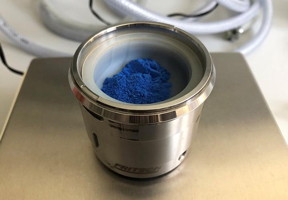 Egyptian blue: the researchers obtained the nanosheets from this powder.
CREDIT
University of Goettingen
Egyptian blue: the researchers obtained the nanosheets from this powder.
CREDIT
University of Goettingen
Abstract: Egyptian blue is one of the oldest manmade colour pigments. It adorns, for instance, the crown of the world famous bust of Nefertiti. But the pigment can do even more. An international research team led by Dr Sebastian Kruss from the Institute of Physical Chemistry at the University of G�ttingen has produced a new nanomaterial based on the Egyptian blue pigment, which is ideally suited for applications in imaging using near infrared spectroscopy and microscopy. The results have been published in the journal Nature Communications.
Groningen, the Netherlands | Posted on March 23rd, 2020
Microscopy and optical imaging are important tools in basic research and biomedicine. They use substances that can release light when excited. Known as "fluorophores", these substances are used to stain very small structures in samples, enabling clear resolution using modern microscopes. Most fluorophores shine in the range of light visible to humans. When using light in the near infrared spectrum, with a wavelength starting at 800 nanometres, light penetrates even deeper into tissue and there are fewer distortions to the image. So far, however, there are only a few known fluorophores that work in the near infrared spectrum.
The research team has now succeeded in exfoliating extremely thin layers from grains of calcium copper silicate, also known as Egyptian blue. These nanosheets are 100,000 times thinner than a human hair and fluoresce in the near infrared range. "We were able to show that even the smallest nanosheets are extremely stable, shine brightly and do not bleach," says Dr Sebastian Kruss, "making them ideal for optical imaging."
The scientists tested their idea for microscopy in animals and plants. For example, they followed the movement of individual nanosheets in order to visualise mechanical processes and the structure of the tissue around cell nuclei in the fruit fly. In addition, they integrated the nanosheets into plants and were able to identify them even without a microscope, which promises future applications in the agricultural industry. "The potential for state-of-the-art microscopy from this material means that new findings in biomedical research can be expected in the future," says Kruss.
###
The study involved scientists from the Institute of Physical Chemistry, the Third Institute of Physics, the Department of Developmental Biochemistry and the Institute of Geology as well as the Department of Dermatology, Venereology and Allergology of the University Medical Center G�ttingen and the University of California Riverside.
####
For more information, please click here
Contacts:Melissa Sollich
49-055-139-26228
Dr Sebastian KrussUniversity of G�ttingenFaculty of ChemistryInstitute for Physical ChemistryTammannstra�e 6, 37077 G�ttingen, GermanyTel: +49 (0)551 39-20936Twitter: @KrussLabEmail: http://www.uni-goettingen.de/en/499131.html
Copyright © University of Groningen
If you have a comment, please Contact us.
Issuers of news releases, not 7th Wave, Inc. or Nanotechnology Now, are solely responsible for the accuracy of the content.
Bookmark:


News and information
 New technology helps reveal inner workings of human genome June 24th, 2022
Boron nitride nanotube fibers get real: Rice lab creates first heat-tolerant, stable fibers from wet-spinning process June 24th, 2022
Imaging
Snapshot measurement of single nanostructure�s circular dichroism March 25th, 2022
Better understanding superconductors with Higgs spectroscopy Prof. Stefan Kaiser from TU Dresden awarded ERC Consolidator Grant March 18th, 2022
Visualizing the invisible: New fluorescent DNA label reveals nanoscopic cancer features March 4th, 2022
Possible Futures
New technology helps reveal inner workings of human genome June 24th, 2022
Boron nitride nanotube fibers get real: Rice lab creates first heat-tolerant, stable fibers from wet-spinning process June 24th, 2022
Discoveries
New technology helps reveal inner workings of human genome June 24th, 2022
Boron nitride nanotube fibers get real: Rice lab creates first heat-tolerant, stable fibers from wet-spinning process June 24th, 2022
Materials/Metamaterials
Nanotubes: a promising solution for advanced rubber cables with 60% less conductive filler June 1st, 2022
New route to build materials out of tiny particles May 27th, 2022
A one-stop shop for quantum sensing materials May 27th, 2022
Announcements
New technology helps reveal inner workings of human genome June 24th, 2022
Boron nitride nanotube fibers get real: Rice lab creates first heat-tolerant, stable fibers from wet-spinning process June 24th, 2022
Interviews/Book Reviews/Essays/Reports/Podcasts/Journals/White papers/Posters
Quantum network nodes with warm atoms June 24th, 2022
New technology helps reveal inner workings of human genome June 24th, 2022
Research partnerships
New technology helps reveal inner workings of human genome June 24th, 2022
Boron nitride nanotube fibers get real: Rice lab creates first heat-tolerant, stable fibers from wet-spinning process June 24th, 2022
