
| Date | 25th, Mar 2020 |
|---|
Home > Press > Electric jolt to carbon makes better water purifier
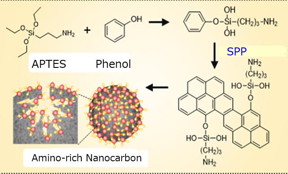 Synthesis process of nanocarbon adsorbent
CREDIT
Nagahiro Saito
Synthesis process of nanocarbon adsorbent
CREDIT
Nagahiro Saito
Abstract: Nagoya University scientists have developed a one-step fabrication process that improves the ability of nanocarbons to remove toxic heavy metal ions from water. The findings, published in the journal ACS Applied Nano Materials, could aid efforts to improve universal access to clean water.
Nagoya, Japan | Posted on March 24th, 2020
Various nanocarbons are being studied and used for purifying water and wastewater by adsorbing dyes, gases, organic compounds and toxic metal ions. These nanocarbons can adsorb heavy metal ions, like lead and mercury, onto their surfaces through molecular attraction forces. But this attraction is weak, and so they aren't very efficient adsorbents on their own.
To improve adsorption, scientists are considering adding molecules to the nanocarbons, like amino groups, that form stronger chemical bonds with heavy metals. They are also trying to find ways to use all available surfaces on nanocarbons for metal ion adsorption, including the surfaces of their inner pores. This would enhance their capacity to adsorb more metal ions at a time.
Materials scientist Nagahiro Saito of Nagoya University's Institute of Innovation for Future Society and colleagues developed a new method for synthesizing an "amino-modified nanocarbon" that more efficiently adsorbs several heavy metal ions compared to conventional methods.
They mixed phenol, as a source of carbon, with a compound called APTES, as a source of amino groups. This mixture was placed in a glass chamber and exposed to a high voltage, creating a plasma in liquid. The method they used, called "solution plasma process," was maintained for 20 minutes. Black precipitates of amino-modified carbons formed and were collected, washed and dried.
A variety of tests showed that amino groups had evenly distributed over the nanocarbon surface, including into its slit-like pores.
"Our single-step process facilitates the bonding of amino groups on both outer and inner surfaces of the porous nanocarbon," says Saito. "This drastically increased their adsorption capacity compared to a nanocarbon on its own."
They put the amino-modified nanocarbons through ten cycles of adsorbing copper, zinc and cadmium metal ions, washing them between each cycle. Although the capacity to adsorb metal ions decreased with repetitive cycles, the reduction was small, making them relatively stable for repetitive use.
Finally, the team compared their amino-modified nanocarbons with five others synthesized by conventional methods. Their nanocarbon had the highest adsorption capacity for the metal ions tested, indicating there are more amino groups on their nanocarbon than the others.
"Our process could help reduce the costs of water purification and bring us closer to achieving universal and equitable access to safe and affordable drinking water for all by 2030," says Saito.
####
About Nagoya UniversityNagoya University has a history of about 150 years, with its roots in a temporary medical school and hospital established in 1871, and was formally instituted as the last Imperial University of Japan in 1939. Although modest in size compared to the largest universities in Japan, Nagoya University has been pursuing excellence since its founding. Six of the 18 Japanese Nobel Prize-winners since 2000 did all or part of their Nobel Prize-winning work at Nagoya University: four in Physics - Toshihide Maskawa and Makoto Kobayashi in 2008, and Isamu Akasaki and Hiroshi Amano in 2014; and two in Chemistry - Ryoji Noyori in 2001 and Osamu Shimomura in 2008. In mathematics, Shigefumi Mori did his Fields Medal-winning work at the University. A number of other important discoveries have also been made at the University, including the Okazaki DNA Fragments by Reiji and Tsuneko Okazaki in the 1960s; and depletion forces by Sho Asakura and Fumio Oosawa in 1954.
For more information, please click here
Contacts:Nagahiro Saito
@NagoyaUniv
Copyright © Nagoya University
If you have a comment, please Contact us.
Issuers of news releases, not 7th Wave, Inc. or Nanotechnology Now, are solely responsible for the accuracy of the content.
Bookmark:


News and information
 New technology helps reveal inner workings of human genome June 24th, 2022
Boron nitride nanotube fibers get real: Rice lab creates first heat-tolerant, stable fibers from wet-spinning process June 24th, 2022
Govt.-Legislation/Regulation/Funding/Policy
Solving the solar energy storage problem with rechargeable batteries that can convert and store energy at once June 24th, 2022
Boron nitride nanotube fibers get real: Rice lab creates first heat-tolerant, stable fibers from wet-spinning process June 24th, 2022
UBCO researchers change the game when it comes to activity tracking: Flexible, highly sensitive motion device created by extrusion printing June 17th, 2022
University of Illinois Chicago joins Brookhaven Lab's Quantum Center June 10th, 2022
Possible Futures
New technology helps reveal inner workings of human genome June 24th, 2022
Boron nitride nanotube fibers get real: Rice lab creates first heat-tolerant, stable fibers from wet-spinning process June 24th, 2022
Discoveries
New technology helps reveal inner workings of human genome June 24th, 2022
Boron nitride nanotube fibers get real: Rice lab creates first heat-tolerant, stable fibers from wet-spinning process June 24th, 2022
Announcements
New technology helps reveal inner workings of human genome June 24th, 2022
Boron nitride nanotube fibers get real: Rice lab creates first heat-tolerant, stable fibers from wet-spinning process June 24th, 2022
Interviews/Book Reviews/Essays/Reports/Podcasts/Journals/White papers/Posters
Quantum network nodes with warm atoms June 24th, 2022
New technology helps reveal inner workings of human genome June 24th, 2022
Environment
University of Strathclyde and National University of Singapore to co-ordinate satellite quantum communications May 13th, 2022
Lightening up the nanoscale long-wavelength optoelectronics May 13th, 2022
Water
Scientists offer solutions for risky tap water June 17th, 2022
UBCO researchers change the game when it comes to activity tracking: Flexible, highly sensitive motion device created by extrusion printing June 17th, 2022
Organic water splitters get a boost June 10th, 2022
Grants/Sponsored Research/Awards/Scholarships/Gifts/Contests/Honors/Records
Solving the solar energy storage problem with rechargeable batteries that can convert and store energy at once June 24th, 2022
Boron nitride nanotube fibers get real: Rice lab creates first heat-tolerant, stable fibers from wet-spinning process June 24th, 2022
