
Mar 25, 2020
(Nanowerk News) Terahertz (THz) waves fall between microwave and infrared radiation in the electromagnetic spectrum, oscillating at frequencies of between 100 billion and 30 trillion cycles per second. These waves are prized for their distinctive properties: they can penetrate paper, clothing, wood and walls, as well as detect air pollution. THz sources could revolutionize security and medical imaging systems. What's more, their ability to carry vast quantities of data could hold the key to faster wireless communications.
THz waves are a type of non-ionizing radiation, meaning they pose no risk to human health. The technology is already used in some airports to scan passengers and detect dangerous objects and substances.
Despite holding great promise, THz waves are not widely used because they are costly and cumbersome to generate. But new technology developed by researchers at EPFL could change all that. The team at the Power and Wide-band-gap Electronics Research Laboratory (POWERlab), led by Prof. Elison Matioli, built a nanodevice (1 nanometer = 1 millionth of a millimeter) that can generate extremely high-power signals in just a few picoseconds, or one trillionth of a second, - which produces high-power THz waves.
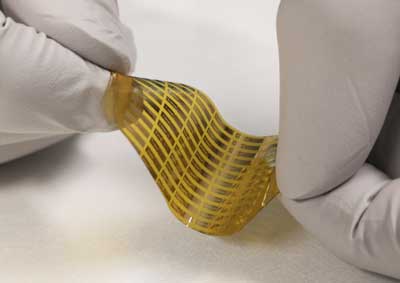 The nanoscale terahertz wave generator can be implemented on flexible substrates. (Image: EPFL / POWERlab)
The technology, which can be mounted on a chip or a flexible medium, could one day be installed in smartphones and other hand-held devices. The work first-authored by Mohammad Samizadeh Nikoo, a PhD student at the POWERlab, has been published in the journal Nature ("Nanoplasma-enabled picosecond switches for ultrafast electronics").
The nanoscale terahertz wave generator can be implemented on flexible substrates. (Image: EPFL / POWERlab)
The technology, which can be mounted on a chip or a flexible medium, could one day be installed in smartphones and other hand-held devices. The work first-authored by Mohammad Samizadeh Nikoo, a PhD student at the POWERlab, has been published in the journal Nature ("Nanoplasma-enabled picosecond switches for ultrafast electronics").
The nanoscale terahertz wave generator can be implemented on flexible substrates. (Image: EPFL / POWERlab)
The technology, which can be mounted on a chip or a flexible medium, could one day be installed in smartphones and other hand-held devices. The work first-authored by Mohammad Samizadeh Nikoo, a PhD student at the POWERlab, has been published in the journal Nature ("Nanoplasma-enabled picosecond switches for ultrafast electronics").
