
Apr 08, 2020
(Nanowerk News) In an effort to make highly sensitive sensors to measure sugar and other vital signs of human health, Iowa State University’s Sonal Padalkar figured out how to deposit nanomaterials on cloth and paper.
Feedback from a peer-reviewed paper (ACS Sustainable Chemistry and Engineering, "Cerium Oxide Based Glucose Biosensors: Influence of Morphology and Underlying Substrate on Biosensor Performance"), describing her new fabrication technology mentioned the metal-oxide nanomaterials the assistant professor of mechanical engineering was working with – including zinc oxide, cerium oxide and copper oxide, all at scales down to billionths of a meter – also have antimicrobial properties.
“I might as well see if I can do something else with this technology,” Padalkar said. “And that’s how I started studying antimicrobial uses.”
It turns out nanomaterials are rough on microbes such as bacteria. They actually puncture the cell walls of the single-cell microbes, causing leaks and ultimately death.
Put that on a cloth and you could have an effective, chemical-free disinfecting wipe.
 Here's a sample from Sonal Padalkar's lab: a carbon cloth coated with zinc oxide nanomaterials that are just billionths of a meter in size. Padalkar says the shape, size and density of the zinc oxide can be fine-tuned on the cloth. (Image: Sonal Padalkar) (click on image to enlarge)
“The implications of our present antimicrobial studies are enormous,” Padalkar said. “We can find applications in wide areas, including our everyday life to many very specific applications, like surgical units in hospitals.”
But does it work on tiny viruses, too?
More study is needed, Padalkar said. But, the mechanism would be the same – puncturing the protein coats of viruses to damage and kill the microbes.
Here's a sample from Sonal Padalkar's lab: a carbon cloth coated with zinc oxide nanomaterials that are just billionths of a meter in size. Padalkar says the shape, size and density of the zinc oxide can be fine-tuned on the cloth. (Image: Sonal Padalkar) (click on image to enlarge)
“The implications of our present antimicrobial studies are enormous,” Padalkar said. “We can find applications in wide areas, including our everyday life to many very specific applications, like surgical units in hospitals.”
But does it work on tiny viruses, too?
More study is needed, Padalkar said. But, the mechanism would be the same – puncturing the protein coats of viruses to damage and kill the microbes.
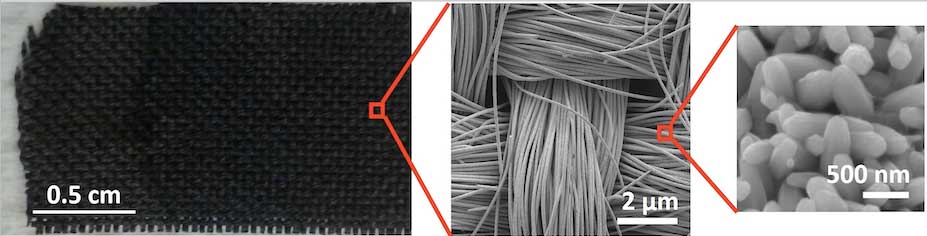 Here's a sample from Sonal Padalkar's lab: a carbon cloth coated with zinc oxide nanomaterials that are just billionths of a meter in size. Padalkar says the shape, size and density of the zinc oxide can be fine-tuned on the cloth. (Image: Sonal Padalkar) (click on image to enlarge)
“The implications of our present antimicrobial studies are enormous,” Padalkar said. “We can find applications in wide areas, including our everyday life to many very specific applications, like surgical units in hospitals.”
But does it work on tiny viruses, too?
More study is needed, Padalkar said. But, the mechanism would be the same – puncturing the protein coats of viruses to damage and kill the microbes.
Here's a sample from Sonal Padalkar's lab: a carbon cloth coated with zinc oxide nanomaterials that are just billionths of a meter in size. Padalkar says the shape, size and density of the zinc oxide can be fine-tuned on the cloth. (Image: Sonal Padalkar) (click on image to enlarge)
“The implications of our present antimicrobial studies are enormous,” Padalkar said. “We can find applications in wide areas, including our everyday life to many very specific applications, like surgical units in hospitals.”
But does it work on tiny viruses, too?
More study is needed, Padalkar said. But, the mechanism would be the same – puncturing the protein coats of viruses to damage and kill the microbes.
