
Apr 08, 2020
(Nanowerk News) Iron oxide nanoparticles coated with silica may seem like an unlikely player in enabling Norway to fight the coronavirus outbreak.
But it turns out these particles, when coated with silica, have a strong affinity for RNA, the genetic material inside the virus that causes COVID-19.
Researchers at the Norwegian University of Science and Technology (NTNU) in collaboration with St. Olavs Hospital are building on this affinity in developing a test method that uses the magnetic particles.
The problem for Norway and countries across the globe is that the reagents needed to test for COVID-19 are in short supply. In conventional tests, reagents are used to extract RNA from the virus so it can be identified, said Professor Magnar Bjørås at NTNU’s Department of Clinical and Molecular Medicine.
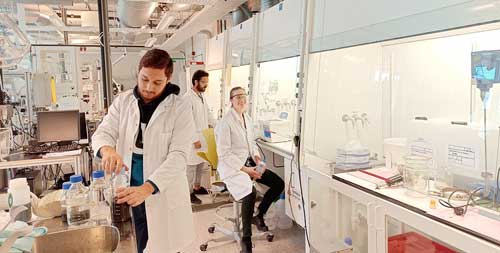 Gearing up to produce as many nanoparticles as possible for the COVID-19 test. The production operators for the team are Zeeshan Ali, Regina Lopez Fyllingsnes, Ahmad Bin Ashar and José Paulino Peris Sastre (missing). (Image: NTNU)
The new test uses the magnetic nanoparticles to extract RNA from a solution containing a sample from the patient. The solution contains substances that crack the virus open so that its genetic material can be extracted. RNA from the virus in the solution is strongly attracted to the silica-covered magnetic nanoparticles. The next step is to use a magnet to pull the RNA-covered particles out of the solution.
“We can then identify the genetic code from the RNA and compare it to the coronavirus,” Bjørås said. The researchers tested the accuracy of their method by running tests from patients in parallel with commercial tests. Bjørås said the new method is more sensitive than commercial tests.
Bjørås said the lab at NTNU’s Department of Chemical Engineering that is making the magnetic particles can make 30-40 000 tests a day, a rate that can be increased after Easter. The plan is to scale up to be able to produce a minimum of 150000 tests per week, he said. Robots can also help run parts of the test to speed up the testing process.
Gearing up to produce as many nanoparticles as possible for the COVID-19 test. The production operators for the team are Zeeshan Ali, Regina Lopez Fyllingsnes, Ahmad Bin Ashar and José Paulino Peris Sastre (missing). (Image: NTNU)
The new test uses the magnetic nanoparticles to extract RNA from a solution containing a sample from the patient. The solution contains substances that crack the virus open so that its genetic material can be extracted. RNA from the virus in the solution is strongly attracted to the silica-covered magnetic nanoparticles. The next step is to use a magnet to pull the RNA-covered particles out of the solution.
“We can then identify the genetic code from the RNA and compare it to the coronavirus,” Bjørås said. The researchers tested the accuracy of their method by running tests from patients in parallel with commercial tests. Bjørås said the new method is more sensitive than commercial tests.
Bjørås said the lab at NTNU’s Department of Chemical Engineering that is making the magnetic particles can make 30-40 000 tests a day, a rate that can be increased after Easter. The plan is to scale up to be able to produce a minimum of 150000 tests per week, he said. Robots can also help run parts of the test to speed up the testing process.
Gearing up to produce as many nanoparticles as possible for the COVID-19 test. The production operators for the team are Zeeshan Ali, Regina Lopez Fyllingsnes, Ahmad Bin Ashar and José Paulino Peris Sastre (missing). (Image: NTNU)
The new test uses the magnetic nanoparticles to extract RNA from a solution containing a sample from the patient. The solution contains substances that crack the virus open so that its genetic material can be extracted. RNA from the virus in the solution is strongly attracted to the silica-covered magnetic nanoparticles. The next step is to use a magnet to pull the RNA-covered particles out of the solution.
“We can then identify the genetic code from the RNA and compare it to the coronavirus,” Bjørås said. The researchers tested the accuracy of their method by running tests from patients in parallel with commercial tests. Bjørås said the new method is more sensitive than commercial tests.
Bjørås said the lab at NTNU’s Department of Chemical Engineering that is making the magnetic particles can make 30-40 000 tests a day, a rate that can be increased after Easter. The plan is to scale up to be able to produce a minimum of 150000 tests per week, he said. Robots can also help run parts of the test to speed up the testing process.
