
Apr 08, 2020
(Nanowerk News) For years, scientists have looked for ways to cool molecules down to ultracold temperatures, at which point the molecules should slow to a crawl, allowing scientists to precisely control their quantum behavior. This could enable researchers to use molecules as complex bits for quantum computing, tuning individual molecules like tiny knobs to carry out multiple streams of calculations at a time.
While scientists have super-cooled atoms, doing the same for molecules, which are more complex in their behavior and structure, has proven to be a much bigger challenge.
Now MIT physicists have found a way to cool molecules of sodium lithium down to 200 billionths of a Kelvin, just a hair above absolute zero. They did so by applying a technique called collisional cooling, in which they immersed molecules of cold sodium lithium in a cloud of even colder sodium atoms. The ultracold atoms acted as a refrigerant to cool the molecules even further.
Collisional cooling is a standard technique used to cool down atoms using other, colder atoms. And for more than a decade, researchers have attempted to supercool a number of different molecules using collisional cooling, only to find that when molecules collided with atoms, they exchanged energy in such a way that the molecules were heated or destroyed in the process, called "bad" collisions.
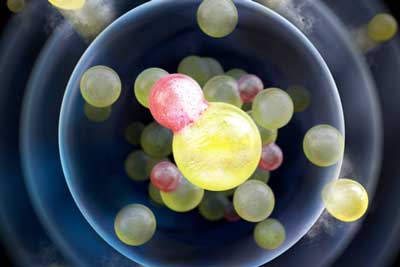 A new refrigerator for molecules. Sodium atoms (yellow spheres) collide with sodium-lithium molecules (combined-yellow-red-spheres). The atom-molecule mixture is trapped in an optical trap whose effective edge is shown as a white rim. As the trap is loosened (depicted as a dimmer rim), the most energetic sodium atoms leave the trap, providing evaporative cooling. The cooling is transferred to the molecules via elastic collisions. The frost on the molecules indicates that they have reached a temperature of 200 billionths of a degree Kelvin. (Image: Pilsu Heo)
In their own experiments, the MIT researchers found that if sodium lithium molecules and sodium atoms were made to spin in the same way, they could avoid self-destructing, and instead engaged in "good" collisions, where the atoms took away the molecules' energy, in the form of heat. The team used precise control of magnetic fields and an intricate system of lasers to choreograph the spin and the rotational motion of the molecules. As result, the atom-molecule mixture had a high ratio of good-to-bad collisions and was cooled down from 2 microkelvins to 220 nanokelvins.
"Collisional cooling has been the workhorse for cooling atoms," adds Nobel Prize laureate Wolfgang Ketterle, the John D. Arthur professor of physics at MIT. "I wasn't convinced that our scheme would work, but since we didn't know for sure, we had to try it. We know now that it works for cooling sodium lithium molecules. Whether it will work for other classes of molecules remains to be seen."
Their findings, published in the journal Nature ("Collisional cooling of ultracold molecules"), mark the first time researchers have successfully used collisional cooling to cool molecules down to nanokelvin temperatures.
Ketterle's coauthors on the paper are lead author Hyungmok Son, a graduate student in Harvard University's Department of Physics, along with MIT physics graduate student Juliana Park, and Alan Jamison, a professor of physics at the University of Waterloo and visiting scientist in MIT's Research Laboratory of Electronics.
A new refrigerator for molecules. Sodium atoms (yellow spheres) collide with sodium-lithium molecules (combined-yellow-red-spheres). The atom-molecule mixture is trapped in an optical trap whose effective edge is shown as a white rim. As the trap is loosened (depicted as a dimmer rim), the most energetic sodium atoms leave the trap, providing evaporative cooling. The cooling is transferred to the molecules via elastic collisions. The frost on the molecules indicates that they have reached a temperature of 200 billionths of a degree Kelvin. (Image: Pilsu Heo)
In their own experiments, the MIT researchers found that if sodium lithium molecules and sodium atoms were made to spin in the same way, they could avoid self-destructing, and instead engaged in "good" collisions, where the atoms took away the molecules' energy, in the form of heat. The team used precise control of magnetic fields and an intricate system of lasers to choreograph the spin and the rotational motion of the molecules. As result, the atom-molecule mixture had a high ratio of good-to-bad collisions and was cooled down from 2 microkelvins to 220 nanokelvins.
"Collisional cooling has been the workhorse for cooling atoms," adds Nobel Prize laureate Wolfgang Ketterle, the John D. Arthur professor of physics at MIT. "I wasn't convinced that our scheme would work, but since we didn't know for sure, we had to try it. We know now that it works for cooling sodium lithium molecules. Whether it will work for other classes of molecules remains to be seen."
Their findings, published in the journal Nature ("Collisional cooling of ultracold molecules"), mark the first time researchers have successfully used collisional cooling to cool molecules down to nanokelvin temperatures.
Ketterle's coauthors on the paper are lead author Hyungmok Son, a graduate student in Harvard University's Department of Physics, along with MIT physics graduate student Juliana Park, and Alan Jamison, a professor of physics at the University of Waterloo and visiting scientist in MIT's Research Laboratory of Electronics.
A new refrigerator for molecules. Sodium atoms (yellow spheres) collide with sodium-lithium molecules (combined-yellow-red-spheres). The atom-molecule mixture is trapped in an optical trap whose effective edge is shown as a white rim. As the trap is loosened (depicted as a dimmer rim), the most energetic sodium atoms leave the trap, providing evaporative cooling. The cooling is transferred to the molecules via elastic collisions. The frost on the molecules indicates that they have reached a temperature of 200 billionths of a degree Kelvin. (Image: Pilsu Heo)
In their own experiments, the MIT researchers found that if sodium lithium molecules and sodium atoms were made to spin in the same way, they could avoid self-destructing, and instead engaged in "good" collisions, where the atoms took away the molecules' energy, in the form of heat. The team used precise control of magnetic fields and an intricate system of lasers to choreograph the spin and the rotational motion of the molecules. As result, the atom-molecule mixture had a high ratio of good-to-bad collisions and was cooled down from 2 microkelvins to 220 nanokelvins.
"Collisional cooling has been the workhorse for cooling atoms," adds Nobel Prize laureate Wolfgang Ketterle, the John D. Arthur professor of physics at MIT. "I wasn't convinced that our scheme would work, but since we didn't know for sure, we had to try it. We know now that it works for cooling sodium lithium molecules. Whether it will work for other classes of molecules remains to be seen."
Their findings, published in the journal Nature ("Collisional cooling of ultracold molecules"), mark the first time researchers have successfully used collisional cooling to cool molecules down to nanokelvin temperatures.
Ketterle's coauthors on the paper are lead author Hyungmok Son, a graduate student in Harvard University's Department of Physics, along with MIT physics graduate student Juliana Park, and Alan Jamison, a professor of physics at the University of Waterloo and visiting scientist in MIT's Research Laboratory of Electronics.
