
| Date | 9th, Apr 2020 |
|---|
Home > Press > House cleaning on the nanoscale: FAU scientists develop method for cleaning surfaces at the nanoscale
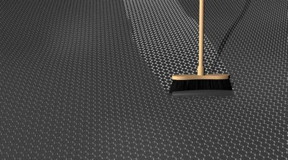 Artistic rendition of the world�s smallest broom in action. (CENEM, FAU Erlangen-N�rnberg)
Abstract: A team of scientists at Friedrich-Alexander Universit�t Erlangen-N�rnberg (FAU) has developed a novel mechanical cleaning method for surfaces on the nanoscale. The technique successfully removes even the tiniest contaminants down to the atomic scale, achieving an unprecedented level of cleanliness. The results of this study led by Prof. Dr. Erdmann Spiecker from the Department of Materials Science at FAU have now been published in the prestigious journal Nature Communications.
N�rnberg, Germany | Posted on April 8th, 2020
World's smallest broom
Inspiration for the technique was drawn from everyday life as cleaning with a broom works in a similar way. Of course, on the nanoscale instead of using an entire broom, only a single bristle in the form of a very small metal tip is used. This 'bristle' is pressed onto a surface and moved back and forth in a sweeping motion. 'It really is surprisingly similar to a regular broom,' says Prof. Spiecker, Chair of Micro- and Nanostructure Research. 'A broom removes loose particles such as dust or breadcrumbs, and it is no different on the nanoscale.' However, on small scales, the broom is not controlled by hand, but instead by joystick that controls a small piezo motor. Moreover, powerful electron microscopes are used to monitor and control the cleaning process in real time.
Cleaning the world's thinnest window
By cleaning graphene, the team managed to apply their technique to the thinnest material in existence, as graphene is made of a single atomic layer of carbon. 'A major challenge was to clean the graphene from both sides, similar to cleaning a window pane,' says Peter Schweizer, a research associate at the Chair of Micro- and Nanostructure Research, who performed the delicate experiments with his colleague Christian Dolle. 'With our electron microscopes, we always have to look through the material. Otherwise, it's impossible to reveal the atomic structure.' Graphene is known for its mechanical strength. Nevertheless, it is highly surprising that a monoatomic layer can survive the high mechanical forces of a cleaning procedure without being damaged. 'When we first told our colleagues about it, they didn't believe us,' adds Prof. Spiecker.
Nano-dust: Nothing stays clean for ever
Having atomically-clean surfaces enabled the authors of this study to also explore the origins and mechanisms of recontamination at the nanoscale. Leaving a cleaned sample out in air leads to the rapid accumulation of dust on its surface. 'This is really not surprising as we are all too familiar with dust settling in our homes. There is no reason why this should be different on the nanoscale,' says Prof. Spiecker. Besides airborne contamination, the team also found a prevalence of surface diffusion when a cleaned specimen is put into a vacuum environment, a phenomenon often encountered in scientific experiments.
Molecular assembly
Finally, the research team used the atomically clean surfaces as a basis for the targeted assembly of an atomically thin layer from molecular building blocks. Porphyrin molecules synthesized in the Department of Chemistry were applied to the cleaned surfaces and welded in place by a high-powered electron beam. The result was a graphene-like monolayer with nanocrystalline structure.
Interdisciplinary research fostered at FAU
The paper highlights one of FAU's strengths in the field of materials research: interdisciplinary research across different departments and faculties. Prof. Dr. Andreas Hirsch and his team from the Department of Chemistry provided both important chemicals for nanostructure assembly and valuable insights into chemical processes on surfaces. This collaboration was further aided by the DFG funded projects CRC 953 'Synthetic Carbon Allotropes' and RTG 1896 "In situ microscopy with electrons, X-rays and scanning probes". Finally, the research would not have been possible without the excellent equipment and microscopes at FAU's Center for Nanoanalysis and Electron Microscopy (CENEM).
####
For more information, please click here
Contacts:Press Office at FAU
49-913-170-229
@FAU_Germany
Copyright © Friedrich-Alexander Universit�t Erlangen-N�rnberg
If you have a comment, please Contact us.
Issuers of news releases, not 7th Wave, Inc. or Nanotechnology Now, are solely responsible for the accuracy of the content.
Bookmark:


News and information
 New technology helps reveal inner workings of human genome June 24th, 2022
Boron nitride nanotube fibers get real: Rice lab creates first heat-tolerant, stable fibers from wet-spinning process June 24th, 2022
Graphene/ Graphite
OCSiAl expands its graphene nanotube production capacities to Europe June 17th, 2022
Bumps could smooth quantum investigations: Rice University models show unique properties of 2D materials stressed by contoured substrates June 10th, 2022
Nanotubes: a promising solution for advanced rubber cables with 60% less conductive filler June 1st, 2022
Dynamic metasurfaces and metadevices empowered by graphene May 6th, 2022
Imaging
Snapshot measurement of single nanostructure�s circular dichroism March 25th, 2022
Better understanding superconductors with Higgs spectroscopy Prof. Stefan Kaiser from TU Dresden awarded ERC Consolidator Grant March 18th, 2022
Visualizing the invisible: New fluorescent DNA label reveals nanoscopic cancer features March 4th, 2022
Possible Futures
New technology helps reveal inner workings of human genome June 24th, 2022
Boron nitride nanotube fibers get real: Rice lab creates first heat-tolerant, stable fibers from wet-spinning process June 24th, 2022
Discoveries
New technology helps reveal inner workings of human genome June 24th, 2022
Boron nitride nanotube fibers get real: Rice lab creates first heat-tolerant, stable fibers from wet-spinning process June 24th, 2022
Announcements
New technology helps reveal inner workings of human genome June 24th, 2022
Boron nitride nanotube fibers get real: Rice lab creates first heat-tolerant, stable fibers from wet-spinning process June 24th, 2022
Tools
New technology helps reveal inner workings of human genome June 24th, 2022
Snapshot measurement of single nanostructure�s circular dichroism March 25th, 2022
Eyebrow-raising: Researchers reveal why nanowires stick to each other February 11th, 2022
JEOL Introduces New Scanning Electron Microscope with �Simple SEM� Automation and Live Elemental and 3D Analysis January 14th, 2022
