
| Date | 12th, Apr 2020 |
|---|
Home > Press > Hair surface engineering to be advanced by nano vehicles: This new researched technology can help both drug delivery and hair cosmetics industry
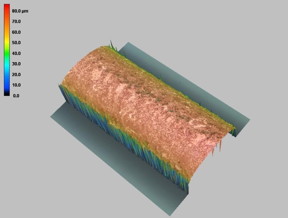
Abstract: "Hair surface engineering: modification of fibrous materials of biological origin using functional ceramic nano containers", a project headed by Rawil Fakhrullin, is supported by the Russian Science Foundation.
Kazan, Russian Federation | Posted on April 10th, 2020
Dr. Fakhrullin explains, "We will modify the surface of hair and other fibrous materials of natural origin by the directed formation of nano-structured layers based on functional inorganic ceramic nano containers carrying a variety of organic components. Materials of natural origin are hypoallergenic, comfortable to use, but they have rather low wear resistance, and they are prone to deformation and biodegradation. Directed modification of properties using functionalized nano materials will significantly expand the field of application of natural fibers."
Based on the close similarity of the microstructure of fibrous materials of natural origin and mammalian hair, the scientists are going to create a universal technology for modifying the surface of fibers of biological origin for use in the textile and cosmetic industries.
�By modifying the fibrous structures of natural origin, it will be possible to change their aesthetic properties (color, texture and smell), protect them from biodegradation by applying antibacterial, fungicidal and insecticidal preparations, as well as increase the fire resistance of fabrics and non-woven materials based on wool, cotton, linen and silk,� elaborates Fakhrullin.
KFU bionanotechnologists will develop methods for modifying human hair. With their help, it will be possible not only to change the color of the hair, thickness, texture and aroma, but also to protect the structure of the hair and skin under them from ultraviolet radiation.
In addition, using these methods, the project head is convinced, it will be possible to create tools for applying topical anti-inflammatory drugs based on functional nano containers. When applied to human hair in affected areas of the skin, they will provide a prolonged gradual release of drugs. Veterinary preparations with a similar principle of action can be applied to the fur of farm and domestic animals for medicinal purposes.
In the process, scientists will also study the fundamental processes of self-assembly of inorganic nanoparticles on the surface of biological fibers and determine the optimal parameters for the directed modification of the properties of fibrous materials.
"Inorganic nano particles of various origin, biopolymers and their complexes will be used to study the patterns of self-assembly of nanoparticles on the surface of fibers," Fakhrullin concludes.
####
For more information, please click here
Contacts:Yury Nurmeev
@KazanUni
Copyright © Kazan Federal University
If you have a comment, please Contact us.
Issuers of news releases, not 7th Wave, Inc. or Nanotechnology Now, are solely responsible for the accuracy of the content.
Bookmark:


News and information
 New technology helps reveal inner workings of human genome June 24th, 2022
Boron nitride nanotube fibers get real: Rice lab creates first heat-tolerant, stable fibers from wet-spinning process June 24th, 2022
Possible Futures
New technology helps reveal inner workings of human genome June 24th, 2022
Boron nitride nanotube fibers get real: Rice lab creates first heat-tolerant, stable fibers from wet-spinning process June 24th, 2022
Self Assembly
Nanoclusters self-organize into centimeter-scale hierarchical assemblies April 22nd, 2022
Atom by atom: building precise smaller nanoparticles with templates March 4th, 2022
Nanostructures get complex with electron equivalents: Nanoparticles of two different sizes break away from symmetrical designs January 14th, 2022
Nanomedicine
New technology helps reveal inner workings of human genome June 24th, 2022
New nano-gel to protect children receiving chemotherapy from hearing loss June 17th, 2022
Discoveries
New technology helps reveal inner workings of human genome June 24th, 2022
Boron nitride nanotube fibers get real: Rice lab creates first heat-tolerant, stable fibers from wet-spinning process June 24th, 2022
Announcements
New technology helps reveal inner workings of human genome June 24th, 2022
Boron nitride nanotube fibers get real: Rice lab creates first heat-tolerant, stable fibers from wet-spinning process June 24th, 2022
Interviews/Book Reviews/Essays/Reports/Podcasts/Journals/White papers/Posters
Quantum network nodes with warm atoms June 24th, 2022
New technology helps reveal inner workings of human genome June 24th, 2022
Food/Agriculture/Supplements
Scientists offer solutions for risky tap water June 17th, 2022
Polymer fibers with graphene nanotubes make it possible to heat hard-to-reach, complex-shaped items February 11th, 2022
Unprecedented view of a single catalyst nanoparticle at work: X-rays reveal compositional changes on active surface under reaction conditions October 1st, 2021
Nanobiotechnology
New technology helps reveal inner workings of human genome June 24th, 2022
New nano-gel to protect children receiving chemotherapy from hearing loss June 17th, 2022
