
| Date | 24th, Apr 2020 |
|---|
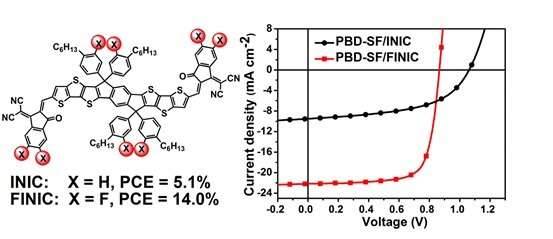 The molecular structures and device performance. Credit: Peking University
Recently, Professor Zhan Xiaowei's group from the College of Engineering at Peking University made progress in non-fullerene acceptors for organic solar cells (OSCs). They developed a new fluorinated fused-ring electron acceptor (FREA) with 3-D stacking and exciton and charge transport (Adv. Mater., DOI: 10.1002/adma.202000645).
In 2015, the Zhan group pioneered the concept of FREA and invented the landmark molecule ITIC. In 2017, they firstly introduced fluorinated 2-(3-oxo-2,3-dihydroinden-1-ylidene) -malononitrile, 1FIC and 2FIC, in FREAs (J. Am. Chem. Soc., 2017, 139, 1336–1343, cited 547 times; Adv. Mater., 2017, 29, 1700144, cited 549 times). Now, all the best non-fullerene acceptors are based on 1FIC/2FIC.
Most recently, they proposed a new design strategy to construct FREAs via fluorination of both end-groups and side-chains. Close 3-D stacking network is formed due to 3-D non-covalent interactions caused by F atoms on both end-groups and side-chains, which is beneficial to efficient 3-D exciton and charge transport. The OSCs based on FINIC with fluorinated end-groups and side-chains show an efficiency of 14.0%, much higher than that of the nonfluorinated INIC-based cells (5.1%).
More information: Shuixing Dai et al. High-Performance Fluorinated Fused-Ring Electron Acceptor with 3D Stacking and Exciton/Charge Transport, Advanced Materials (2020). DOI: 10.1002/adma.202000645
Citation: Researchers develop fused-ring electron acceptor with 3-D exciton and charge transport (2020, April 24) retrieved 28 June 2022 from https://phys.org/news/2020-04-fused-ring-electron-acceptor-d-exciton.html
This document is subject to copyright. Apart from any fair dealing for the purpose of private study or research, no part may be reproduced without the written permission. The content is provided for information purposes only.
