
Apr 24, 2020
(Nanowerk News) A thousand litres of seawater can contain up to 8.3 million particles of microplastics. Until now, identifying these very small particles has been difficult – usually they are only detected once they have accumulated in the bodies of fish. A method developed at VTT utilises nanocellulose structures for early particle identification. Nanocellulose would allow particles to be captured even before they enter waterways.
The properties of nanocellulose films and hydrogels support the identification and capture of very small microplastic particles.
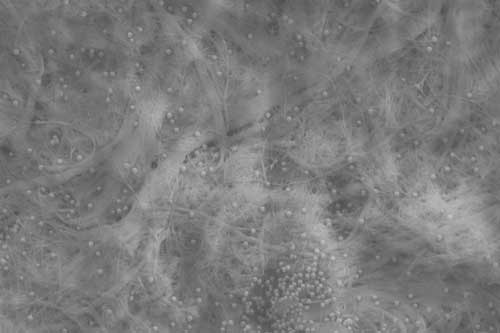 A scanning electron microscope shows how the microplastic particles are attached to the nanocellulose structure. The diameter of the plastic particles is 100 nanometers. (Image: VTT)
“Nanocellulose has a mesh-like, porous structure and a large BET surface area. In the water, powerful capillary forces are generated in this structure, allowing particles to be transported inside the mesh and bound there”, says Research Professor Tekla Tammelin from VTT.
The method provides a way to catch microplastic particles of a size that the human eye cannot detect. These are particles with a diameter of only 100 nanometres.
“Nanocellulose structures can be used to identify and analyse these particles and to obtain information about their behaviour at an earlier stage. We can determine the concentration of particles in water and analyse, for example, whether particles are released into drinking water from plastic bottles.”
A scanning electron microscope shows how the microplastic particles are attached to the nanocellulose structure. The diameter of the plastic particles is 100 nanometers. (Image: VTT)
“Nanocellulose has a mesh-like, porous structure and a large BET surface area. In the water, powerful capillary forces are generated in this structure, allowing particles to be transported inside the mesh and bound there”, says Research Professor Tekla Tammelin from VTT.
The method provides a way to catch microplastic particles of a size that the human eye cannot detect. These are particles with a diameter of only 100 nanometres.
“Nanocellulose structures can be used to identify and analyse these particles and to obtain information about their behaviour at an earlier stage. We can determine the concentration of particles in water and analyse, for example, whether particles are released into drinking water from plastic bottles.”
A scanning electron microscope shows how the microplastic particles are attached to the nanocellulose structure. The diameter of the plastic particles is 100 nanometers. (Image: VTT)
“Nanocellulose has a mesh-like, porous structure and a large BET surface area. In the water, powerful capillary forces are generated in this structure, allowing particles to be transported inside the mesh and bound there”, says Research Professor Tekla Tammelin from VTT.
The method provides a way to catch microplastic particles of a size that the human eye cannot detect. These are particles with a diameter of only 100 nanometres.
“Nanocellulose structures can be used to identify and analyse these particles and to obtain information about their behaviour at an earlier stage. We can determine the concentration of particles in water and analyse, for example, whether particles are released into drinking water from plastic bottles.”
