
Apr 27, 2020
(Nanowerk News) The duration of their snapshot relates to one second as one second relates to the age of the universe: In a joint collaboration with Australian Scientist Tim Davis and the Group around Harald Gießen (University of Stuttgart), Physicists from CENIDE have developed ultrafast vector microscopy as a way of determining electric fields on surfaces with high temporal and spatial resolution. The new method was used to measure the dynamics of optical skyrmions in the time domain for the first time.
The renowned journal Science publishes this breakthrough in nanooptics ("Ultrafast vector imaging of plasmonic skyrmion dynamics with deep subwavelength resolution").
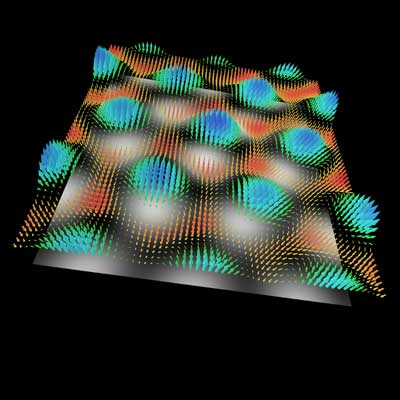 Visualization of optical skyrmions at a point in time when their electric fields in the center point out of the surface. The distance between adjacent skyrmions is the plasmon wavelength of 780 nanometers. (Image: Tim Davis)
Nanooptics is all about interactions between light and matter. Researchers engaged in this field use spectroscopic and microscopic methods to observe and influence the properties and states of tiny structures and even individual molecules. Like with optical computers, which are still in their infancy: their structures can be far smaller than the wavelength of light, and they require tricks such as nano-antennas to couple light into nanostructures effectively. However, it is quite challenging to analyze the electric fields around such structures in space and time.
A team of physicists led by Professor Frank-J. Meyer zu Heringdorf (UDE), the Australian nanooptics expert Dr. Timothy J. Davis, and Professor Harald Gießen (University of Stuttgart) have now realized a pioneering achievement: With their vector microscopy, based on time-resolved 2-photon photoemission microscopy, they have been able to analyze the electrical fields on a metal surface with pinpoint accuracy and temporal precision – down to 10 nanometers of local resolution and in a range of sub-femtoseconds.
Visualization of optical skyrmions at a point in time when their electric fields in the center point out of the surface. The distance between adjacent skyrmions is the plasmon wavelength of 780 nanometers. (Image: Tim Davis)
Nanooptics is all about interactions between light and matter. Researchers engaged in this field use spectroscopic and microscopic methods to observe and influence the properties and states of tiny structures and even individual molecules. Like with optical computers, which are still in their infancy: their structures can be far smaller than the wavelength of light, and they require tricks such as nano-antennas to couple light into nanostructures effectively. However, it is quite challenging to analyze the electric fields around such structures in space and time.
A team of physicists led by Professor Frank-J. Meyer zu Heringdorf (UDE), the Australian nanooptics expert Dr. Timothy J. Davis, and Professor Harald Gießen (University of Stuttgart) have now realized a pioneering achievement: With their vector microscopy, based on time-resolved 2-photon photoemission microscopy, they have been able to analyze the electrical fields on a metal surface with pinpoint accuracy and temporal precision – down to 10 nanometers of local resolution and in a range of sub-femtoseconds.
Visualization of optical skyrmions at a point in time when their electric fields in the center point out of the surface. The distance between adjacent skyrmions is the plasmon wavelength of 780 nanometers. (Image: Tim Davis)
Nanooptics is all about interactions between light and matter. Researchers engaged in this field use spectroscopic and microscopic methods to observe and influence the properties and states of tiny structures and even individual molecules. Like with optical computers, which are still in their infancy: their structures can be far smaller than the wavelength of light, and they require tricks such as nano-antennas to couple light into nanostructures effectively. However, it is quite challenging to analyze the electric fields around such structures in space and time.
A team of physicists led by Professor Frank-J. Meyer zu Heringdorf (UDE), the Australian nanooptics expert Dr. Timothy J. Davis, and Professor Harald Gießen (University of Stuttgart) have now realized a pioneering achievement: With their vector microscopy, based on time-resolved 2-photon photoemission microscopy, they have been able to analyze the electrical fields on a metal surface with pinpoint accuracy and temporal precision – down to 10 nanometers of local resolution and in a range of sub-femtoseconds.
