
Apr 28, 2020
(Nanowerk News) The same material you'll find at the tip of a pencil--graphite--has long been a key component in today's lithium-ion batteries. As our reliance on these batteries increases, however, graphite-based electrodes are due for an upgrade. For that, scientists are looking to the element at the heart of the digital revolution: silicon.
Scientists at the U.S. Department of Energy's Pacific Northwest National Laboratory have come up with a novel way to use this promising but problematic energy storage ingredient. Silicon, used in computer chips and many other products, is appealing because it can hold 10 times the electrical charge per gram compared to graphite. The trouble is, silicon expands greatly when it encounters lithium, and it is too weak to withstand the pressure of electrode manufacturing.
To tackle these issues, a team led by PNNL researchers Ji-Guang (Jason) Zhang and Xiaolin Li developed a unique nanostructure that limits silicon's expansion while fortifying it with carbon. Their work, which was recently published in the journal Nature Communications ("Hierarchical porous silicon structures with extraordinary mechanical strength as high-performance lithium-ion battery anodes"), could inform new electrode material designs for other types of batteries and eventually help increase the energy capacity of the lithium-ion batteries in electric cars, electronic devices, and other equipment.
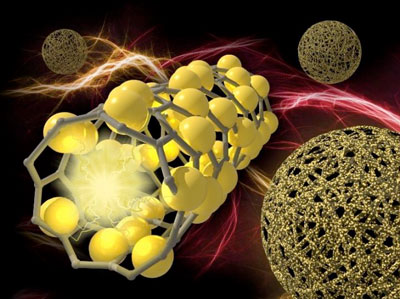 Silicon microspheres have extraordinary mechanical strength due to the addition of carbon nanotubes which make the spheres resemble balls of yarn. In this representation, the image on the left illustrates a close-up of a portion of a microsphere made of silicon nanoparticles deposited on carbon nanotubes. (Illustration by Michael Perkins/PNNL)
Silicon microspheres have extraordinary mechanical strength due to the addition of carbon nanotubes which make the spheres resemble balls of yarn. In this representation, the image on the left illustrates a close-up of a portion of a microsphere made of silicon nanoparticles deposited on carbon nanotubes. (Illustration by Michael Perkins/PNNL)
