
The team’s nanotechnology-enabled approach uses molecular imprinting to selectively adsorb antibiotic-resistant genes and concentrate them near photocatalytic sites for efficient degradation. When the imprinted molecule is removed, for example by acid washing, it leaves behind a target-specific cavity that enables selective adsorption and photocatalytic inactivation with minimum interference by background water constituents. The researchers hypothesized that molecular imprinting of graphitic carbon nitride with common coronavirus attachment factors could enable selective virus adsorption near reactive sites, resulting in reliably high disinfection rates.
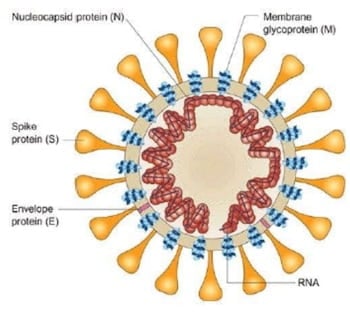 A schematic of the SARS-CoV-2 viral particle, which presents a number of targets for filtration technology being developed at Rice University. Courtesy of Nature Medicine/
www.nature.com/articles/nm1143/figures/3.
The researchers will modify their approach to target SARS-CoV-2 and other coronaviruses by imprinting molecules involved in virus attachment onto the graphitic carbon nitride photocatalysts. The team will use low pathogenic coronaviruses to assess the adsorption kinetics and selectivity of the molecularly imprinted graphitic carbon nitride. Inactivation efficiency will be assessed by quantifying residual viable virus concentrations.
A schematic of the SARS-CoV-2 viral particle, which presents a number of targets for filtration technology being developed at Rice University. Courtesy of Nature Medicine/
www.nature.com/articles/nm1143/figures/3.
The researchers will modify their approach to target SARS-CoV-2 and other coronaviruses by imprinting molecules involved in virus attachment onto the graphitic carbon nitride photocatalysts. The team will use low pathogenic coronaviruses to assess the adsorption kinetics and selectivity of the molecularly imprinted graphitic carbon nitride. Inactivation efficiency will be assessed by quantifying residual viable virus concentrations.
This project could enhance surface recognition of various types of coronaviruses, which in turn could help efforts to concentrate the viruses, allowing more precise separation through sorbents and improving the detection limits of the sensors used in diagnostics and surveillance efforts.
“SARS-CoV-2 has been found in air ducts, suggesting it could spread through a building’s air-conditioning system, and in stool, even from patients who have tested negative for COVID-19,” professor Pedro Alvarez said. “That suggests it could reach wastewater treatment plants, where it could survive for days. We need to enhance the capacity and resiliency of multimedia treatment processes — especially air filtration and wastewater disinfection — to protect public health.” Alvarez and bioscientist Yizhi Jane Tao have received a National Science Foundation (NSF) RAPID grant to develop their method for selective adsorption and photocatalytic disinfection of SARS-CoV-2.
For additional information, view the National Science Foundation award abstract. The research that the approach is based on was published in Environmental Science & Technology (www.doi.org/10.1021/acs.est.9b06926).
