
| Date | 8th, May 2020 |
|---|
Home > Press > 2D oxide flakes pick up surprise electrical properties: Rice University lab detects piezoelectric effects in nanosheets due to defects
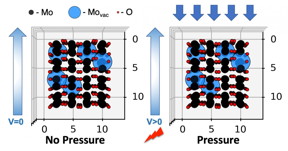 Electrets � electrons trapped in defects in two-dimensional molybdenum dioxide � give the material piezoelectric properties, according to Rice University researchers. The defects (blue) appear in the material during formation in a furnace, and generate an electric field when under pressure. (Credit: Ajayan Research Group/Rice University)
Abstract: Rice University researchers have found evidence of piezoelectricity in lab-grown, two-dimensional flakes of molybdenum dioxide.
Houston, TX | Posted on May 7th, 2020
Their investigation showed the surprise electrical properties are due to electrons trapped in defects throughout the material, which is less than 10 nanometers thick. They characterize these charges as electrets, which appear in some insulating materials and generate internal and external electric fields.
Piezoelectricity is likewise a property of materials that respond to stress by generating an electric voltage across their surfaces or generate mechanical strain in response to an applied electric field. It has many practical and scientific uses, from the conversion of a wiggling guitar string into an electrical signal to scanning microscopes like those used to make the new finding.
The researchers at Rice�s Brown School of Engineering found their micron-scale flakes exhibit a piezoelectric response that is as strong as that observed in such conventional 2D piezoelectric materials as molybdenum disulfide.
The report by Rice materials scientist Pulickel Ajayan and collaborators appears in Advanced Materials.
The key appears to be defects that make molybdenum dioxide�s crystal lattice imperfect. When strained, the dipoles of electrons trapped in these defects seem to align, as with other piezoelectric materials, creating an electric field leading to the observed effect.
�Super thin, 2D crystals continue to show surprises, as in our study,� Ajayan said. �Defect engineering is a key to engineer properties of such materials but is often challenging and hard to control.�
�Molybdenum dioxide isn�t expected to show any piezoelectricity,� added Rice postdoctoral researcher Anand Puthirath, a co-corresponding author of the paper. �But because we�re making the material as thin as possible, confinement effects come into the picture.�
He said the effect appears in molybdenum dioxide flakes grown by chemical vapor deposition. Stopping the growth process at various points gave the researchers some control over the defects� density, if not their distribution.
Lead author and Rice alumna Amey Apte added the researchers� single-chemical, precursor-based vapor deposition technique �helps in the reproducibility and clean nature of growing molybdenum oxide on a variety of substrates.�
The researchers found the piezoelectric effect is stable at room temperature for significant timescales. The molybdenum dioxide flakes remained stable at temperatures up to 100 degrees Celsius (212 degrees Fahrenheit). But annealing them for three days at 250 C (482 F) eliminated the defects and halted the piezoelectric effect.
Puthirath said the material has many potential applications. �It can be used as an energy harvester, because if you strain this material, it will give you energy in the form of electricity,� he said. �If you give it voltage, you induce mechanical expansion or compression. And if you want to mobilize something at the nanoscale, you can simply apply voltage and this will expand and move that particle the way you want.�
Co-authors of the paper are Rice alumna Sandhya Susarla, now a postdoctoral scholar at Lawrence Berkeley National Laboratory; graduate students Kosar Mozaffari and Farnaz Safi Samghabadi, research assistant professor Long Chang and Dmitri Litvinov, a professor of electrical and computer engineering, at the University of Houston; Jordan Hachtel and Juan Carlos Idrobo of Oak Ridge National Laboratory; and David Moore and Nicholas Glavin of the Air Force Research Laboratory at Wright-Patterson Air Force Base, Ohio. Apte is now at the Intel Corp., Chandler, Arizona.
Ajayan and Pradeep Sharma, the M.D. Anderson Chair Professor and department chair of mechanical engineering at the University of Houston, are co-corresponding authors. Ajayan is chair of Rice�s Department of Materials Science and NanoEngineering, the Benjamin M. and Mary Greenwood Anderson Professor in Engineering and a professor of chemistry.
The Air Force Office of Scientific Research and the Department of Energy's Office of Science supported the research. Microscopy research was performed at Oak Ridge National Laboratory�s Center for Nanophase Materials Sciences.
####
About Rice UniversityLocated on a 300-acre forested campus in Houston, Rice University is consistently ranked among the nation�s top 20 universities by U.S. News & World Report. Rice has highly respected schools of Architecture, Business, Continuing Studies, Engineering, Humanities, Music, Natural Sciences and Social Sciences and is home to the Baker Institute for Public Policy. With 3,962 undergraduates and 3,027 graduate students, Rice�s undergraduate student-to-faculty ratio is just under 6-to-1. Its residential college system builds close-knit communities and lifelong friendships, just one reason why Rice is ranked No. 1 for lots of race/class interaction and No. 4 for quality of life by the Princeton Review. Rice is also rated as a best value among private universities by Kiplinger�s Personal Finance.
Follow Rice News and Media Relations via Twitter @RiceUNews.
For more information, please click here
Contacts:Jeff Falk713-348-6775
Mike Williams713-348-6728
Copyright © Rice University
If you have a comment, please Contact us.
Issuers of news releases, not 7th Wave, Inc. or Nanotechnology Now, are solely responsible for the accuracy of the content.
Bookmark:


 Emerging applications of elemental 2D materials:
Rice Department of Materials Science and NanoEngineering:
George R. Brown School of Engineering:
News and information
New technology helps reveal inner workings of human genome June 24th, 2022
Boron nitride nanotube fibers get real: Rice lab creates first heat-tolerant, stable fibers from wet-spinning process June 24th, 2022
2 Dimensional Materials
Controlled synthesis of crystal flakes paves path for advanced future electronics June 17th, 2022
Solving the puzzle of 2D disorder: An interdisciplinary team developed a new method to characterize disorder in 2D materials June 17th, 2022
UBCO researchers change the game when it comes to activity tracking: Flexible, highly sensitive motion device created by extrusion printing June 17th, 2022
Bumps could smooth quantum investigations: Rice University models show unique properties of 2D materials stressed by contoured substrates June 10th, 2022
Laboratories
University of Illinois Chicago joins Brookhaven Lab's Quantum Center June 10th, 2022
Govt.-Legislation/Regulation/Funding/Policy
Solving the solar energy storage problem with rechargeable batteries that can convert and store energy at once June 24th, 2022
Boron nitride nanotube fibers get real: Rice lab creates first heat-tolerant, stable fibers from wet-spinning process June 24th, 2022
UBCO researchers change the game when it comes to activity tracking: Flexible, highly sensitive motion device created by extrusion printing June 17th, 2022
University of Illinois Chicago joins Brookhaven Lab's Quantum Center June 10th, 2022
Possible Futures
New technology helps reveal inner workings of human genome June 24th, 2022
Boron nitride nanotube fibers get real: Rice lab creates first heat-tolerant, stable fibers from wet-spinning process June 24th, 2022
Discoveries
New technology helps reveal inner workings of human genome June 24th, 2022
Boron nitride nanotube fibers get real: Rice lab creates first heat-tolerant, stable fibers from wet-spinning process June 24th, 2022
Announcements
New technology helps reveal inner workings of human genome June 24th, 2022
Boron nitride nanotube fibers get real: Rice lab creates first heat-tolerant, stable fibers from wet-spinning process June 24th, 2022
Interviews/Book Reviews/Essays/Reports/Podcasts/Journals/White papers/Posters
Quantum network nodes with warm atoms June 24th, 2022
New technology helps reveal inner workings of human genome June 24th, 2022
Military
Boron nitride nanotube fibers get real: Rice lab creates first heat-tolerant, stable fibers from wet-spinning process June 24th, 2022
Bumps could smooth quantum investigations: Rice University models show unique properties of 2D materials stressed by contoured substrates June 10th, 2022
Nanostructured fibers can impersonate human muscles June 3rd, 2022
Lightening up the nanoscale long-wavelength optoelectronics May 13th, 2022
Battery Technology/Capacitors/Generators/Piezoelectrics/Thermoelectrics/Energy storage
Solving the solar energy storage problem with rechargeable batteries that can convert and store energy at once June 24th, 2022
OCSiAl expands its graphene nanotube production capacities to Europe June 17th, 2022
Engineering piezoelectricity and strain sensitivity in CdS to promote piezocatalytic hydrogen evolution May 13th, 2022
