

May 08, 2020
(Nanowerk News) Made of a single layer of carbon atoms linked in a hexagonal honeycomb pattern, graphene’s structure is simple and seemingly delicate. Since its discovery in 2004, scientists have found that graphene is in fact exceptionally strong. And although graphene is not a metal, it conducts electricity at ultrahigh speeds, better than most metals.
In 2018, MIT scientists led by Pablo Jarillo-Herrero and Yuan Cao discovered that when two sheets of graphene are stacked together at a slightly offset “magic” angle, the new “twisted” graphene structure can become either an insulator, completely blocking electricity from flowing through the material, or paradoxically, a superconductor, able to let electrons fly through without resistance. It was a monumental discovery that helped launch a new field known as “twistronics,” the study of electronic behavior in twisted graphene and other materials.
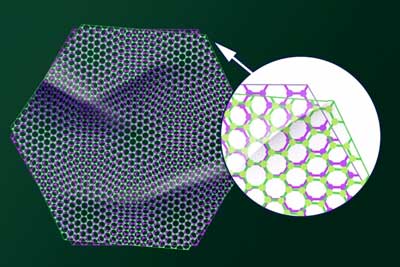 In this illustration, two sheets of graphene are stacked together at a slightly offset “magic” angle, which can become either an insulator or superconductor. “We placed one sheet of graphene on top of another, similar to placing plastic wrap on top of plastic wrap,” MIT professor Pablo Jarillo-Herrero says. “You would expect there would be wrinkles, and regions where the two sheets would be a bit twisted, some less twisted, just as we see in graphene.” (Image: José-Luis Olivares, MIT)
Now the MIT team reports their latest advancements in graphene twistronics, in two papers published in the journal Nature.
In the first study ("Mapping the twist-angle disorder and Landau levels in magic-angle graphene"), the researchers, along with collaborators at the Weizmann Institute of Science, have imaged and mapped an entire twisted graphene structure for the first time, at a resolution fine enough that they are able to see very slight variations in local twist angle across the entire structure.
The results revealed regions within the structure where the angle between the graphene layers veered slightly away from the average offset of 1.1 degrees.
The team detected these variations at an ultrahigh angular resolution of 0.002 degree. That’s equivalent to being able to see the angle of an apple against the horizon from a mile away.
They found that structures with a narrower range of angle variations had more pronounced exotic properties, such as insulation and superconductivity, versus structures with a wider range of twist angles.
“This is the first time an entire device has been mapped out to see what is the twist angle at a given region in the device,” says Jarillo-Herrero, the Cecil and Ida Green Professor of Physics at MIT. “And we see that you can have a little bit of variation and still show superconductivity and other exotic physics, but it can’t be too much. We now have characterized how much twist variation you can have, and what is the degradation effect of having too much.”
In the second study ("Tunable correlated states and spin-polarized phases in twisted bilayer–bilayer graphene"), the team report creating a new twisted graphene structure with not two, but four layers of graphene. They observed that the new four-layer magic-angle structure is more sensitive to certain electric and magnetic fields compared to its two-layer predecessor. This suggests that researchers may be able to more easily and controllably study the exotic properties of magic-angle graphene in four-layer systems.
“These two studies are aiming to better understand the puzzling physical behavior of magic-angle twistronics devices,” says Cao, a graduate student at MIT. “Once understood, physicists believe these devices could help design and engineer a new generation of high-temperature superconductors, topological devices for quantum information processing, and low-energy technologies.”
In this illustration, two sheets of graphene are stacked together at a slightly offset “magic” angle, which can become either an insulator or superconductor. “We placed one sheet of graphene on top of another, similar to placing plastic wrap on top of plastic wrap,” MIT professor Pablo Jarillo-Herrero says. “You would expect there would be wrinkles, and regions where the two sheets would be a bit twisted, some less twisted, just as we see in graphene.” (Image: José-Luis Olivares, MIT)
Now the MIT team reports their latest advancements in graphene twistronics, in two papers published in the journal Nature.
In the first study ("Mapping the twist-angle disorder and Landau levels in magic-angle graphene"), the researchers, along with collaborators at the Weizmann Institute of Science, have imaged and mapped an entire twisted graphene structure for the first time, at a resolution fine enough that they are able to see very slight variations in local twist angle across the entire structure.
The results revealed regions within the structure where the angle between the graphene layers veered slightly away from the average offset of 1.1 degrees.
The team detected these variations at an ultrahigh angular resolution of 0.002 degree. That’s equivalent to being able to see the angle of an apple against the horizon from a mile away.
They found that structures with a narrower range of angle variations had more pronounced exotic properties, such as insulation and superconductivity, versus structures with a wider range of twist angles.
“This is the first time an entire device has been mapped out to see what is the twist angle at a given region in the device,” says Jarillo-Herrero, the Cecil and Ida Green Professor of Physics at MIT. “And we see that you can have a little bit of variation and still show superconductivity and other exotic physics, but it can’t be too much. We now have characterized how much twist variation you can have, and what is the degradation effect of having too much.”
In the second study ("Tunable correlated states and spin-polarized phases in twisted bilayer–bilayer graphene"), the team report creating a new twisted graphene structure with not two, but four layers of graphene. They observed that the new four-layer magic-angle structure is more sensitive to certain electric and magnetic fields compared to its two-layer predecessor. This suggests that researchers may be able to more easily and controllably study the exotic properties of magic-angle graphene in four-layer systems.
“These two studies are aiming to better understand the puzzling physical behavior of magic-angle twistronics devices,” says Cao, a graduate student at MIT. “Once understood, physicists believe these devices could help design and engineer a new generation of high-temperature superconductors, topological devices for quantum information processing, and low-energy technologies.”
In this illustration, two sheets of graphene are stacked together at a slightly offset “magic” angle, which can become either an insulator or superconductor. “We placed one sheet of graphene on top of another, similar to placing plastic wrap on top of plastic wrap,” MIT professor Pablo Jarillo-Herrero says. “You would expect there would be wrinkles, and regions where the two sheets would be a bit twisted, some less twisted, just as we see in graphene.” (Image: José-Luis Olivares, MIT)
Now the MIT team reports their latest advancements in graphene twistronics, in two papers published in the journal Nature.
In the first study ("Mapping the twist-angle disorder and Landau levels in magic-angle graphene"), the researchers, along with collaborators at the Weizmann Institute of Science, have imaged and mapped an entire twisted graphene structure for the first time, at a resolution fine enough that they are able to see very slight variations in local twist angle across the entire structure.
The results revealed regions within the structure where the angle between the graphene layers veered slightly away from the average offset of 1.1 degrees.
The team detected these variations at an ultrahigh angular resolution of 0.002 degree. That’s equivalent to being able to see the angle of an apple against the horizon from a mile away.
They found that structures with a narrower range of angle variations had more pronounced exotic properties, such as insulation and superconductivity, versus structures with a wider range of twist angles.
“This is the first time an entire device has been mapped out to see what is the twist angle at a given region in the device,” says Jarillo-Herrero, the Cecil and Ida Green Professor of Physics at MIT. “And we see that you can have a little bit of variation and still show superconductivity and other exotic physics, but it can’t be too much. We now have characterized how much twist variation you can have, and what is the degradation effect of having too much.”
In the second study ("Tunable correlated states and spin-polarized phases in twisted bilayer–bilayer graphene"), the team report creating a new twisted graphene structure with not two, but four layers of graphene. They observed that the new four-layer magic-angle structure is more sensitive to certain electric and magnetic fields compared to its two-layer predecessor. This suggests that researchers may be able to more easily and controllably study the exotic properties of magic-angle graphene in four-layer systems.
“These two studies are aiming to better understand the puzzling physical behavior of magic-angle twistronics devices,” says Cao, a graduate student at MIT. “Once understood, physicists believe these devices could help design and engineer a new generation of high-temperature superconductors, topological devices for quantum information processing, and low-energy technologies.”
