
| Date | 9th, May 2020 |
|---|
Home > Press > Chemistry breakthrough could speed up drug development: Scientists have successfully developed a new technique to reliably grow crystals of organic soluble molecules from nanoscale droplets, unlocking the potential of accelerated new drug development
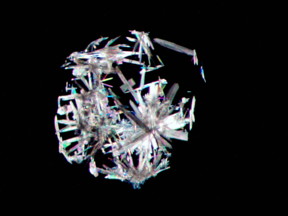 Scientists have successfully developed a new technique to reliably grow crystals of organic soluble molecules from nanoscale droplets, unlocking the potential of accelerated new drug development.
CREDIT
Dr Michael Hall, Newcastle University
Scientists have successfully developed a new technique to reliably grow crystals of organic soluble molecules from nanoscale droplets, unlocking the potential of accelerated new drug development.
CREDIT
Dr Michael Hall, Newcastle University
Abstract: Scientists have successfully developed a new technique to reliably grow crystals of organic soluble molecules from nanoscale droplets, unlocking the potential of accelerated new drug development.
Newcastle upon Tyne, UK | Posted on May 8th, 2020
Chemistry experts from Newcastle and Durham universities, working in collaboration with SPT Labtech, have grown the small crystals from nanoscale encapsulated droplets. Their innovative method, involving the use of inert oils to control evaporative solvent loss, has the potential to enhance the drug development pipeline.
Whilst crystallization of organic soluble molecules is a technique used by scientists all over the world, the ability to do so with such small quantities of analyte is ground-breaking.
Through the use of this new method, called Encapsulated Nanodroplet Crystallisation (ENaCt), the researchers have shown that hundreds of crystallisation experiments can be set up within a few minutes. Each experiment involves a few micrograms of molecular analyte dissolved in a few nanolitres of organic solvent and is automated, allowing for rapid set up of hundreds of unique experiments with ease. Concentration of these nanodroplet experiments results in the growth of the desired high quality single crystals that are suitable for modern X-ray diffraction analysis.
Publishing their findings in the journal Chem, the team, led by Drs Hall and Probert, of Newcastle University, UK, successfully developed a new approach to molecular crystallisation which allows access, within a few days, to high quality single crystals, whilst requiring only few milligrams of analyte.
Dr Hall, Senior Lecturer in Chemistry, Newcastle University, said: "We have developed a nanoscale crystallisation technique for organic-soluble small molecules, using high-throughput liquid-handling robotics to undertake multiple crystallisation experiments simultaneously with minimal sample requirements and high success rates.
"This new method has the potential to have far-reaching impact within the molecular sciences and beyond. Fundamental research will benefit from highly detailed characterisation of new molecules, such as natural products or complex synthetic molecules, by X-ray crystallography, whilst the development of new drugs by the pharmaceutical industry will be accelerated, through rapid access to characterised crystalline forms of new active pharmaceutical ingredients."
Understanding these new crystalline forms, known as polymorphs, is essential to the successful generation of new pharmaceutical agents and drugs. The ability to investigate these forms quickly and on a vast scale, whilst minimising the amount of analyte required, could be a key
Breakthrough enabled by the new ENaCT protocol.
Dr Paul Thaw from SPT Labtech, added: "Enabling this work to develop a novel high-throughput method for single crystal X-ray diffraction on mosquito� with the Newcastle team has been a pleasure. Having the ability to quickly screen organic soluble small molecules on the microgram scale will deliver valuable insight for both academic research and pharmaceutical drug design and validation."
Dr Probert, Senior Lecturer in Inorganic Chemistry and Head of Crystallography, Newcastle University, commented "...this new approach to crystallisation has the ability to transform the scientific landscape for the analysis of small molecules, not only in the drug discovery and delivery areas but also in the more general understanding of the crystalline solid state ..."
The whole team believe that the ENaCt methodology has the potential rewrite some of the preconceptions within the molecular sciences and beyond.
####
For more information, please click here
Contacts:Ivan Lazarov
07-970-656-214
@UniofNewcastle
Copyright © Newcastle University
If you have a comment, please Contact us.
Issuers of news releases, not 7th Wave, Inc. or Nanotechnology Now, are solely responsible for the accuracy of the content.
Bookmark:


News and information
 New technology helps reveal inner workings of human genome June 24th, 2022
Boron nitride nanotube fibers get real: Rice lab creates first heat-tolerant, stable fibers from wet-spinning process June 24th, 2022
Possible Futures
New technology helps reveal inner workings of human genome June 24th, 2022
Boron nitride nanotube fibers get real: Rice lab creates first heat-tolerant, stable fibers from wet-spinning process June 24th, 2022
Nanomedicine
New technology helps reveal inner workings of human genome June 24th, 2022
New nano-gel to protect children receiving chemotherapy from hearing loss June 17th, 2022
Discoveries
New technology helps reveal inner workings of human genome June 24th, 2022
Boron nitride nanotube fibers get real: Rice lab creates first heat-tolerant, stable fibers from wet-spinning process June 24th, 2022
Announcements
New technology helps reveal inner workings of human genome June 24th, 2022
Boron nitride nanotube fibers get real: Rice lab creates first heat-tolerant, stable fibers from wet-spinning process June 24th, 2022
Interviews/Book Reviews/Essays/Reports/Podcasts/Journals/White papers/Posters
Quantum network nodes with warm atoms June 24th, 2022
New technology helps reveal inner workings of human genome June 24th, 2022
Nanobiotechnology
New technology helps reveal inner workings of human genome June 24th, 2022
New nano-gel to protect children receiving chemotherapy from hearing loss June 17th, 2022
