
May 11, 2020
(Nanowerk News) Future display technologies such as virtual and augmented reality require higher pixel resolutions and optical contrast. However, the potential of state-of-the-art displays is limited by the individual pixel size to achieve necessary resolution.
Researchers at the University of Stuttgart have now succeeded to observe switching processes at previously unattained nanometer resolution. It opens the door towards new and innovative ultra-high-resolution displays of the future.
The journal Science Advances reports their groundbreaking work ("Watching in situ the hydrogen diffusion dynamics in magnesium on the nanoscale").
 Visualization of the topography of magnesium with nanometer resolution covered with an optical scattering phase map showing hydrogenated and unhydrogenated areas. (Image: University of Stuttgart)
The size of pixels in state-of-the-art switchable optical devices is intrinsically limited by the fabrication of micrometer-sized transistors and spatial light modulators. To further decrease their size, several approaches are currently under debate and investigated in research labs all over the world. One promising route can be found in the field of nanoplasmonics.
A plasmonic nanoparticle typically has sizes of only several tens of nanometers and can focus light into sub-wavelength dimensions with an extreme localization of electro-magnetic fields. By adjusting the size of such particles, their color appearance can be shifted through the entire visible spectral range.
In combination with phase-transition materials their optical properties and their appearance can be tuned, colors can be turned on and off, and one can realize switchable colored plasmonic pixels with nanometers size.
One promising material for this purpose is magnesium. The well-known metal can, under external stimulus, hydrogenate to a dielectric insulator with an extreme optical material contrast. This makes it an ideal candidate for optically active and switchable systems such as dynamic holography, plasmonic color displays, or switchable metamaterials.
So far, the optical switching from metallic magnesium to dielectric magnesium hydride with hydrogen is strongly limited by intrinsic material factors and obstacles such as the volume expansion of the material, poor cyclability, and limited diffusion coefficients.
Visualization of the topography of magnesium with nanometer resolution covered with an optical scattering phase map showing hydrogenated and unhydrogenated areas. (Image: University of Stuttgart)
The size of pixels in state-of-the-art switchable optical devices is intrinsically limited by the fabrication of micrometer-sized transistors and spatial light modulators. To further decrease their size, several approaches are currently under debate and investigated in research labs all over the world. One promising route can be found in the field of nanoplasmonics.
A plasmonic nanoparticle typically has sizes of only several tens of nanometers and can focus light into sub-wavelength dimensions with an extreme localization of electro-magnetic fields. By adjusting the size of such particles, their color appearance can be shifted through the entire visible spectral range.
In combination with phase-transition materials their optical properties and their appearance can be tuned, colors can be turned on and off, and one can realize switchable colored plasmonic pixels with nanometers size.
One promising material for this purpose is magnesium. The well-known metal can, under external stimulus, hydrogenate to a dielectric insulator with an extreme optical material contrast. This makes it an ideal candidate for optically active and switchable systems such as dynamic holography, plasmonic color displays, or switchable metamaterials.
So far, the optical switching from metallic magnesium to dielectric magnesium hydride with hydrogen is strongly limited by intrinsic material factors and obstacles such as the volume expansion of the material, poor cyclability, and limited diffusion coefficients.
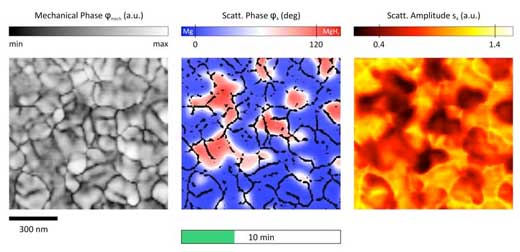 Dynamics of the magnesium hydride phase formation in magnesium with nanometer resolution captured with in-situ scanning near-field optical microscopy. (Image: University of Stuttgart)
Visualization of the topography of magnesium with nanometer resolution covered with an optical scattering phase map showing hydrogenated and unhydrogenated areas. (Image: University of Stuttgart)
The size of pixels in state-of-the-art switchable optical devices is intrinsically limited by the fabrication of micrometer-sized transistors and spatial light modulators. To further decrease their size, several approaches are currently under debate and investigated in research labs all over the world. One promising route can be found in the field of nanoplasmonics.
A plasmonic nanoparticle typically has sizes of only several tens of nanometers and can focus light into sub-wavelength dimensions with an extreme localization of electro-magnetic fields. By adjusting the size of such particles, their color appearance can be shifted through the entire visible spectral range.
In combination with phase-transition materials their optical properties and their appearance can be tuned, colors can be turned on and off, and one can realize switchable colored plasmonic pixels with nanometers size.
One promising material for this purpose is magnesium. The well-known metal can, under external stimulus, hydrogenate to a dielectric insulator with an extreme optical material contrast. This makes it an ideal candidate for optically active and switchable systems such as dynamic holography, plasmonic color displays, or switchable metamaterials.
So far, the optical switching from metallic magnesium to dielectric magnesium hydride with hydrogen is strongly limited by intrinsic material factors and obstacles such as the volume expansion of the material, poor cyclability, and limited diffusion coefficients.
Dynamics of the magnesium hydride phase formation in magnesium with nanometer resolution captured with in-situ scanning near-field optical microscopy. (Image: University of Stuttgart)
