
| Date | 13th, May 2020 |
|---|
Home > Press > Twisting 2D materials uncovers their superpowers: Researchers have developed a completely new method for twisting atomically thin materials, paving the way for applications of 'twistronics' based on tunable 2D materials
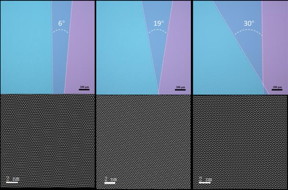 The twist angle between the layers governs the crystal symmetry and can lead to a variety of interesting physical behaviours, such as unconventional superconductivity, tunnelling conductance, nonlinear optics and structural super-lubricity.
CREDIT
Luojun Du et al. Aalto University
The twist angle between the layers governs the crystal symmetry and can lead to a variety of interesting physical behaviours, such as unconventional superconductivity, tunnelling conductance, nonlinear optics and structural super-lubricity.
CREDIT
Luojun Du et al. Aalto University
Abstract: Two-dimensional (2D) materials, which consist of a single layer of atoms, have attracted a lot of attention since the isolation of graphene in 2004. They have unique electrical, optical, and mechanical properties, like high conductivity, flexibility and strength, which makes them promising materials for such things as lasers, photovoltaics, sensors and medical applications.
Aalto, Finland | Posted on May 12th, 2020
When a sheet of 2D material is placed over another and slightly rotated, the twist can radically change the bilayer material's properties and lead to exotic physical behaviours, such as high temperature superconductivity - exiting for electrical engineering; nonlinear optics - exciting for lasers and data transmission; and structural super-lubricity- a newly discovered mechanical property which researchers are only beginning to understand. The study of these properties has given birth to a new field of research called twistronics, so-called because it's a combination of twist and electronics.
Aalto University's researchers collaborating with international colleagues have now developed a new method for making these twisted layers on scales that are large enough to be useful, for the first time. Their new method for transferring single-atom layers of molybdenum disulfide (MoS2) allows researchers to precisely control the twist angle between layers with up to a square centimetre in area, making it record-breaking in terms of size. Controlling the interlayer twist angle on a large scale is crucial for the future practical applications of twistronics.
'Our demonstrated twist method allows us to tune the properties of stacked multilayer MoS2 structures on larger scales than ever before. The transfer method can also apply to other two-dimensional layered materials', says Dr Luojun Du from Aalto University, one of the lead authors of the work.
A significant advancement for a brand-new field of research
Since twistronics research was introduced only in 2018, basic research is still needed to understand the properties of twisted materials better before they find their ways to practical applications. The Wolf Prize in Physics, one of the most prestigious scientific awards, was awarded to Profs. Rafi Bistritzer, Pablo Jarillo-Herrero, and Allan H. MacDonald this year for their groundbreaking work on twistronics, which indicates the game-changing potential of the emerging field.
Previous research has demonstrated that it is possible to fabricate the required twist angle by transfer method or atomic force microscope tip manipulation techniques in small scales. The sample size has usually been in the order of ten-microns, less than the size of a human hair. Larger few-layer films have also been fabricated, but their interlayer twist angle is random. Now the researchers can grow large films using an epitaxial growth method and water assistant transfer method.
'Since no polymer is needed during the transfer process, the interfaces of our sample are relatively clean. With the control of twist angle and ultra-clean interfaces, we could tune the physical properties, including low-frequency interlayer modes, band structure, and optical and electrical properties', Du says.
'Indeed, the work is of great significance in guiding the future applications of twistronics based on 2D materials', adds Professor Zhipei Sun from Aalto University.
The results were published in Nature Communications.
####
For more information, please click here
Contacts:Luojun Du
@aaltouniversity
Copyright © Aalto University
If you have a comment, please Contact us.
Issuers of news releases, not 7th Wave, Inc. or Nanotechnology Now, are solely responsible for the accuracy of the content.
Bookmark:


 M. Liao et.al., Precise control the interlayer twist angle of large scale MoS2 homostructures:
News and information
New technology helps reveal inner workings of human genome June 24th, 2022
Boron nitride nanotube fibers get real: Rice lab creates first heat-tolerant, stable fibers from wet-spinning process June 24th, 2022
2 Dimensional Materials
Controlled synthesis of crystal flakes paves path for advanced future electronics June 17th, 2022
Solving the puzzle of 2D disorder: An interdisciplinary team developed a new method to characterize disorder in 2D materials June 17th, 2022
UBCO researchers change the game when it comes to activity tracking: Flexible, highly sensitive motion device created by extrusion printing June 17th, 2022
Bumps could smooth quantum investigations: Rice University models show unique properties of 2D materials stressed by contoured substrates June 10th, 2022
Nanomedicine
New technology helps reveal inner workings of human genome June 24th, 2022
New nano-gel to protect children receiving chemotherapy from hearing loss June 17th, 2022
Sensors
Photonic integrated erbium doped amplifiers reach commercial performance: Boosting light power revolutionizes communications and autopilots June 17th, 2022
A one-stop shop for quantum sensing materials May 27th, 2022
New nanomechanical oscillators with record-low loss May 13th, 2022
Discoveries
New technology helps reveal inner workings of human genome June 24th, 2022
Boron nitride nanotube fibers get real: Rice lab creates first heat-tolerant, stable fibers from wet-spinning process June 24th, 2022
Announcements
New technology helps reveal inner workings of human genome June 24th, 2022
Boron nitride nanotube fibers get real: Rice lab creates first heat-tolerant, stable fibers from wet-spinning process June 24th, 2022
Interviews/Book Reviews/Essays/Reports/Podcasts/Journals/White papers/Posters
Quantum network nodes with warm atoms June 24th, 2022
New technology helps reveal inner workings of human genome June 24th, 2022
Photonics/Optics/Lasers
Photonic integrated erbium doped amplifiers reach commercial performance: Boosting light power revolutionizes communications and autopilots June 17th, 2022
Marching to the Cadence of Electronics: Innovation A new paper in Nature validates technology developed by John Bowers and collaborators June 10th, 2022
Solar/Photovoltaic
Solving the solar energy storage problem with rechargeable batteries that can convert and store energy at once June 24th, 2022
USTC found a pathway to high-quality ZnSe quantum wires April 8th, 2022
Graphene crystals grow better under copper cover April 1st, 2022
Peering into precise ultrafast dynamics in matter March 25th, 2022
