
May 26, 2020
(Nanowerk News) Researchers at the UAB, ICMAB and the ALBA Synchrotron, in collaboration with the UB and ICN2, have developed a new technique to locally modify the properties of a metamagnetic material. The method consists in applying local pressure to the surface of the material using nanometric needles and allows a much more easy and local modification than current methods (Materials Horizons, "Local manipulation of metamagnetism by strain nanopatterning").
The research opens the door to a more accurate and precise control of magnetic materials and allows to improve the architecture and capacity of magnetic digital memories.
Some memory devices where information from smartphones and computers is stored are based on a very precise control of the magnetic properties, at nanoscopic scale. The more precise this control is, the more storage capacity and speed they can have.
In certain cases, the combination of ferromagnetism (where the magnetism of all the atoms in the material points in the same direction) and antiferromagnetism (where the magnetism of the atoms in the material points alternately in opposite directions) is used to store the information.
One of the materials that can show these two arrangements is the alloy of iron and rhodium (FeRh), because it shows a metamagnetic transition between these two phases at a temperature very close to room temperature.
In particular, it can change state from antiferromagnetic to ferromagnetic simply when heated. The antiferromagnetic state is more robust and secure than the ferromagnetic one, since it is not easily altered by the presence of magnets in its proximity, i.e. an external magnetic field cannot erase the information easily.
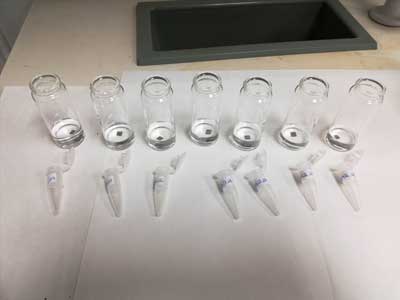 Some samples of FeRh metamagnetic material, ready to be analised at the ALBA Synchrotron (IMAGE: ICMAB-CSIC)
A team of researchers from the UAB, the ICMAB, and the ALBA Synchrotron, along with scientists from the UB and the ICN2, have used mechanical pressure to modify this transition and stabilize the antiferromagnetic state.
The researchers have observed that pressing the surface of the iron-rhodium alloy with a nanometer-sized needle causes the magnetic state to change in a simple and localized way. By pressing on different areas of the material, the researchers have managed to generate antiferromagnetic nano-islands embedded in a ferromagnetic matrix, a very difficult task with the current techniques available.
If the process is repeated over the entire surface of the alloy, the new technique can induce this change across large areas of the material drawing patterns with nanoscopic resolution with areas with different magnetic properties, generating structures as small as those that can currently be achieved using more complex methods.
Some samples of FeRh metamagnetic material, ready to be analised at the ALBA Synchrotron (IMAGE: ICMAB-CSIC)
A team of researchers from the UAB, the ICMAB, and the ALBA Synchrotron, along with scientists from the UB and the ICN2, have used mechanical pressure to modify this transition and stabilize the antiferromagnetic state.
The researchers have observed that pressing the surface of the iron-rhodium alloy with a nanometer-sized needle causes the magnetic state to change in a simple and localized way. By pressing on different areas of the material, the researchers have managed to generate antiferromagnetic nano-islands embedded in a ferromagnetic matrix, a very difficult task with the current techniques available.
If the process is repeated over the entire surface of the alloy, the new technique can induce this change across large areas of the material drawing patterns with nanoscopic resolution with areas with different magnetic properties, generating structures as small as those that can currently be achieved using more complex methods.
Some samples of FeRh metamagnetic material, ready to be analised at the ALBA Synchrotron (IMAGE: ICMAB-CSIC)
A team of researchers from the UAB, the ICMAB, and the ALBA Synchrotron, along with scientists from the UB and the ICN2, have used mechanical pressure to modify this transition and stabilize the antiferromagnetic state.
The researchers have observed that pressing the surface of the iron-rhodium alloy with a nanometer-sized needle causes the magnetic state to change in a simple and localized way. By pressing on different areas of the material, the researchers have managed to generate antiferromagnetic nano-islands embedded in a ferromagnetic matrix, a very difficult task with the current techniques available.
If the process is repeated over the entire surface of the alloy, the new technique can induce this change across large areas of the material drawing patterns with nanoscopic resolution with areas with different magnetic properties, generating structures as small as those that can currently be achieved using more complex methods.
