
| Date | 3rd, Jun 2020 |
|---|
Home > Press > Exotic nanotubes move in less-mysterious ways: Rice scientists, engineers show boron nitride�s promise for composites, biomedical applications
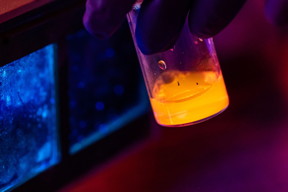 Rice University scientists analyzed the motion of single boron nitride nanotubes. The nanotubes are stable semiconductors and excellent conductors of heat. They could be useful as building blocks for composite materials or in biomedical studies. (Credit: Jeff Fitlow/Rice University)
Abstract: Boron nitride nanotubes are anything but boring, according to Rice University scientists who have found a way to watch how they move in liquids.
Video produced by Brandon Martin/Rice University
Houston, TX | Posted on June 2nd, 2020
The researchers� method to study the real-time dynamics of boron nitride nanotubes (BNNTs) allowed them to confirm, for the first time, that Brownian motion of BNNTs in solution matches predictions and that, like carbon nanotubes of comparable sizes, they remain rigid.
Those properties and others -- BNNTs are nearly transparent to visible light, resist oxidation, are stable semiconductors and are excellent conductors of heat -- could make them useful as building blocks for composite materials or in biomedical studies, among other applications. The study will help scientists better understand particle behavior in the likes of liquid crystals, gels and polymer networks.
Rice scientists Matteo Pasquali and Angel Mart� and graduate student and lead author Ashleigh Smith McWilliams isolated single BNNTs by combining them with a fluorescent rhodamine surfactant.
This allowed the researchers to show their Brownian motion -- the random way particles move in a fluid, like dust in air -- is the same as for carbon nanotubes, and thus they will behave in a similar way in fluid flows. That means BNNTs can be used in liquid-phase processing for the large-scale production of films, fibers and composites.
�BNNTs are typically invisible in fluorescence microscopy,� Mart� said. �However, when they are covered by fluorescent surfactants, they can be easily seen as small moving rods. BNNTs are a million times thinner than a hair. Understanding how these nanostructures move and diffuse in solution at a fundamental level is of great importance for manufacturing materials with specific and desired properties.�
The new data comes from experiments carried out at Rice and reported in the Journal of Physical Chemistry B.
Understanding how shear helps nanotubes align has already paid off in the Pasquali lab�s development of conductive carbon nanotube fibers, films and coatings, already making waves in materials and medical research.
�BNNTs are the neglected cousins of carbon nanotubes,� Pasquali said. �They were discovered just a few years later, but took much longer to take off, because carbon nanotubes had taken most of the spotlight.
�Now that BNNT synthesis has advanced and we understand their fundamental fluid behavior, the community could move much faster towards applications,� he said. �For example, we could make fibers and coatings that are thermally conductive but electrically insulating, which is very unusual as electrical insulators have poor thermal conductivity.�
Unlike carbon nanotubes that emit lower-energy near-infrared light and are easier to spot under the microscope, the Rice team had to modify the multiwalled BNNTs to make them both dispersible and viewable. Rhodamine molecules combined with long aliphatic chains served this purpose, attaching to the nanotubes to keep them separate and allowing them to be located between glass slides separated just enough to let them move freely. The rhodamine tag let the researchers track single nanotubes for up to five minutes.
�We needed to be able to visualize the nanotube for relatively long periods of time, so we could accurately model its movement,� Smith McWilliams said. �Since rhodamine tags coordinated to the BNNT surface were less likely to photobleach (or go dim) than those free in solution, the BNNT appeared as a bright fluorescent signal against a dark background, as you can see in the video. This helped me keep the nanotube in focus throughout the video and enabled our code to accurately track its movement over time.�
The paper will appear in a special virtual issue of the publication, a Festschrift dedicated to Peter Rossky, Rice�s dean of the Wiess School of Natural Sciences. Rossky plans to step down from the post on July 1 to focus on his research as the Harry C. and Olga K. Professor of Chemistry and a professor of chemical and biomolecular engineering.
Co-authors of the paper are graduate students Zhao Tang and Selin Erg�len and alumnus Carlos de los Reyes, now a process engineer at Intel Corp. Mart� is an associate professor of chemistry, of bioengineering and of materials science and nanoengineering. Pasquali is the A.J. Hartsook Professor of Chemical and Biomolecular engineering, of chemistry and of materials science and nanoengineering.
The National Science Foundation, the Air Force Office of Scientific Research and the Welch Foundation supported the research.
####
About Rice UniversityLocated on a 300-acre forested campus in Houston, Rice University is consistently ranked among the nation�s top 20 universities by U.S. News & World Report. Rice has highly respected schools of Architecture, Business, Continuing Studies, Engineering, Humanities, Music, Natural Sciences and Social Sciences and is home to the Baker Institute for Public Policy. With 3,962 undergraduates and 3,027 graduate students, Rice�s undergraduate student-to-faculty ratio is just under 6-to-1. Its residential college system builds close-knit communities and lifelong friendships, just one reason why Rice is ranked No. 1 for lots of race/class interaction and No. 4 for quality of life by the Princeton Review. Rice is also rated as a best value among private universities by Kiplinger�s Personal Finance.
Follow Rice News and Media Relations via Twitter @RiceUNews.
For more information, please click here
Contacts:Jeff Falk713-348-6775
Mike Williams713-348-6728
Copyright © Rice University
If you have a comment, please Contact us.
Issuers of news releases, not 7th Wave, Inc. or Nanotechnology Now, are solely responsible for the accuracy of the content.
Bookmark:


 Wiess School of Natural Sciences:
George R. Brown School of Engineering:
News and information
New technology helps reveal inner workings of human genome June 24th, 2022
Boron nitride nanotube fibers get real: Rice lab creates first heat-tolerant, stable fibers from wet-spinning process June 24th, 2022
Chemistry
Nanoscale chemically ordered-disordered domains in Fe3Pt alloys and their three-dimensional interface and lattice strain May 27th, 2022
Flexible quantum sieve made at TU Dresden filters the fuel of Starship Enterprise April 15th, 2022
Videos/Movies
Scientists prepare for the world�s smallest race: Nanocar Race II March 18th, 2022
Visualizing the invisible: New fluorescent DNA label reveals nanoscopic cancer features March 4th, 2022
OCSiAl receives the green light for Luxembourg graphene nanotube facility project to power the next generation of electric vehicles in Europe March 4th, 2022
Nanotube fibers stand strong -- but for how long? Rice scientists calculate how carbon nanotubes and their fibers experience fatigue December 24th, 2021
Govt.-Legislation/Regulation/Funding/Policy
Solving the solar energy storage problem with rechargeable batteries that can convert and store energy at once June 24th, 2022
Boron nitride nanotube fibers get real: Rice lab creates first heat-tolerant, stable fibers from wet-spinning process June 24th, 2022
UBCO researchers change the game when it comes to activity tracking: Flexible, highly sensitive motion device created by extrusion printing June 17th, 2022
University of Illinois Chicago joins Brookhaven Lab's Quantum Center June 10th, 2022
Possible Futures
New technology helps reveal inner workings of human genome June 24th, 2022
Boron nitride nanotube fibers get real: Rice lab creates first heat-tolerant, stable fibers from wet-spinning process June 24th, 2022
Nanotubes/Buckyballs/Fullerenes/Nanorods
Boron nitride nanotube fibers get real: Rice lab creates first heat-tolerant, stable fibers from wet-spinning process June 24th, 2022
Nanotubes: a promising solution for advanced rubber cables with 60% less conductive filler June 1st, 2022
Protective equipment with graphene nanotubes meets the strictest ESD safety standards March 25th, 2022
CEA and Startup C12 Join Forces to Develop Next-Generation Quantum Computers with Multi-Qubit Chips at Wafer Scale March 25th, 2022
Discoveries
New technology helps reveal inner workings of human genome June 24th, 2022
Boron nitride nanotube fibers get real: Rice lab creates first heat-tolerant, stable fibers from wet-spinning process June 24th, 2022
Announcements
New technology helps reveal inner workings of human genome June 24th, 2022
Boron nitride nanotube fibers get real: Rice lab creates first heat-tolerant, stable fibers from wet-spinning process June 24th, 2022
Interviews/Book Reviews/Essays/Reports/Podcasts/Journals/White papers/Posters
Quantum network nodes with warm atoms June 24th, 2022
New technology helps reveal inner workings of human genome June 24th, 2022
Military
Boron nitride nanotube fibers get real: Rice lab creates first heat-tolerant, stable fibers from wet-spinning process June 24th, 2022
Bumps could smooth quantum investigations: Rice University models show unique properties of 2D materials stressed by contoured substrates June 10th, 2022
Nanostructured fibers can impersonate human muscles June 3rd, 2022
Lightening up the nanoscale long-wavelength optoelectronics May 13th, 2022
Grants/Sponsored Research/Awards/Scholarships/Gifts/Contests/Honors/Records
Solving the solar energy storage problem with rechargeable batteries that can convert and store energy at once June 24th, 2022
Boron nitride nanotube fibers get real: Rice lab creates first heat-tolerant, stable fibers from wet-spinning process June 24th, 2022
