
Jun 05, 2020
(Nanowerk Spotlight) Bismuth antimonide (BiSb) is an important material in nanoelectronics as a topological insulator – offering unique opportunities to control electric currents and magnetism, and a promising materials for future spintronic applications – and as a thermoelectric material that converts heat into electricity and vice versa. However, some of its thermal properties are still mostly unknown at the nanoscale.
This is an issue because in order for BiSb to exhibit its thermoelectric properties it has to be an alloy i.e. a material where bismuth (Bi) and antimony (Sb) are randomly mixed. But at the nanoscale, it is difficult to mix Bi and Sb, they phase separate very easily i.e. on one side of the nanoparticle you have bismuth and the other side you have antimony; but no mixture with the two chemical elements.
New findings reported in Journal of Physical Chemistry C ("Chemical Ordering in Bi1-xSbx Nanostructures: Alloy, Janus or Core-Shell?") provide the phase diagram of bismuth antimonide at nanoscale sizes for different types of morphologies like sphere, rod, wire, and film, thereby filling the knowledge gap about the thermal properties of BiSb at the nanoscale.
"By using nanothermodynamics concepts, we newly defined a surface segregation index to easily determine which chemical element segregates preferentially to the surface," Gregory Guisbiers, an Assistant Professor at the University of Arkansas at Little Rock, tells Nanowerk. "The most significant result of our work is that miscibility is not enhanced at the nanoscale but phase separation is!"
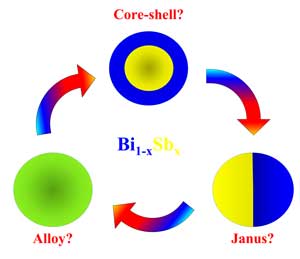 Chemical ordering in Bi1-xSbx Nanostructures: alloy, Janus or core-shell? (Image courtesy of the researchers)
So far, the phase diagram of BiSb has been totally unknown at the nanoscale, both experimentally and theoretically. This work provides the thermodynamic conditions – temperature and composition – to obtain an alloy of BiSb. Consequently, experimentalists will be able to fabricate alloyed BiSb nanostructures much more easily.
The reason why Guisbiers decided to work with his PhD student Luke D. Geoffrion on this topic is that BiSb is a very interesting material. It was the first experimentally observed topological insulator. It is also a thermoelectric material.
"This material is very complex electronically – its electronic band structure strongly depends on its composition," he elaborates. "Indeed, it changes from semimetal at low Sb concentration (xSb
Chemical ordering in Bi1-xSbx Nanostructures: alloy, Janus or core-shell? (Image courtesy of the researchers)
So far, the phase diagram of BiSb has been totally unknown at the nanoscale, both experimentally and theoretically. This work provides the thermodynamic conditions – temperature and composition – to obtain an alloy of BiSb. Consequently, experimentalists will be able to fabricate alloyed BiSb nanostructures much more easily.
The reason why Guisbiers decided to work with his PhD student Luke D. Geoffrion on this topic is that BiSb is a very interesting material. It was the first experimentally observed topological insulator. It is also a thermoelectric material.
"This material is very complex electronically – its electronic band structure strongly depends on its composition," he elaborates. "Indeed, it changes from semimetal at low Sb concentration (xSb
Chemical ordering in Bi1-xSbx Nanostructures: alloy, Janus or core-shell? (Image courtesy of the researchers)
So far, the phase diagram of BiSb has been totally unknown at the nanoscale, both experimentally and theoretically. This work provides the thermodynamic conditions – temperature and composition – to obtain an alloy of BiSb. Consequently, experimentalists will be able to fabricate alloyed BiSb nanostructures much more easily.
The reason why Guisbiers decided to work with his PhD student Luke D. Geoffrion on this topic is that BiSb is a very interesting material. It was the first experimentally observed topological insulator. It is also a thermoelectric material.
"This material is very complex electronically – its electronic band structure strongly depends on its composition," he elaborates. "Indeed, it changes from semimetal at low Sb concentration (xSb